Effective golf bag quality control is the single most important factor separating successful sourcing programs from costly failures. A brand’s reputation is built on the products its customers actually receive — not on factory promises or sample photos. Yet many buyers lack a systematic golf bag quality control framework, leading to defective shipments, customer returns, and damaged brand trust. This guide provides a complete, actionable golf bag quality control system that any B2B buyer can implement immediately.
Why Golf Bag Quality Control Matters More Than Ever in 2026
The consequences of poor golf bag quality control are severe and immediate. Customer reviews reveal recurring failures: zippers breaking after just a few rounds, color fading within six months of use, seams ripping at stress points, and dividers collapsing entirely-. The most common complaint across hundreds of reviews is that bags look good initially but fail within a single season — exactly the scenario that proper golf bag quality control is designed to prevent.
For B2B buyers, every defective bag that reaches your customer represents not just a replacement cost but also shipping fees, handling labor, and most damagingly, a hit to your brand‘s credibility. Industry data shows that companies implementing thorough golf bag quality control protocols reduce product returns by up to 40%. In 2026, with customer expectations higher than ever, there is no excuse for shipping subpar product.
The Three-Stage Golf Bag Quality Control Framework
Professional golf bag quality control follows a staged approach rather than a single final check. Waiting until bags are packed to inspect them is a guaranteed path to disaster. Instead, implement these three inspection gates across your production cycle.
Stage 1: Incoming Quality Control (IQC) — Materials First
The first stage of golf bag quality control begins before a single stitch is sewn. IQC inspects all incoming materials: fabric rolls, zippers, foam padding, hardware, webbing, and thread. A factory using defective materials cannot produce quality bags, no matter how skilled their workers.
What to Inspect at IQC:
- Fabric quality: Verify denier rating (e.g., 1680D ballistic nylon), color consistency across bolts, absence of stains or holes, UV stability testing results
- Zipper function: Check YKK or equivalent brand marking, smooth open/close cycles, corrosion resistance
- Hardware condition: Inspect buckles, D-rings, stand feet for rust, sharp edges, or plating defects
- Foam density: Confirm padding meets specification for divider protection and strap comfort
- Compliance documentation: Certificates for REACH (Europe), Prop 65 (California), or OEKO-TEX for dyes-
Many quality failures originate from unseen material defects. A fabric roll may look fine on the surface but have inconsistent tensile strength or hidden color shade shifts between dye lots. IQC catches these issues before they enter production.
Stage 2: In-Process Quality Control (IPQC) — Catching Defects Early
IPQC is the most critical yet most overlooked stage of golf bag quality control. Production is a dynamic process — needle tension changes as machines heat up, workers tire, and materials behave differently at scale. Without IPQC, small process drifts become thousands of defective units.
Mandatory IPQC Gates:
- First-Article Approval: Production cannot begin until the very first unit off the line matches the signed golden sample in every detail — dimensions, colors, logo placement, stitching density. This single gate prevents the majority of major defects
- Mid-Run Structural Check: Every two hours, inspect critical stress points: strap anchor stitching, pocket seam reinforcement, divider attachment strength. Machine tension often loosens as motors heat up — catch this drift before seams weaken
- Pre-Final Assembly Check: Before linings are sealed and pockets are closed, verify internal workmanship and hardware installation. Once linings are sealed, defects become much harder to correct
Industry benchmarks from top OEM factories show that rigorous IPQC, combined with ISO 9001-certified quality management systems, enables defect rates below 1.5% and batch inspection pass rates above 99.5%-.
Stage 3: Final Quality Control (FQC) and Pre-Shipment Inspection (PSI)
The final stage of golf bag quality control occurs after production is complete and at least 80% of units are packed. FQC and PSI serve as your last opportunity to reject defective goods before they leave the factory.
Comprehensive PSI Checklist for Golf Bags:
A. Appearance Check:
- Fabric condition: No stains, holes, color variation, or fraying
- Stitching quality: Consistent stitches per inch (minimum 6 SPI at stress points), no loose threads, no skipped stitches
- Logo and branding: Embroidery or print is centered, aligned, and securely attached
- Hardware finish: No rust, sharp edges, plating scratches, or misaligned components
B. Functionality Testing:
- Zipper operation: Open and close each zipper at least 20 times — no sticking, skipping, or separating teeth
- Pocket capacity: Confirm each pocket opens fully and closes securely
- Stand mechanism: For stand bags, deploy legs 3-5 times — should extend smoothly and lock in position
- Strap adjustment: Shoulder straps adjust easily and stay at set position under load
- Handle strength: Apply upward force equivalent to loaded bag weight (typically 10-15kg) — no tearing or deformation
C. Durability and Safety Tests:
- Load testing: Fill bag with clubs or equivalent weight, carry and shake — monitor for seam stress or divider collapse
- Water resistance (if applicable): Spray test on fabric surface — water should bead and not penetrate to interior
- Weight verification: Confirm actual weight matches specification (carry bags typically 2-6 lbs, cart bags 5-9 lbs)-
- Chemical compliance: Confirm materials pass REACH and Prop 65 screening-
The AQL Standard: Your Statistical Foundation for Golf Bag Quality Control
AQL (Acceptable Quality Level) is the statistical backbone of professional golf bag quality control. It establishes how many defective units are acceptable in a random sample, providing an objective pass/fail standard rather than subjective judgment.
The industry-standard AQL for bags is Level II sampling with limits of 0 (critical defects), 2.5 (major defects), and 4.0 (minor defects).
Defect Classification for Golf Bag Quality Control:
| Defect Type | Definition | Examples | AQL Limit |
|---|---|---|---|
| Critical | Safety hazard or total product failure | Sharp hardware edges that can cut user | 0% |
| Major | Functional failure or severe cosmetic defect | Broken zipper, torn seam, failed stand mechanism, off-color logo | 2.5% |
| Minor | Cosmetic issue not affecting function | Loose thread, small scuff mark, slightly misaligned pocket | 4.0% |
The AQL standard is not optional for serious buyers. Every golf bag quality control agreement should reference AQL Level II, 2.5/4.0 in your purchase contract.
Certifications That Validate Golf Bag Quality Control
Third-party certifications provide independent validation of a factory’s golf bag quality control systems. When evaluating suppliers, look for:
| Certification | What It Validates |
|---|---|
| ISO 9001 | Documented quality management system covering raw materials to final inspection- |
| BSCI | Ethical labor practices and social compliance-51 |
| REACH | Chemical safety compliance for European market |
| Prop 65 | Chemical safety for California market |
| GRS | Recycled content claims for eco-friendly bags |
Factories with ISO 9001 certification have structured quality control processes and on-time delivery rates typically exceeding 95%. Without these certifications, you cannot verify that a factory has any systematic golf bag quality control in place at all.
Third-Party Inspection: An Extra Layer of Golf Bag Quality Control
While factory self-inspection is essential, many buyers hire independent third-party inspection firms to conduct final PSI before shipment release. Third-party inspectors bring impartiality, specialized checklists, and professional testing equipment.
A third-party PSI typically includes:
- Random sample selection per AQL standards
- Comprehensive visual and functional testing as described above
- Detailed inspection report with photos of any defects
- Pass/fail recommendation based on pre-agreed AQL limits
For large orders or first-time supplier relationships, third-party inspection adds minimal cost relative to the risk of accepting a defective container.
Common Golf Bag Quality Control Failures to Watch For
Based on industry data and customer complaint analysis, these are the most frequent golf bag quality control failures:
- Zipper failure: Zippers that stick, skip teeth, or separate entirely — often caused by low-quality zippers or improper installation-
- Seam tearing: Stitching that unravels at strap attachment points and pocket corners — caused by insufficient reinforcement (bar tacking required, not simple backstitch)
- Color fading: Fabric that loses color within months of UV exposure — caused by inadequate UV stabilizers in dye-
- Dividers collapsing: Internal divider system losing structure — caused by insufficient foam density or poor attachment-
- Stand mechanism failure: Legs that won‘t deploy or lock — caused by weak springs or misaligned pivot points
Each of these failures is preventable with proper golf bag quality control at IQC (material verification), IPQC (assembly checks), and PSI (final functional testing).
How to Build a Golf Bag Quality Control Agreement with Your Supplier
Protect your business by including these clauses in every purchase contract:
- Golden sample requirement: Signed physical sample that serves as the quality benchmark for the entire order
- AQL specification: Level II, 2.5/4.0 as the acceptance standard
- Inspection access: Right to conduct IQC, IPQC, and PSI at factory‘s expense
- Third-party inspection right: Option to hire independent inspector at buyer’s cost, with factory cooperation required
- Defect remedy: Supplier responsible for replacement, repair, or refund for units failing AQL limits
- Documentation requirement: Factory must provide inspection reports and photos for each QC stage
Conclusion: Make Golf Bag Quality Control a Competitive Advantage
Implementing a systematic golf bag quality control framework transforms quality from a gamble into a predictable outcome. By staging inspections across IQC, IPQC, and PSI, applying AQL standards, verifying supplier certifications, and building quality protections into your contracts, you protect your brand‘s reputation and your customers‘ experience.
In 2026, the most successful B2B buyers are those who treat golf bag quality control not as a cost to minimize but as a strategic investment. The framework outlined above works for any order size, from 200-piece trial runs to full container shipments.
*With 20 years of dedicated golf bag manufacturing and ISO 9001-certified quality management systems, we implement multi-stage quality control on every order — from IQC on all incoming materials to AQL-based PSI before shipment. Contact us to discuss your quality requirements and request a factory audit.*
OEM & ODM Service
Whether you’re planning to build your own brand, develop new products, or find a stable manufacturing partner for the US and European markets, working with a professional OEM & ODM factory can significantly improve your product quality and market competitiveness.
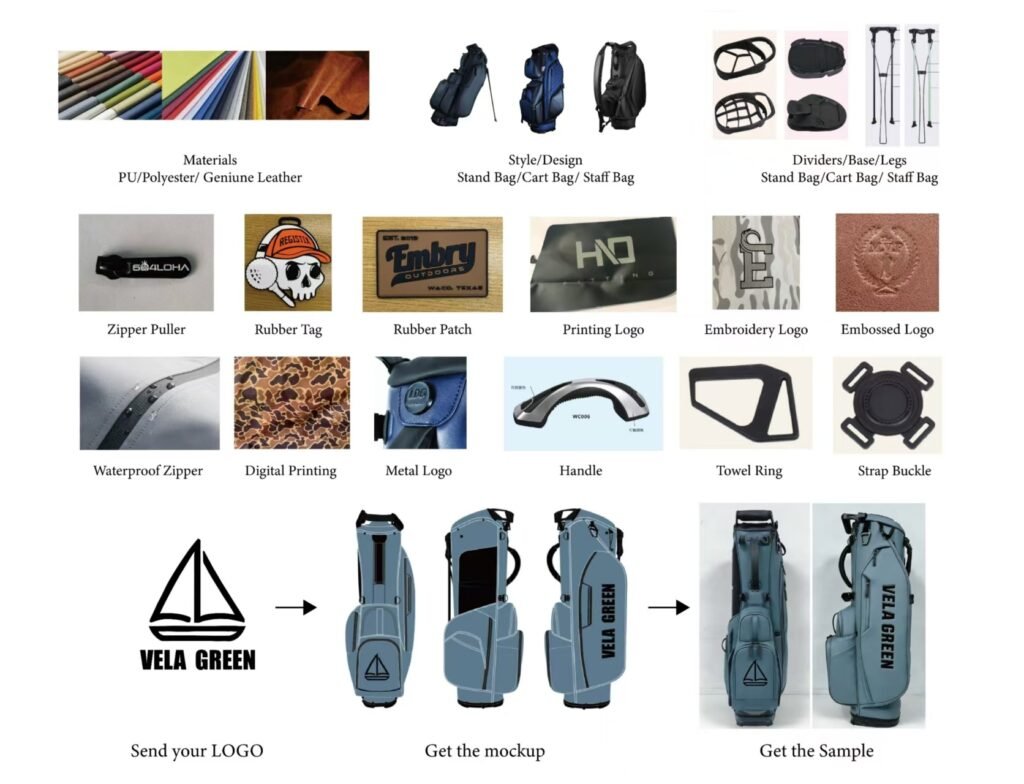
At Vela Green, we provide full-range OEM & ODM services for golf bags, golf headcovers, gloves, towels and other golf accessories. We support custom design, material selection, logo branding, color matching and mass production, strictly complying with CPSC, REACH and other international standards. With mature production experience, reliable quality control and professional export support, we help brands and importers develop market-oriented products with efficient lead times and flexible order quantities.