Golf bag certification is no longer optional—it is the single most important safeguard for your supply chain, your brand reputation, and your customer relationships. A shipment that arrives without proper golf bag certification faces customs rejection, costly fines, or even destruction. Yet too many B2B buyers treat certification as an afterthought, discovering too late that their “certified” supplier cannot produce valid documentation.
This golf bag certification guide outlines the seven essential standards every buyer must verify before placing a bulk order, from quality management systems to chemical compliance. Mastering golf bag certification transforms a potential liability into a competitive advantage.
Why Golf Bag Certification Matters More Than Ever in 2026
The regulatory landscape for golf bag certification has fundamentally shifted in 2026. Exporting to the EU now requires appointing a Responsible Person under the General Product Safety Regulation (GPSR), which came into effect on 13 December 2024. Non-EU manufacturers must now designate an EU-based representative to ensure product safety compliance. Meanwhile, the US Consumer Product Safety Commission (CPSC) will mandate electronic filing for all imported regulated consumer products from July 8, 2026, requiring importers to submit product certificate data through the Automated Commercial Environment (ACE) system upon entry-.
Without proper golf bag certification, your shipment will not enter these markets. Period. Worse, eighteen US states now restrict PFAS in consumer products, with seven new bans taking effect in 2026 covering apparel, textiles, and related goods-. Golf bag certification ensures you stay ahead of this rapidly expanding chemical regulatory web.
Standard #1: ISO 9001 — The Foundation of Golf Bag Certification
ISO 9001 is the gold standard for quality management systems in golf bag certification. This certification demonstrates that the factory has documented processes from raw material inspection to final QC-. It assures international buyers that production is well-organized and focused on continuous improvement. ISO 9001-certified factories typically on-time delivery rates above 95%.
For B2B buyers, ISO 9001 is non-negotiable in any serious golf bag certification portfolio. Without it, the factory lacks the fundamental quality infrastructure to produce consistent, defect-free products at scale.
Standard #2: BSCI — Ethical Manufacturing in Golf Bag Certification
BSCI (Business Social Compliance Initiative) is the key ethical component of golf bag certification. It ensures that the factory follows ethical labor practices and meets social compliance standards. BSCI certification covers fair wages, reasonable working hours, occupational health and safety, and prohibition of child and forced labor.
For brands selling to European markets, BSCI is increasingly a mandatory requirement within golf bag certification. Major European retailers and distributors will not accept shipments from factories lacking BSCI or equivalent certification.
Standard #3: REACH — Chemical Safety in Golf Bag Certification
REACH (Registration, Evaluation, Authorization and Restriction of Chemicals) is the EU’s comprehensive chemical safety regulation, restricting over 200 hazardous substances in products sold in Europe-. For golf bag certification, REACH applies to every component: fabric, zippers, hardware, foam, and adhesives. The regulation dynamically updates its SVHC list, and non-compliance can result in products being denied entry into the EU.
Different materials face different testing requirements—PU leather and PVC need phthalates testing, while nylon with water-resistant coating requires PFAS testing. Your supplier’s golf bag certification must be material-specific, not a generic document.
Standard #4: California Proposition 65 — US Compliance in Golf Bag Certification
Prop 65 is arguably the most enforced chemical safety law in the United States. It requires businesses to provide clear warnings before exposing consumers to chemicals known to cause cancer or reproductive toxicity. For golf bag certification, Prop 65 covers lead and cadmium in metal hardware, phthalates in PVC and PU materials, and other restricted substances.
Non-compliance penalties can reach $2,500 per violation per day. No serious golf bag certification for the US market omits Prop 65 compliance. Importers must verify test reports before shipment.
Standard #5: GRS — Recycled Content Verification in Golf Bag Certification
GRS (Global Recycled Standard) is the leading certification for verifying recycled content in golf bag materials. It tracks recycled content through the entire supply chain and enforces social and chemical safety requirements alongside environmental criteria.
Products containing at least 20% recycled content can earn B2B certification, while 50% or more qualifies for consumer-facing labels. For brands marketing eco-friendly or sustainable golf bags, GRS is the essential component of golf bag certification that prevents “greenwashing” claims.
Additionally, the new Materials Matter Standard will become effective on December 31, 2026, and mandatory by December 31, 2027-. Smart buyers are already requiring suppliers to align with this upcoming framework.
Standard #6: OEKO-TEX — Textile Safety in Golf Bag Certification
OEKO-TEX Standard 100 is the global benchmark for textile safety. It tests materials for over 1,000 harmful substances to ensure safety for human use. For golf bag certification, OEKO-TEX covers fabrics, linings, webbing, and threads—anything textile that comes into contact with skin.
This certification is particularly valuable for golf bags marketed as premium or health-conscious. It adds a layer of credibility beyond basic golf bag certification, signalling to end customers that every textile component has been independently verified.
Standard #7: EU GPSR — The New Regulatory Obligation in Golf Bag Certification
The EU General Product Safety Regulation (GPSR) came into effect on 13 December 2024 and marks a significant shift in EU consumer product safety law. It directly impacts any non-EU brand placing golf bags on the EU market.
Under GPSR, non-EU golf bag certification now requires appointing an EU-based Responsible Person (Authorized Representative) who ensures product safety compliance, maintains technical documentation, and acts as the contact point for EU authorities. Your supplier’s golf bag certification must include evidence that this requirement is being met.
How to Verify Golf Bag Certification: A Step-by-Step Process
Verifying golf bag certification is as important as obtaining it. Follow this three-step process.
Step 1: Request Current Certificates
Ask each supplier for current PDFs of all relevant golf bag certification documents. ISO 9001 certificates expire after three years; BSCI audits are valid for two years. Check issue and expiry dates carefully. Recent certifications demonstrate active compliance management.
Step 2: Cross-Reference Certificate Numbers
Certificate numbers can be cross-referenced. For ISO 9001, verify the issuing body and search their database. For BSCI, confirm that the audit report is valid. Legitimate golf bag certification documents always contain verifiable information.
Step 3: Request Specific Test Reports, Not Just Certificates
Certificates are policy-level documents. Test reports prove actual compliance for your specific products. Ask for REACH SVHC test reports and Prop 65 test reports for the exact materials used in your order.
Red Flags in Golf Bag Certification: What to Watch For
| Red Flag | Why It Matters |
|---|---|
| Expired certificates | Supplier letting compliance lapse |
| Generic statements without numbers | May be trading company, not certified factory |
| Refusal to share third-party test reports | Lacks documentation or hides non-compliance |
| Certificates from unknown bodies | Not recognized by legitimate markets |
| Claims of “all certifications” without specifics | Evasive, likely incomplete |
These red flags should prompt deeper due diligence before any B2B order commitment.
Golf Bag Certification by Target Market
Different markets prioritize different certifications. Understanding these priorities helps you build a tailored golf bag certification portfolio.
For the European Union, mandatory certifications include REACH for chemical safety, BSCI for social compliance, and now GPSR with EU Responsible Person requirements. RoHS applies if your bags contain electronic components such as built-in lighting or GPS tracking devices. OEKO-TEX and GRS are voluntary but increasingly expected for premium positioning.
For the United States, CPSC compliance with electronic filing after July 8, 2026 is mandatory-. Prop 65 applies to products sold in California. PFAS compliance is increasingly required as more states ban these chemicals. USGA certification is valuable for tournament-level equipment.
For global brands, ISO 9001 provides universal quality assurance. BSCI is widely recognized by European and multinational retailers. GRS enables credible sustainability claims across all markets.
The Cost of Skipping Golf Bag Certification
The cost of proper golf bag certification is negligible compared to the cost of non-compliance:
- Shipment detention: Weeks or months in customs, missed retail windows
- Fines: Up to €50,000+ for non-compliant shipments in the EU
- Product destruction: Entire shipments may be confiscated and destroyed
- Liability lawsuits: If harmful chemicals are found in your products
- Reputation damage: Lost customer trust that takes years to rebuild
B2B buyers who prioritize golf bag certification from the start avoid all of these risks. The small upfront investment in verification delivers massive downstream returns in risk reduction and brand protection.
Looking Ahead: The Future of Golf Bag Certification
Several developments will shape golf bag certification over the next 18 months:
- Mandatory PFAS bans are expanding across US states in 2026 and 2027
- Digital Product Passports will likely be required for EU consumer goods, including bags and accessories
- Materials Matter Standard becomes effective December 31, 2026 and mandatory by December 31, 2027-
- New China GB standards for leather products (GB 20400-2026) set stricter safety requirements for accessible components-
Forward-thinking buyers are already requiring suppliers to align with these emerging frameworks. The brands that treat golf bag certification as a strategic investment, not a compliance burden, will gain competitive advantage as regulations tighten.
Conclusion: Golf Bag Certification Is Your Brand‘s First Line of Defense
Golf bag certification transforms uncertainty into confidence. By verifying ISO 9001 (quality management), BSCI (ethical labor), REACH and Prop 65 (chemical safety), GRS (recycled content), OEKO-TEX (textile safety), and GPSR (EU regulatory compliance), you protect your shipments from customs rejection and your brand from reputational damage.
The seven standards above are not optional for serious B2B buyers in 2026. They are the baseline for responsible golf bag sourcing.
*With 20 years of manufacturing experience and a full suite of golf bag certifications — ISO 9001, BSCI, REACH, Prop 65, GRS, and OEKO-TEX — we maintain verified compliance documentation for every production batch. Contact us to request current certificates and discuss your compliance requirements.*
OEM & ODM Service
Whether you’re planning to build your own brand, develop new products, or find a stable manufacturing partner for the US and European markets, working with a professional OEM & ODM factory can significantly improve your product quality and market competitiveness.
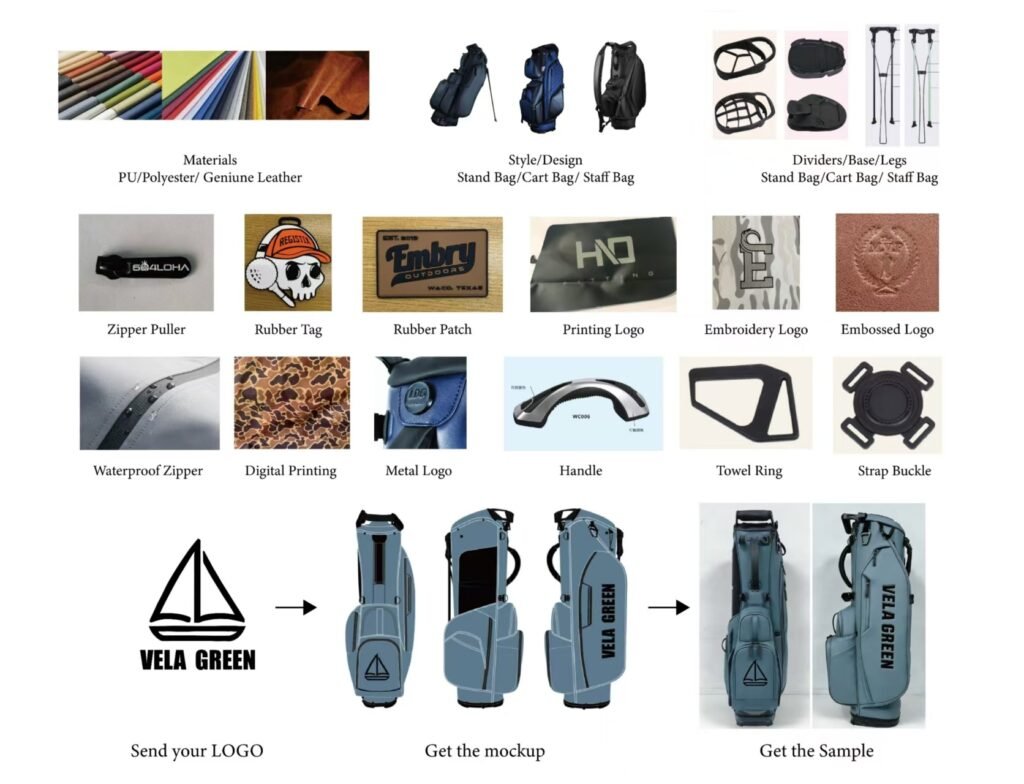
At Vela Green, we provide full-range OEM & ODM services for golf bags, golf headcovers, gloves, towels and other golf accessories. We support custom design, material selection, logo branding, color matching and mass production, strictly complying with CPSC, REACH and other international standards. With mature production experience, reliable quality control and professional export support, we help brands and importers develop market-oriented products with efficient lead times and flexible order quantities.