The global golf equipment market is experiencing a historic expansion. More than 160 million people worldwide played some form of golf in 2025, marking an almost 50% rise from 2023 [12†L11]. This unprecedented participation surge has transformed golf bag marketing from a routine promotional activity into a strategic imperative. For B2B suppliers, effective golf bag marketing now requires more than listing features and prices. It demands a nuanced understanding of demographic shifts, technological adoption, sustainability priorities, and channel evolution. This guide provides a complete framework for golf bag marketing strategies that win wholesale accounts and build long-term brand loyalty in the 2026 golf boom.
Why Golf Bag Marketing Is Undergoing a Radical Shift in 2026
The foundation of modern golf bag marketing rests on three seismic shifts reshaping the sport. First, the consumer base is diversifying dramatically. Female golfers in the United States reached nearly 7.9 million in 2024, increasing from 20% of participants in 2012 to 28% in 2024 [8†L21-L23]. Globally, women now account for 43% of off-course participants [8†L26]. Younger demographics are also joining in record numbers. This demographic transformation directly affects golf bag marketing, because new players have different needs: lighter bags, ergonomic designs, fresh aesthetics.
Second, the US alone is projected to pass 50 million participants across 2026, opening vast new markets for well-positioned brands [12†L12-L14]. Third, the global golf bags market was valued at US$1.3 billion in 2024 and is projected to reach US$2 billion by 2030, growing at a CAGR of 7.3% [10†L5-L6].
Key Trends Shaping Golf Bag Marketing in 2026
Successful golf bag marketing strategies must address four major trends driving buyer behavior this year.
Trend #1: The Acceleration of Smart Golf Technology
AI-driven technology has become a primary driver of equipment demand. The global golf equipment market grew to an estimated $20.9 billion in 2026 and is predicted to reach $26.7 billion by 2031, with AI adoption cited as one of the most influential factors driving this rise [12†L19-L23]. From smart clubs with embedded sensors to AI-powered swing analysis, the integration of technology is reshaping the consumer experience.
For golf bag marketing, this trend creates a crucial question: how does your bag complement smart golf devices? A bag with integrated charging ports for GPS devices and rangefinders, dedicated padded compartments for sensitive electronics, and cable management systems is no longer a luxury—it is an expectation. Wholesale buyers are increasingly looking for bags that serve as the “command center” for tech-equipped golfers. In your golf bag marketing collateral, highlight how your designs accommodate the modern golfer‘s digital ecosystem.
Trend #2: Sustainability as a Competitive Advantage
Environmental responsibility has moved from a nice-to-have to a must-have in golf bag marketing. The European Tour Group has committed to achieving net zero carbon by 2040 under its updated Green Drive sustainability strategy [4†L6-L8]. Meanwhile, equipment manufacturers are accelerating the integration of recycled and bio-based materials, aligning with the eco-conscious goals of prominent golf associations and course operators [8†L10-L12]. Consumers increasingly reward brands that demonstrate genuine environmental commitment.
For golf bag marketing, this means using sustainable materials as a selling point, not just a footnote. GRS-certified recycled fabrics, bio-based foams, and water-based adhesives appeal directly to environmentally conscious pro shops and retailers. Dedicated golf bag marketing materials that showcase sustainability certifications give wholesale buyers ammunition to justify premium pricing to their own customers.
Trend #3: The Female and Junior Golfer Surge
Demographic shifts are fundamentally altering the product mix in golf bag marketing. The surge in female and junior golfer demographics is expanding the consumer base well beyond its traditional core, creating heightened demand for bags that are lighter, ergonomically tailored for smaller statures, and aesthetically diverse [11†L31-L34]. As the number of women and girls playing on-course has increased by 23% since 2018—significantly exceeding broader population shifts—major brands are now stocking a wider variety of carry and stand bags [11†L36-L38].
In your golf bag marketing strategy, consider developing specific product lines targeting female and junior golfers. Lighter materials, adjusted strap ergonomics, and fresh color palettes differentiate these offerings from unisex designs. Wholesale buyers serving country clubs and golf academies are actively seeking specialized products for their growing female and junior memberships. Position your golf bag marketing to highlight how your designs meet these underserved needs.
Trend #4: Lightweight Materials and Premiumization
Manufacturers are increasingly using high-tensile fabrics and carbon fiber to decrease bag weight without sacrificing durability, catering to walking golfers and travel-focused consumers while justifying higher price points [11†L41-L44]. This lightweight trend goes hand in hand with premiumization—consumers willing to pay more for superior materials, better craftsmanship, and enhanced features.
The financial impact is tangible. Acushnet Holdings Corp. reported a 5.5% increase in net sales for its Titleist Golf Gear segment due to higher average selling prices, while Topgolf Callaway Brands reported its Golf Equipment segment generated $1.39 billion in revenue for 2023 [11†L45-L48]. For golf bag marketing, premiumization means focusing marketing messaging on durability, weight savings, material quality, and long-term value rather than competing on price alone. Wholesale buyers are willing to pay for quality when you can demonstrate superior ROI through fewer returns and higher customer satisfaction.
Channel Strategies for Effective Golf Bag Marketing
How you reach wholesale buyers is as important as what you say. Modern golf bag marketing requires a multi-channel approach.
Digital-First B2B Golf Bag Marketing
B2B buyers increasingly conduct research online before contacting suppliers. Professional golf bag marketing requires a robust digital presence:
- Technical content. Create detailed product specifications, material comparison guides, and durability test results. B2B buyers value transparency and data.
- Visual assets. High-resolution product photography, 360-degree views, and lifestyle images showing bags on-course help buyers visualize your products in their stores.
- Case studies. Document successful partnerships with other pro shops, resorts, or tournament organizers. Show how your bags performed in real-world conditions.
- SEO-optimized content. Publish regular blog posts targeting wholesale golf bag buyers, covering topics from trend analysis to care guides. Each piece of content builds authority for your golf bag marketing efforts.
Trade Show and Direct Engagement
Industry events remain vital for golf bag marketing. The 73rd PGA Show, held January 20-23, 2026, showcased golf‘s momentum, innovation, and global community, providing energy and confidence for the season ahead [1†L15-L17]. At such events, focus on product demonstrations, material sampling, and relationship building. Wholesale buyers want to touch fabrics, test zippers, and feel strap padding before committing. Use trade shows to collect qualified leads for follow-up golf bag marketing campaigns.
Wholesale Platform Presence
List your products on B2B platforms where buyers actively search for golf bag suppliers. Complete profiles with detailed specifications, high-quality images, and responsive customer service. Monitor platform analytics to understand which products generate the most inquiries, then refine your golf bag marketing accordingly.
Positioning Your Brand Through Effective Golf Bag Marketing
Differentiation is the essence of successful golf bag marketing. With increasing competition, your brand must occupy a clear position in buyers‘ minds.
Specialization as a Positioning Strategy
Consider whether your golf bag marketing will position your brand as a generalist or a specialist. Specialist positioning—targeting a specific segment such as eco-friendly bags, premium leather designs, lightweight walking bags, or tournament-quality travel covers—often commands higher margins and builds stronger loyalty. In your golf bag marketing materials, emphasize your unique expertise: materials knowledge, design capabilities, quality control standards, or sustainable manufacturing practices.
Value-Added Services in Golf Bag Marketing
Differentiation also comes from services beyond the product itself. In your golf bag marketing, highlight:
- Shorter lead times than industry average
- Lower MOQ flexibility for testing new markets
- Design support for custom branding and features
- Transparent quality control reporting
- After-sales support and warranty handling
These value-added services become powerful differentiators in golf bag marketing because they reduce risk and operational burden for wholesale buyers.
Building Authority Through Thought Leadership
Establishing your brand as a knowledgeable industry resource strengthens golf bag marketing effectiveness. Publish trend analysis, material guides, and manufacturing insights. Share expertise on social media and in industry publications. When wholesale buyers view you as a trusted advisor rather than just a vendor, your golf bag marketing conversions improve dramatically.
Practical Golf Bag Marketing Tactics for 2026
Tactic #1: Segment Your Wholesale Audience
Different wholesale buyers have different priorities. Tailor your golf bag marketing approach by segment:
| Segment | Key Priorities | Marketing Focus |
|---|---|---|
| Pro shops | Brand reputation, quality, local service | Durability, aesthetic appeal, quick fulfillment |
| Online retailers | Margins, shipping costs, return rates | Landed cost analysis, packaging efficiency |
| Tournament organizers | On-time delivery, customization, price | Bulk ordering, custom branding, reliability |
| Corporate gift buyers | Presentation, perceived value, variety | Custom packaging, premium finishes, minimum MOQ |
Tactic #2: Create Compelling Product Stories
Facts tell, but stories sell. In your golf bag marketing, move beyond feature lists to tell the story of each product: the design inspiration, the material selection process, the quality testing it survived, the customer who loved it. A well-told story differentiates your bags from identical-sounding competitors.
Tactic #3: Leverage Customer Evidence
Social proof is powerful in golf bag marketing. Collect and showcase:
- Testimonials from satisfied wholesale clients
- Photos of your bags in use at tournaments or resorts
- Repeat order statistics and client retention rates
- Independent quality audit results
Make this evidence prominent in your golf bag marketing materials—on your website, in proposals, and at trade shows.
Tactic #4: Offer Sample Programs
Wholesale buyers rarely commit to large orders without seeing and touching product. In your golf bag marketing, offer clear sample policies: low-cost stock samples, pre-production samples for custom designs, and sample fees that apply toward bulk orders. A confident sample policy signals that you stand behind your quality.
Measuring Golf Bag Marketing Success
Effective golf bag marketing requires ongoing measurement and optimization. Track these key performance indicators:
- Lead conversion rate. Percentage of wholesale inquiries that become orders.
- Average order value. Are your marketing efforts attracting larger buyers?
- Customer acquisition cost. Marketing spend divided by new wholesale clients gained.
- Repeat order rate. Percentage of wholesale buyers who place additional orders.
- Lead time by channel. Which marketing channels generate the fastest-closing leads?
Review these metrics quarterly. Double down on channels and tactics delivering the strongest results, and adjust or eliminate underperforming approaches.
How to Differentiate Your Brand in a Crowded Market
The global golf bags market, while growing at a healthy CAGR of 7.3%, is increasingly competitive [10†L5-L6]. Successful golf bag marketing requires clear differentiation.
For your brand, with 20 years of manufacturing experience and a track record serving 15+ countries, several differentiation angles stand out. Emphasize your ability to offer low MOQ for trial orders, giving buyers flexibility to test markets. Highlight your 7-10 day sampling and 30-day bulk delivery capabilities as a reliability advantage. Showcase your full suite of golf bag certifications—ISO 9001, BSCI, REACH, Prop 65, GRS—as proof of quality management and ethical production. Demonstrate how your packaging and logistics optimization reduces landed cost for wholesale buyers.
Each of these points can anchor golf bag marketing campaigns that attract quality wholesale buyers seeking partners, not just suppliers.
Conclusion: Master Golf Bag Marketing in 2026
The 2026 golf boom presents an unprecedented opportunity for B2B golf bag suppliers. With over 160 million global participants, a surge in female and junior golfers, accelerating technology adoption, and strong market growth, the conditions for successful golf bag marketing have never been better.
The most effective golf bag marketing strategies of 2026 address the four key trends driving the industry: smart technology integration, sustainable materials, demographic diversification, and lightweight premiumization. They employ multi-channel tactics—digital content, trade shows, wholesale platforms—tailored to different buyer segments. They position brands through specialization, value-added services, and thought leadership. And they measure success through data, optimizing continuously.
Now is the time to refine your golf bag marketing approach. Understand the trends reshaping the sport. Segment your audience. Tell compelling product stories. Leverage customer evidence. Offer confident sample programs. Differentiate clearly. The wholesale buyers you win today will become the long-term partners driving your growth tomorrow.
With 20 years of golf bag manufacturing experience and a full suite of marketing support—product photography, technical specifications, sample programs, and wholesale pricing—we help B2B clients succeed in the 2026 golf boom. Contact us to discuss how we can support your golf bag marketing efforts.
OEM & ODM Service
Whether you’re planning to build your own brand, develop new products, or find a stable manufacturing partner for the US and European markets, working with a professional OEM & ODM factory can significantly improve your product quality and market competitiveness.
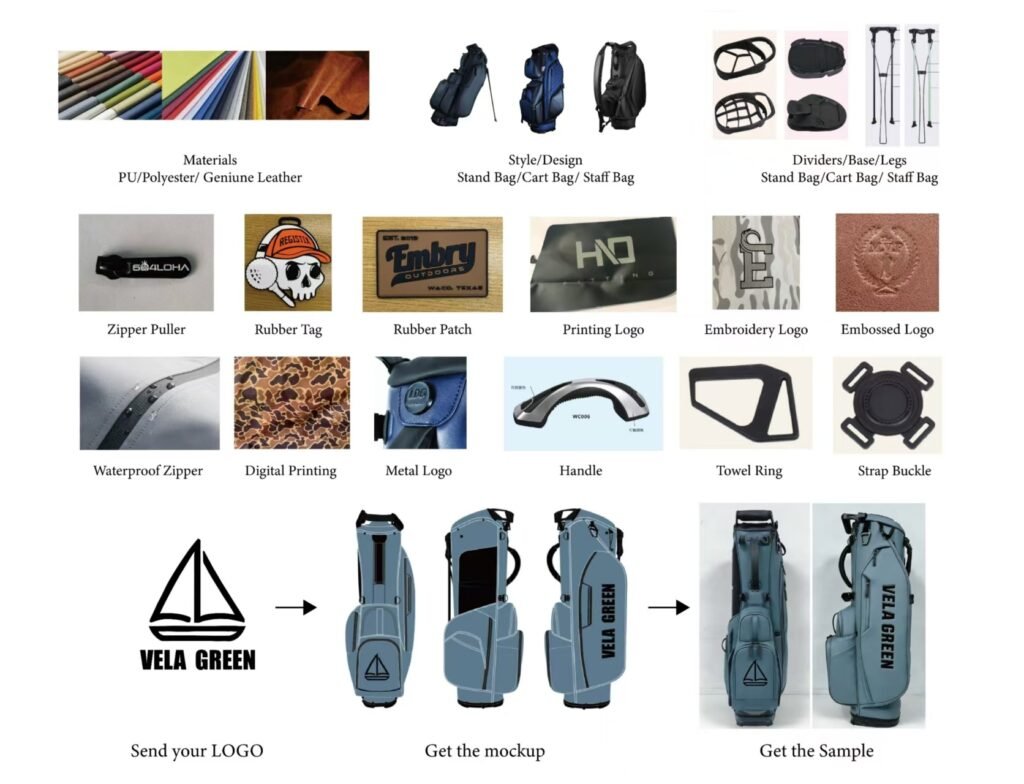
At Vela Green, we provide full-range OEM & ODM services for golf bags, golf headcovers, gloves, towels and other golf accessories. We support custom design, material selection, logo branding, color matching and mass production, strictly complying with CPSC, REACH and other international standards. With mature production experience, reliable quality control and professional export support, we help brands and importers develop market-oriented products with efficient lead times and flexible order quantities.