Product testing is the invisible shield that protects your brand from costly returns and customer complaints. Yet many B2B buyers never request test reports from their suppliers, trusting instead that “quality” will somehow materialize. The global golf bags market is projected to reach USD 1.75 billion by 2031, but without rigorous golf bag testing standards, your share of that market could vanish into returns and warranty claims.
This guide presents eight critical golf bag testing standards that every B2B buyer should verify before approving bulk production.
Why Golf Bag Testing Standards Matter
The golf bag industry has established specific golf bag testing standards to ensure product durability, safety, and performance. In China, the primary standard is QB/T 4586-2013, which covers everything from appearance quality to load-bearing performance.
A factory that cannot provide test reports against recognized golf bag testing standards is a factory that cannot guarantee quality. Industry data shows that factories without ISO 9001 quality systems often achieve customer reorder rates below 30%, while those with documented testing achieve reorder rates exceeding 70%.
For B2B buyers, golf bag testing standards serve three essential purposes:
- They verify that the product will survive real-world use
- They protect against liability from material failures
- They ensure compliance with international market requirements
Test #1: Load-Bearing Performance
Load-bearing performance is among the most critical golf bag testing standards. This test evaluates whether the bag can carry a full set of clubs without structural failure.
What the Test Measures
Under QB/T 4586-2013, the bag is loaded with a specified weight and subjected to simulated use conditions. The test checks for:
- Seam integrity under load
- Strap attachment strength
- Base deformation
- Overall structural stability
Why It Matters for B2B Buyers
A golf bag that fails load-bearing tests will collapse during normal use. Customers will return the bag, and your brand will suffer. For stand bags, this test is especially critical—the legs must support the bag‘s weight without buckling.
Test #2: Oscillation Impact Performance
Oscillation impact testing is another essential golf bag testing standard. This test simulates the repetitive impacts a bag experiences during normal carry and transport-.
What the Test Measures
The bag is subjected to repeated impacts—simulating being set down, bumped, and transported. The test evaluates:
- Handle attachment durability
- Strap seam strength
- Hardware resistance to shock
- Overall structural integrity
Industry Benchmark
Premium manufacturers achieve batch pass rates above 99.5% on oscillation impact tests. A factory that cannot share oscillation impact test results should raise immediate concerns.
Test #3: Zipper and Hardware Durability
Zippers and hardware are the most common failure points in golf bags. Dedicated golf bag testing standards address these components specifically-.
Zipper Durability Tests
- Cycle testing: Zippers are opened and closed hundreds of times to simulate years of use
- Corrosion resistance: Hardware is exposed to salt spray to test rust resistance
- Tensile strength: Zipper pulls are tested for breaking strength
Hardware Corrosion Testing
Under QB/T 4586-2013, hardware corrosion resistance is tested using neutral salt spray (NSS) methods. This is critical for golf bags used in humid or coastal environments.
What to Ask Your Supplier
- “What zipper cycle test results can you provide?”
- “Have you conducted corrosion resistance testing on hardware?”
- “What is your zipper brand and model—and what testing has been done on it?”
Test #4: Seam Strength and Stitching Integrity
Seam failure is one of the most common quality issues in golf bags. Golf bag testing standards include specific tests for seam strength and stitching integrity.
What the Test Measures
- Tensile strength: The force required to pull a seam apart
- Stitch density: Stitches per inch (minimum 6 SPI at stress points)
- Bar-tack reinforcement: Strength of reinforced stitching at high-stress areas
Industry Standards
Stitching at strap attachment points, pocket corners, and handle bases must be bar-tacked (multiple zigzag stitches) to distribute load. A factory that cannot document seam strength testing is a factory that cannot guarantee durability.
Test #5: Color Fastness and UV Resistance
Color fading is a visible quality issue that damages brand perception. Golf bag testing standards include color fastness tests for both light exposure and rubbing.
What the Test Measures
- Light fastness: Resistance to fading from UV exposure (measured using xenon arc testing per GB/T8427-2008)
- Rubbing fastness: Resistance to color transfer from friction
- Water fastness: Resistance to color bleeding when wet
Why It Matters
Golf bags spend hours in direct sunlight. A bag that fades after one season creates customer frustration. B2B buyers should request color fastness test reports (minimum Grade 4 on a 5-point scale).
Test #6: Water Resistance and Moisture Protection
Water resistance is increasingly important in golf bag testing standards as golfers play in all weather conditions.
What the Test Measures
- Surface water repellency: Water beads on the fabric surface rather than soaking in
- Seam sealing: Stitched seams remain watertight under spray
- Zipper water resistance: Waterproof zippers maintain seal under pressure
Industry Benchmark
Water resistance testing typically follows AATCC 22 standards. A Grade 4+ (spray rating) is considered acceptable for most golf bag applications.
Test #7: Chemical Safety and Compliance
Chemical safety testing has become essential in golf bag testing standards due to stricter international regulations-.
Key Chemical Tests
| Test | What It Detects | Market Requirement |
|---|---|---|
| Formaldehyde content | Free or hydrolyzed formaldehyde in textiles | EU, US |
| Azo dyes | Carcinogenic aromatic amines in dyes | EU |
| Heavy metals | Lead, cadmium, mercury in hardware | US Prop 65 |
| Phthalates | Plasticizers in PVC and PU materials | EU, US |
| PFAS | Per- and polyfluoroalkyl substances | US state bans |
REACH and Prop 65 Compliance
European REACH regulations restrict over 200 hazardous substances. California Proposition 65 requires warnings for products containing listed chemicals. Without proper golf bag testing standards documentation, your shipment may be detained at customs-.
Test #8: Appearance and Workmanship Quality
The final golf bag testing standard is appearance quality. Under QB/T 4586-2013, Appearance quality is a defined inspection parameter.
What the Test Measures
- Stitching consistency: No skipped stitches, loose threads, or puckering
- Panel alignment: Seams and panels meet cleanly
- Logo placement: Embroidery or printing is centered and aligned
- Hardware finish: No scratches, rust, or plating defects
- Fabric condition: No stains, holes, or weave defects
AQL Standards
Final appearance inspection is conducted under AQL (Acceptable Quality Level) Level II, 2.5/4.0 standards. This is the industry standard for golf bag testing standards in final quality control.
Golf Bag Testing Standards Summary Checklist
| Test Category | Standard Reference | Key Requirement |
|---|---|---|
| Load-bearing | QB/T 4586-2013 5.2.8 | No structural failure under load |
| Oscillation impact | QB/T 4586-2013 | No handle/seam failure |
| Zipper durability | QB/T 4586-2013 | 5,000+ cycles, no corrosion |
| Seam strength | QB/T 4586-2013 | Bar-tacked stress points |
| Color fastness | GB/T8427-2008 | Grade 4+ on 5-point scale |
| Water resistance | AATCC 22 | Grade 4+ spray rating |
| Chemical safety | REACH, Prop 65 | Below regulated limits |
| Appearance | QB/T 4586-2013 5.1 | Clean, consistent workmanship |
How to Use Testing Standards in Supplier Selection
B2B buyers should incorporate golf bag testing standards into their supplier evaluation process:
- Request test reports before sampling. Ask potential suppliers for existing test reports against QB/T 4586-2013 or equivalent standards
- Verify test methods. Ensure the factory uses accredited third-party laboratories (CNAS, CMA, or equivalent)
- Include testing requirements in contracts. Specify that bulk production must pass the same tests as the pre-production sample
- Consider third-party inspection. Hire independent inspectors to verify test compliance before shipment-
Common Golf Bag Testing Mistakes to Avoid
| Mistake | Consequence | Solution |
|---|---|---|
| Trusting supplier claims without test reports | Undiscovered defects, customer returns | Request lab test reports, not verbal assurances |
| Ignoring chemical compliance | Customs holds, product destruction | Verify REACH and Prop 65 test results |
| No AQL standards in contract | No recourse for defective units | Specify AQL Level II, 2.5/4.0 in writing |
| Testing only one sample | Production quality may differ | Require random sampling from bulk production |
Conclusion: Master Golf Bag Testing Standards for 2026 Success
Golf bag testing standards are not optional—they are the foundation of product quality and brand protection. The eight tests in this guide—load-bearing, oscillation impact, zipper durability, seam strength, color fastness, water resistance, chemical safety, and appearance quality—provide a complete framework for B2B quality assurance.
B2B buyers who incorporate golf bag testing standards into their supplier evaluation process protect their brands from costly returns, customs holds, and reputational damage. Start your next supplier relationship by requesting test reports against QB/T 4586-2013 and international standards. The cost of testing is negligible compared to the cost of a failed shipment.
With 20 years of golf bag manufacturing experience and documented testing against QB/T 4586-2013, REACH, and Prop 65 standards, we provide comprehensive test reports for every production batch. Contact us to request our testing documentation and discuss your quality requirements.
OEM & ODM Service
Whether you’re planning to build your own brand, develop new products, or find a stable manufacturing partner for the US and European markets, working with a professional OEM & ODM factory can significantly improve your product quality and market competitiveness.
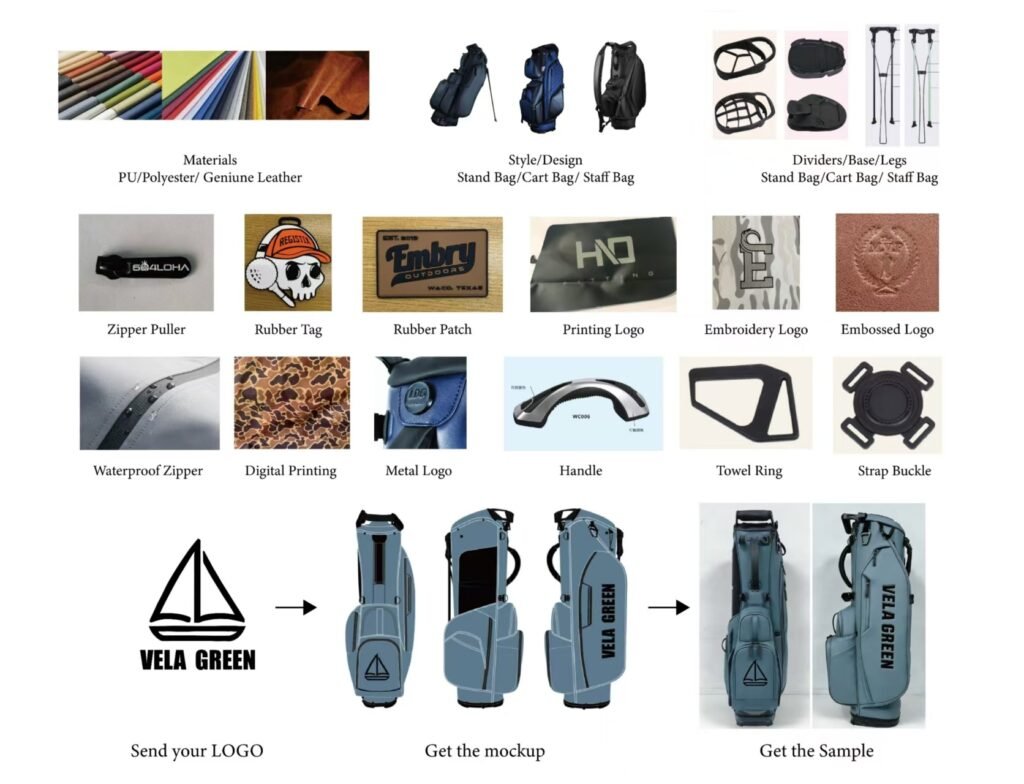
At Vela Green, we provide full-range OEM & ODM services for golf bags, golf headcovers, gloves, towels and other golf accessories. We support custom design, material selection, logo branding, color matching and mass production, strictly complying with CPSC, REACH and other international standards. With mature production experience, reliable quality control and professional export support, we help brands and importers develop market-oriented products with efficient lead times and flexible order quantities.