The shift toward sustainable golf bag materials is no longer a niche trend—it is a market imperative. With over 160 million golfers worldwide and a global golf bags market projected to reach USD 1.75 billion by 2031, the demand for environmentally responsible products has never been stronger. B2B buyers who embrace sustainable golf bag materials gain a competitive advantage, appealing to eco-conscious retailers and consumers while future-proofing their supply chains against tightening regulations.
This guide presents five essential sustainable golf bag materials that B2B buyers should consider for their next product line—from recycled polyester to bio-based foams.
Why Sustainable Golf Bag Materials Matter in 2026
The golf industry is undergoing a significant sustainability transformation. The European Tour Group has committed to achieving net zero carbon by 2040 under its updated Green Drive sustainability strategy. Equipment manufacturers are accelerating the integration of recycled and bio-based materials, aligning with the eco-conscious goals of prominent golf associations and course operators.
For B2B buyers, sustainable golf bag materials offer multiple benefits:
- Regulatory compliance: EU and US regulations increasingly restrict harmful substances and mandate recycled content
- Brand differentiation: Sustainable materials appeal to eco-conscious retailers and consumers
- Supply chain resilience: Diversifying material sources reduces dependency on virgin petroleum-based materials
- Market access: Major retailers increasingly require sustainability credentials from suppliers
The global market for sustainable golf accessories is expanding rapidly, with recycled polyester (rPET) emerging as a standout material. Switching to sustainable materials can slash the carbon footprint of a golf bag by up to 85%, while improved manufacturing techniques can save as much as 200 liters of water per bag.
Option #1: Recycled Polyester (rPET) — The Leading Sustainable Golf Bag Material
Recycled polyester, or rPET, is the most widely adopted sustainable golf bag material in the industry today. Made from post-consumer plastic bottles and textile waste, rPET offers the same durability and water resistance as virgin polyester while significantly reducing environmental impact.
Environmental Impact of rPET
- Carbon reduction: Recycled polyester reduces carbon emissions by approximately 3.8 kg per 1 kg used compared to virgin polyester
- Waste diversion: Each golf bag made with rPET diverts plastic bottles from landfills and oceans
- Water savings: rPET production uses significantly less water than virgin polyester manufacturing
Performance Characteristics
rPET fabrics are available in a range of denier ratings suitable for golf bag construction:
- 420D rPET: Lightweight, suitable for Sunday bags and accent panels
- 600D rPET: Mid-weight, good for standard stand bags
- 1680D rPET: Heavy-duty ballistic construction, ideal for travel bags and high-wear areas
Certification Requirements
For B2B buyers, the key to verifying sustainable golf bag materials is certification. GRS (Global Recycled Standard) certification provides third-party verification of recycled content claims. Products containing at least 20% recycled content can earn B2B certification, while 50% or more qualifies for consumer-facing labels.
Option #2: Bio-Based and Plant-Derived Materials
Bio-based materials represent the next frontier in sustainable golf bag materials. Derived from renewable plant sources rather than petroleum, these materials offer comparable performance with a fraction of the carbon footprint.
Bio-Based Material Options for Golf Bags
- Bio-based nylon: Made from castor beans or other plant oils, bio-based nylon offers excellent durability and elasticity with significantly lower carbon emissions
- Plant-based PU coatings: Traditional PU coatings are petroleum-derived. Plant-based alternatives use renewable feedstocks while maintaining water resistance and durability
- Cork: Natural cork is lightweight, water-resistant, and renewable. It is increasingly used for handle wraps, valuables pockets, and accent panels
- Hemp and organic cotton: These natural fibers can be used for linings and internal dividers, offering biodegradability at end of life
Performance Considerations
Bio-based materials have improved dramatically in recent years. Modern bio-based nylons match the tensile strength and abrasion resistance of conventional nylons while offering lower environmental impact. For B2B buyers, the key is verifying that bio-based claims are substantiated through third-party certification.
Option #3: Recycled Nylon from Ocean and Post-Industrial Waste
Recycled nylon is another important category of sustainable golf bag materials. Unlike rPET, which comes primarily from plastic bottles, recycled nylon can be sourced from ocean-recovered fishing nets and post-industrial textile waste.
Sources of Recycled Nylon
- Ocean-recovered nylon: Fishing nets and other marine debris are collected, cleaned, and processed into high-quality nylon fibers
- Post-industrial nylon: Scrap materials from textile manufacturing are recycled into new fibers
- Post-consumer nylon: Used garments and textiles are processed into new materials
Applications in Golf Bags
Recycled nylon is particularly suitable for golf bags requiring high durability and water resistance. It can be used for:
- Outer shell fabrics (600D–1680D equivalent)
- Divider materials
- Strap webbing
- Hardware attachments
Certification
GRS certification applies to recycled nylon as well as rPET. Additionally, some suppliers offer Ocean Cycle certification, which specifically verifies ocean-recovered content.
Option #4: Bio-Based Foams and Padding
Foam padding is a significant component of golf bag construction, used in dividers, straps, and impact protection zones. Traditional foams are petroleum-derived. Bio-based alternatives represent a growing category of sustainable golf bag materials.
Bio-Based Foam Options
- Soy-based foams: Derived from soybean oil, these foams offer comparable cushioning to conventional polyurethane foams
- Castor oil-based foams: Castor bean oil produces foams with excellent resilience and durability
- Natural latex: Harvested from rubber trees, natural latex offers superior elasticity and is biodegradable
Applications
- Divider padding: 3–5mm bio-based foam provides club protection without petroleum
- Strap padding: 10–12mm bio-based foam offers comfort and shock absorption
- Impact zones: Reinforced areas around the bag base and handle attachment points
Performance Verification
B2B buyers should request durability and compression set testing for bio-based foams. Reputable suppliers can provide test data demonstrating that bio-based foams meet or exceed the performance of conventional foams.
Option #5: Recycled Hardware and Sustainable Packaging
Sustainability extends beyond the bag itself. Recycled hardware and sustainable packaging complete the sustainable golf bag materials ecosystem.
Recycled Hardware Options
- Recycled aluminum: For stand legs, frame components, and hardware attachments
- Recycled steel: For zipper pulls, buckles, and D-rings
- Bio-based plastics: For molded components such as feet and base plates
Sustainable Packaging
- FSC-certified cardboard: From responsibly managed forests
- Recycled polybags: Made from post-consumer recycled plastic
- Molded pulp inserts: Biodegradable alternative to foam and plastic void fill
- Water-based inks: For printing on packaging and hang tags
Implementing Sustainable Golf Bag Materials: A B2B Framework
For B2B buyers incorporating sustainable golf bag materials into their product lines, a systematic approach is essential.
Step 1: Define Your Sustainability Goals
- Target recycled content percentage (e.g., 30%, 50%, or 100%)
- Certifications to pursue (GRS, OEKO-TEX, etc.)
- Carbon footprint reduction targets
Step 2: Evaluate Supplier Capabilities
- Does the supplier have access to certified sustainable materials?
- Can they provide traceability documentation?
- Do they hold GRS, OEKO-TEX, or other relevant certifications?
Step 3: Test Material Performance
- Request material swatches and test reports
- Verify durability, water resistance, and UV stability
- Confirm that sustainable materials meet your quality standards
Step 4: Communicate Sustainability Credentials
- Develop marketing materials highlighting sustainable features
- Include certification information in product specifications
- Train wholesale partners on sustainability selling points
Common Mistakes in Sourcing Sustainable Golf Bag Materials
| Mistake | Consequence | Solution |
|---|---|---|
| Accepting “eco-friendly” claims without certification | Greenwashing, reputational risk | Require GRS, OEKO-TEX, or equivalent certification |
| Switching materials without testing | Performance failures, customer returns | Test sustainable materials thoroughly before adoption |
| Ignoring the full lifecycle | Focus only on fabric, missing hardware and packaging | Address all components—fabric, foam, hardware, packaging |
| No supply chain transparency | Cannot verify sustainability claims | Request traceability documentation from raw material to finished bag |
Conclusion: Lead the Sustainable Golf Bag Revolution
Sustainable golf bag materials are not a passing trend—they are the future of the industry. From rPET and recycled nylon to bio-based foams and recycled hardware, the options for eco-friendly golf bag production are expanding rapidly. B2B buyers who embrace sustainable golf bag materials position their brands as industry leaders, attract eco-conscious wholesale partners, and build supply chains ready for tightening environmental regulations.
The five options in this guide—rPET, bio-based materials, recycled nylon, bio-based foams, and recycled hardware—provide a complete framework for sustainable golf bag sourcing. Start by auditing your current materials against these options. Then work with your supplier to transition to certified sustainable alternatives.
With 20 years of golf bag manufacturing experience and a commitment to sustainable materials—including GRS-certified rPET, bio-based foams, and FSC-certified packaging—we help B2B clients build eco-friendly product lines. Contact us to discuss your sustainable golf bag material requirements and request material swatches.
OEM & ODM Service
Whether you’re planning to build your own brand, develop new products, or find a stable manufacturing partner for the US and European markets, working with a professional OEM & ODM factory can significantly improve your product quality and market competitiveness.
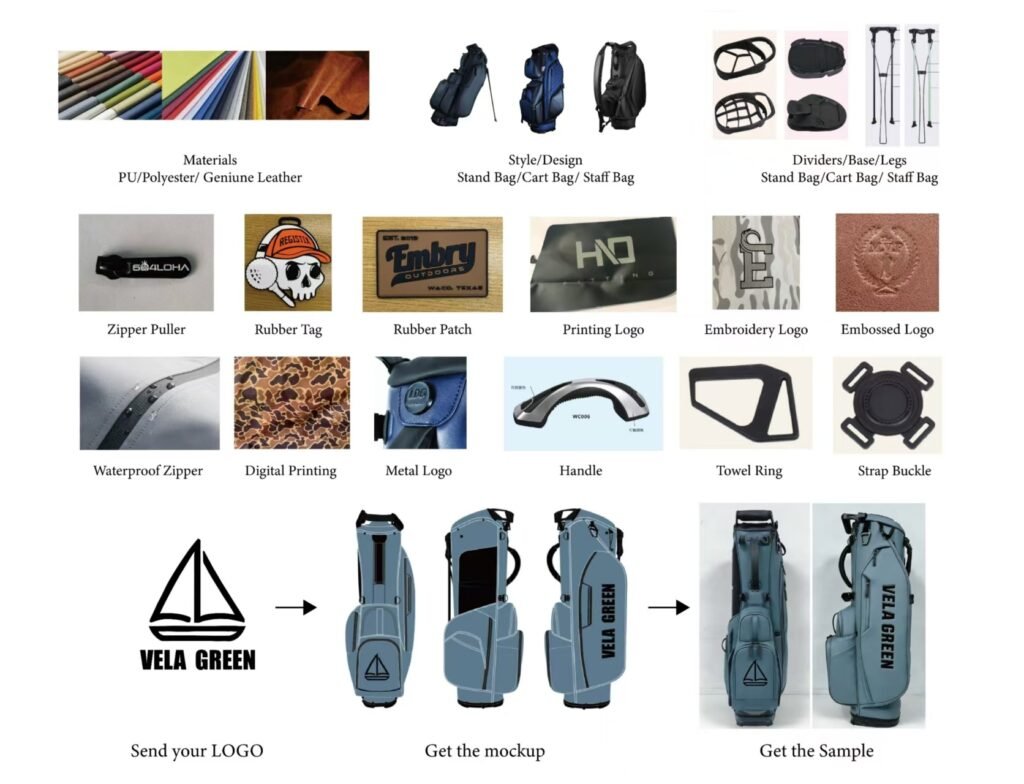
At Vela Green, we provide full-range OEM & ODM services for golf bags, golf headcovers, gloves, towels and other golf accessories. We support custom design, material selection, logo branding, color matching and mass production, strictly complying with CPSC, REACH and other international standards. With mature production experience, reliable quality control and professional export support, we help brands and importers develop market-oriented products with efficient lead times and flexible order quantities.