Golf bag minimum order quantity (MOQ) is one of the most critical factors in B2B sourcing decisions. The global golf bags market is projected to reach USD 1.75 billion by 2031, yet many brands struggle to enter the market because they cannot meet the high volume requirements of traditional factories. Understanding golf bag minimum order quantity dynamics—and how to negotiate them—can mean the difference between launching your product line and watching your idea gather dust.
This guide explains what drives golf bag minimum order quantity, what ranges to expect from different types of suppliers, and four proven strategies to start small and scale smart.
What Is Golf Bag Minimum Order Quantity and Why Does It Exist?
Golf bag minimum order quantity refers to the smallest number of units a factory is willing to produce in a single order. MOQs exist to help manufacturers offset setup costs—machine calibration, sourcing materials, training workers, and conducting quality checks. By requiring a minimum number of units, these costs are distributed across the entire order, making production financially viable.
For custom golf bag production, MOQs take on even greater importance. Custom orders involve unique materials, specialized equipment setups (embroidery, printing, heat transfers), and rigorous quality checks. Producing in higher volumes also brings down per-unit labor costs through efficiency gains as workers become faster with repeated production.
The challenge? High MOQs tie up cash flow, increase storage costs, and limit opportunities for product testing. Lower MOQs provide greater flexibility and allow brands to adapt quickly to market demands.
Standard MOQ Ranges in the Golf Bag Industry
Golf bag minimum order quantity varies dramatically depending on the type of supplier, level of customization, and manufacturing processes involved-.
Ultra-Low MOQ Suppliers (5–50 units)
Some manufacturers now offer ultra-low MOQs starting at just 5 pieces for simple customizations like new logo designs on existing bag patterns-. These suppliers are ideal for:
- Testing new markets without inventory risk
- Small corporate orders or tournament gifts
- Designer brands and high-end boutique channels
MOQ range: 5–50 units
Per-unit cost: Highest
Best for: Market testing, proofs of concept, small-batch premium products
Entry-Level MOQ Suppliers (50–300 units)
In 2026, small orders, fast turnaround has become the survival rule for brands and cross-border e-commerce. For stand bags with simple customizations like logo embroidery or minor color tweaks, manufacturers generally offer lower MOQs-.
MOQ range: 50–300 units
Per-unit cost: Moderate
Best for: Startup brands, product launches, limited-edition runs
Standard MOQ Suppliers (300–1,000 units)
This is the most common range for custom golf bag orders. Factories at this level typically require 300–1,000 units per design-. For junior golf bags, MOQs can start as low as 50–100 pieces, with bulk pricing ranging from $10–$14 for entry-level models and $24–$32 for tournament-level products-.
MOQ range: 300–1,000 units
Per-unit cost: Competitive
Best for: Established brands, retail inventory, wholesale distribution
High-Volume MOQ Suppliers (1,000+ units)
Large-scale factories and top-tier brand OEM partners typically require 1,000+ units per order-. These suppliers offer the lowest per-unit costs but demand significant upfront investment and storage capacity.
MOQ range: 1,000–2,000+ units
Per-unit cost: Lowest
Best for: Mature brands, large retail chains, high-volume distribution
Factors That Drive Golf Bag Minimum Order Quantity
Several factors influence golf bag minimum order quantity:
1. Material Complexity
Custom-dyed fabrics, premium PU leather, and specialized waterproof materials require longer sourcing lead times and higher minimums. Standard materials from the factory‘s in-stock library allow lower MOQs.
2. Customization Level
Simple logo embroidery on an existing bag pattern enables ultra-low MOQs (5–50 units)-. Full custom designs—unique pocket layouts, custom hardware, proprietary stand mechanisms—require higher MOQs to justify tooling and setup costs.
3. Design Complexity
Bags with 14-way full-length dividers, complex stand mechanisms, or multi-material construction require more labor and specialized equipment, pushing MOQs higher. Simple 4-way designs with basic features enable lower MOQs.
4. Factory Type and Region
In 2026, Dongguan surpassed Shenzhen as the core hub for “small-batch, fast-response” source factories, offering ISO9001 compliance, 7-10 day sampling, and 30-day delivery for orders under 2,000 pieces. Factories in different regions have different MOQ expectations based on their business models and cost structures.
Strategy #1: Find Low-MOQ Suppliers with Agile Capabilities
The most effective way to manage golf bag minimum order quantity is to partner with suppliers built for small-batch production. In 2026, the“small-batch, fast-response ” model has become essential for brands needing to test markets without massive inventory risk.
What to Look for in a Low-MOQ Supplier
- ISO9001 certification: Ensures quality management systems are in place
- 7–10 day sampling: Rapid prototyping validates designs before bulk commitment
- 30-day delivery for small orders: Fast turnaround for orders under 2,000 pieces
- 70%+ reorder rate: High client retention indicates consistent quality and service
Real-World Examples
Some factories now offer MOQs as low as 10 pieces for custom orders, making them ideal for designer brands and high-end gift channels. Others combine “compliance + agile” manufacturing to serve cross-border e-commerce brands needing rapid testing and reordering.
Strategy #2: Negotiate Lower MOQs Through Trial Orders
MOQs are often negotiable—especially if you demonstrate long-term potential. Start by requesting a trial order-.
Negotiation Tactics for Golf Bag Minimum Order Quantity
- Trial order compromise: “We will start with 100 units at a slightly higher per-unit price, and commit to 500 units on the next order if quality and lead time are met.”
- Combine product variations: Order different bag types or colors together to meet MOQ thresholds-.
- Order during slower seasons: Factories are more flexible during off-peak periods-.
- Offer upfront payments: A larger deposit can sometimes secure lower MOQs-.
- Signal long-term partnership: “We‘re evaluating long-term partners, not just placing one order”-.
The Trial Order Strategy
A well-executed trial order validates product quality, tests market demand, and builds supplier trust—all without the risk of a massive inventory commitment. Many brands start with 100–300 units, prove sell-through, then scale to 500–1,000 units on subsequent orders.
Strategy #3: Balance MOQ with Total Cost of Ownership
Lower golf bag minimum order quantity means higher per-unit cost—but that doesn‘t mean it’s more expensive overall. Smart buyers calculate total cost of ownership, not just unit price.
The Trade-Off
| Order Size | Per-Unit Cost | Total Investment | Inventory Risk | Cash Flow Impact |
|---|---|---|---|---|
| 100 units | Highest | Low | Low | Low |
| 300 units | Moderate | Moderate | Moderate | Moderate |
| 500 units | Competitive | High | High | High |
| 1,000+ units | Lowest | Very High | Very High | Very High |
When Higher MOQ Makes Sense
- Proven designs with consistent demand: You know the product sells; scale to reduce per-unit cost
- Established brand with retail commitments: Wholesale orders require volume
- Sufficient working capital and storage: You can absorb the investment
When Lower MOQ Makes Sense
- New designs or unproven markets: Test before committing
- Limited working capital: Start small, reinvest profits
- Seasonal or limited-run products: Small batches match demand windows
Strategy #4: Plan a Phased Scaling Approach
The smartest approach to golf bag minimum order quantity is phased scaling—starting small and growing with proven demand.
The Three-Phase Model
Phase 1: Trial (100–200 units)
Launch a new design with a small batch. Test the market, gather customer feedback, and validate quality before scaling.
Phase 2: Initial Bulk (300–500 units)
Based on trial success, place a moderate order to cover the next 90 days of demand. Negotiate better per-unit pricing while maintaining flexibility.
Phase 3: Repeat Orders (200–500 units each)
Establish a recurring reorder cadence (every 45–60 days) for proven SKUs. This keeps inventory fresh, reduces carrying costs, and allows rapid response to demand spikes.
Factories that support orders under 2000 pieces will be delivered in 30 days. enable this phased approach without sacrificing speed. The key is building a supplier relationship that supports both small trial orders and larger repeat orders.
Golf Bag Minimum Order Quantity Summary Checklist
| Strategy | Key Action | Status |
|---|---|---|
| Find low-MOQ suppliers | Identify factories with ISO9001, 7-10 day sampling, and 30-day delivery | ☐ |
| Negotiate trial orders | Start with 100–200 units; commit to growth | ☐ |
| Balance TCO | Calculate total cost, not just unit price | ☐ |
| Phased scaling | Trial → initial bulk → repeat orders | ☐ |
Common Golf Bag Minimum Order Quantity Mistakes to Avoid
| Mistake | Consequence | Solution |
|---|---|---|
| Ordering to MOQ without demand data | Excess inventory, cash flow strain | Validate demand with trial order first |
| Accepting first MOQ without negotiation | Higher than necessary commitment | Request trial orders and tiered pricing |
| Choosing solely on lowest per-unit cost | Overcommitted to unproven designs | Balance cost with flexibility |
| Ignoring factory capability | Low-MOQ supplier may lack quality systems | Verify ISO9001 and reorder rates |
| No scaling plan | Perpetual trial orders, never capturing volume savings | Define phased growth path |
Conclusion: Master Golf Bag Minimum Order Quantity for Smart Sourcing
Golf bag minimum order quantity is not a barrier—it is a strategic variable. The four strategies in this guide—finding low-MOQ suppliers, negotiating trial orders, balancing total cost of ownership, and phased scaling—provide a complete framework for launching and growing your custom golf bag line.
In 2026, the“small-batch, fast-response” model has made it easier than ever for brands of all sizes to enter the golf bag market. Factories with ISO9001 certification, 7-10 day sampling, and 30-day delivery for small orders enable startups, cross-border sellers, and established brands alike to test, learn, and scale without massive upfront investment.
Start your next sourcing project by identifying low-MOQ suppliers, negotiating trial orders, calculating total cost of ownership, and planning your phased scaling path. The brands that master golf bag minimum order quantity today will be the ones capturing market share tomorrow.
With 20 years of golf bag manufacturing experience and flexible MOQ options, we support B2B clients at every stage—from 100-unit trial orders to 5,000-unit bulk production. Contact us to discuss your order requirements and request a sample.
OEM & ODM Service
Whether you’re planning to build your own brand, develop new products, or find a stable manufacturing partner for the US and European markets, working with a professional OEM & ODM factory can significantly improve your product quality and market competitiveness.
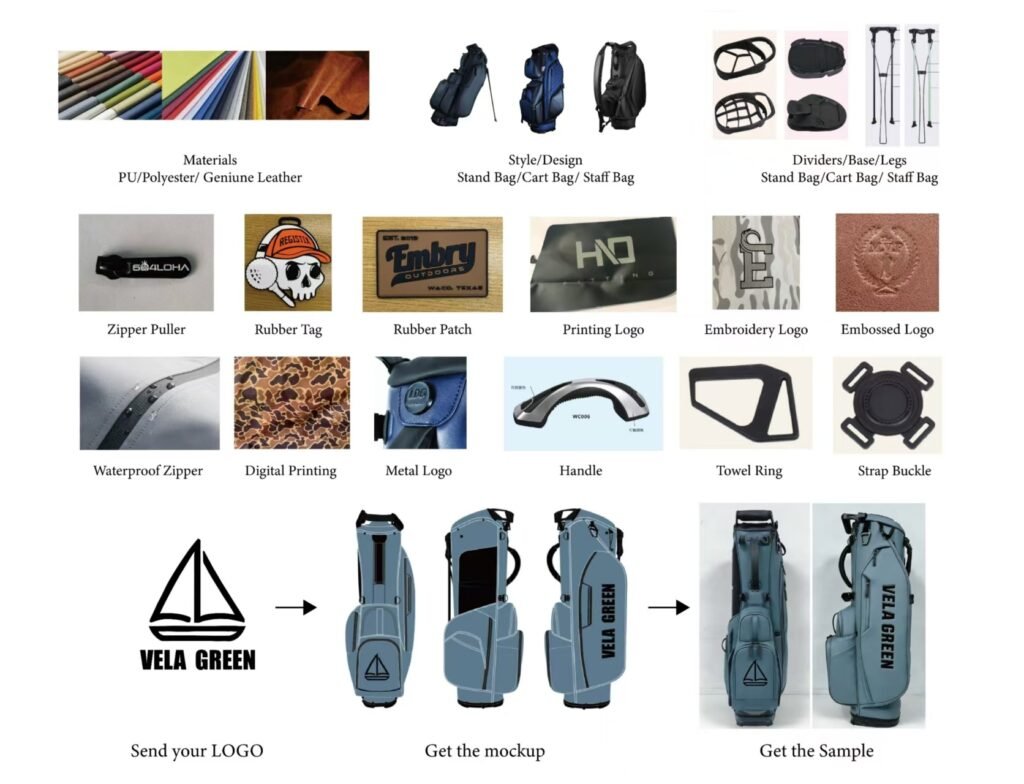
At Vela Green, we provide full-range OEM & ODM services for golf bags, golf headcovers, gloves, towels and other golf accessories. We support custom design, material selection, logo branding, color matching and mass production, strictly complying with CPSC, REACH and other international standards. With mature production experience, reliable quality control and professional export support, we help brands and importers develop market-oriented products with efficient lead times and flexible order quantities.