A well-designed golf bag product portfolio is the foundation of profitable B2B distribution. The global golf equipment market was valued at USD 8.80 billion in 2025 and is projected to grow to USD 13.17 billion by 2032-. Yet many brands approach their golf bag product portfolio reactively—adding products based on supplier suggestions or competitor copying rather than strategic planning. The result? Bloated SKU counts, slow-moving inventory, and diluted brand identity.
This guide presents four essential strategies for building a golf bag product portfolio that balances breadth and depth, meets diverse customer needs, and maximizes wholesale revenue.
Why Golf Bag Product Portfolio Strategy Matters in 2026
The golf industry is undergoing a significant transformation. The market is segmented into various types of golf bags—carry bags, cart bags, and stand bags—with carry bags being the most preferred choice among golfers for their portability and convenience-. At the same time, distribution channels are expanding from traditional pro shops to hypermarkets, online retail, and specialty stores-.
A strategic golf bag product portfolio delivers multiple benefits:
- Channel alignment: Different retail channels require different product assortments—pro shops need premium tour bags; online retailers value lightweight carry bags; resorts prefer travel-friendly options
- Inventory efficiency: Optimized SKU counts reduce carrying costs and improve turnover-
- Brand positioning: A coherent product line communicates your brand‘s identity and target market
- Revenue diversification: Multiple categories reduce dependence on any single product
Successful golf brands are making data the backbone of their design, allocation, and channel strategies-. Your golf bag product portfolio should reflect the same discipline.
Strategy #1: Balance Core Categories in Your Golf Bag Product Portfolio
The foundation of any strong golf bag product portfolio is a balanced mix of core categories. Each category serves different golfers, use cases, and price points.
Essential Categories for a Complete Golf Bag Product Portfolio
| Category | Target User | Key Features | Price Tier |
|---|---|---|---|
| Stand Bags | Walking golfers | Lightweight, dual straps, stand mechanism | Mid-range |
| Cart Bags | Riding golfers | More storage, tour-style design | Mid-to-premium |
| Tour Bags | Competitive players | Full-size, 14-way dividers, premium materials | Premium |
| Travel Bags | Frequent flyers | Padded protection, wheels, durable construction | Mid-range |
| Sunday Bags | Casual/quick rounds | Ultra-light, minimal pockets | Entry-level |
| Junior Bags | Young golfers | Smaller size, lightweight | Entry-level |
How to Balance Your Golf Bag Product Portfolio
- Anchor with volume drivers: Stand bags and cart bags typically account for 50–60% of unit sales. These should be your golf bag product portfolio foundation.
- Add premium differentiators: Tour bags and premium cart bags build brand prestige and higher margins, even if volume is lower.
- Include entry points: Sunday bags and junior bags attract new customers who may upgrade later.
- Consider accessories: A complete golf bag product portfolio often includes matching headcovers, towels, and gloves to increase average order value-.
Some manufacturers now offer comprehensive product lines covering golf bags, headcovers, and accessories as a one-stop solution-. This approach simplifies sourcing and ensures brand consistency across your golf bag product portfolio.
Strategy #2: Optimize SKU Depth and Breadth in Your Golf Bag Product Portfolio
SKU optimization is the hidden lever in golf bag product portfolio management. Too few SKUs limit customer choice; too many SKUs increase carrying costs and complexity-.
Breadth vs. Depth in Golf Bag Product Portfolio
- Breadth: Number of different categories (stand, cart, tour, travel, junior)
- Depth: Number of variations within each category (colors, sizes, materials)
The 80/20 Rule in Golf Bag Product Portfolio
Most golf bag sales follow the Pareto principle: roughly 80% of revenue comes from 20% of SKUs. Identify your top-selling models and colors, then allocate inventory accordingly. For slower-moving SKUs, consider:
- Limited-edition runs: Create scarcity and justify premium pricing
- Seasonal offerings: Introduce fresh colors for spring and holiday seasons
- Channel exclusives: Offer specific colors or models to different retail channels to avoid direct competition
SKU Optimization Questions for Your Golf Bag Product Portfolio
- “Which SKUs generate the highest margin? The fastest turnover?”
- “Which SKUs are slow-moving and should be discounted or discontinued?”
- “What is the minimum viable assortment for each retail channel?”
- “Can we consolidate similar SKUs without losing customer appeal?”
Retail-ready packaging and bundled offerings can reduce SKU complexity by up to 40% while increasing impulse purchases-. Consider gift sets or starter packs as part of your golf bag product portfolio strategy.
Strategy #3: Align Your Golf Bag Product Portfolio with Channel Strategy
Different sales channels require different product assortments. A one-size-fits-all golf bag product portfolio leaves money on the table.
Channel-Specific Assortment Planning
| Channel | Preferred Categories | Assortment Strategy |
|---|---|---|
| Pro Shops | Tour bags, premium cart bags, branded accessories | Limited depth, high perceived value |
| Off-Course Retail | Stand bags, cart bags, travel bags | Broad assortment across price tiers |
| Online Retail | Lightweight bags, value options, seasonal colors | Wide depth, detailed product information |
| Resorts/Clubs | Travel bags, premium cart bags, logo-ready options | Mid-range assortment, customization options |
| Corporate/Tournament | Logo-ready bags, gift sets, promotional items | Customizable, lower MOQ options |
How to Align Your Golf Bag Product Portfolio with Channels
- Differentiate by channel: Reserve certain colors, materials, or features for specific channels to avoid direct competition
- Bundle for wholesale: Create channel-specific bundles (e.g., “Pro Shop Starter Pack” with bag + 3 headcovers + towel)
- Consider private label: Some channels may want exclusive branding on your golf bag product portfolio items
Successful golf brands in wholesale are making data the backbone of their design, allocation, and channel strategies-. Use sell-through data to refine your channel-specific golf bag product portfolio.
Strategy #4: Plan for Product Lifecycle and Seasonal Rotation
A dynamic golf bag product portfolio evolves with the seasons and market trends. Static assortments become stale and lose competitive edge.
Seasonal Planning for Golf Bag Product Portfolio
| Season | Focus | Strategy |
|---|---|---|
| Spring (March-May) | New arrivals, fresh colors | Launch new models; full inventory |
| Summer (June-August) | Core models, travel bags | Monitor sell-through; reorder fast-movers |
| Fall (September-November) | Clearance, holiday preview | Discount slow-movers; introduce holiday colors |
| Winter (December-February) | Planning, limited runs | Plan next year‘s lineup; test new designs |
Lifecycle Stages in Golf Bag Product Portfolio
- Introduction: New models with limited production—test market response
- Growth: Proven models scaled for broader distribution
- Maturity: Core SKUs with consistent demand—optimize for cost efficiency
- Decline: Slow-movers—discount, discontinue, or replace
How to Manage Golf Bag Product Portfolio Lifecycle
- Track sell-through rates by SKU and by season
- Plan 12-18 months ahead for new product development
- Retire underperformers annually to keep your golf bag product portfolio fresh
- Test new designs with limited runs before committing to full production
The golf equipment market is seeing increasing lifestyle crossover trends, with apparel and footwear reflecting lifestyle elements while performance categories demand ongoing material and manufacturing innovation-. Your golf bag product portfolio should reflect this balance—performance-driven core models with lifestyle-inspired seasonal variations.
Golf Bag Product Portfolio Planning Checklist
| Strategy | Key Action | Status |
|---|---|---|
| Balance core categories | Include stand, cart, tour, travel, and junior bags | ☐ |
| Optimize SKU depth | Apply 80/20 rule; retire slow-movers | ☐ |
| Align with channels | Differentiate assortments by channel | ☐ |
| Plan lifecycle | Track sell-through; plan 12-18 months ahead | ☐ |
Common Golf Bag Product Portfolio Mistakes to Avoid
| Mistake | Consequence | Solution |
|---|---|---|
| Too many SKUs | High carrying costs, slow turnover | Apply 80/20 rule; consolidate variations |
| One-size-fits-all assortment | Missed channel opportunities | Differentiate by channel |
| No seasonal planning | Stale inventory, missed trends | Plan 12-18 months ahead |
| Ignoring data | Reactive decisions, missed opportunities | Use sell-through data for planning |
| No entry-level options | Limited customer acquisition | Include Sunday bags or junior bags |
Conclusion: Build a Winning Golf Bag Product Portfolio for 2026
A strategic golf bag product portfolio is not about having the most SKUs—it is about having the right SKUs for the right channels at the right time. The four strategies in this guide—balancing core categories, optimizing SKU depth, aligning with channels, and planning for lifecycle—provide a complete framework for building a winning lineup.
In 2026, successful golf brands are making data the backbone of their design, allocation, and channel strategies-. Your golf bag product portfolio should reflect the same discipline. Start by auditing your current lineup against these four strategies. Identify gaps, retire underperformers, and build a portfolio that serves every customer segment and every sales channel.
The brands that master golf bag product portfolio strategy today will be the ones capturing market share as the golf equipment market grows from USD 8.80 billion to USD 13.17 billion by 2032-.
With 20 years of golf bag manufacturing experience and a comprehensive product range spanning stand bags, cart bags, tour bags, travel bags, and accessories, we help B2B clients build winning product portfolios. Contact us to discuss your product line requirements and request samples.
OEM & ODM Service
Whether you’re planning to build your own brand, develop new products, or find a stable manufacturing partner for the US and European markets, working with a professional OEM & ODM factory can significantly improve your product quality and market competitiveness.
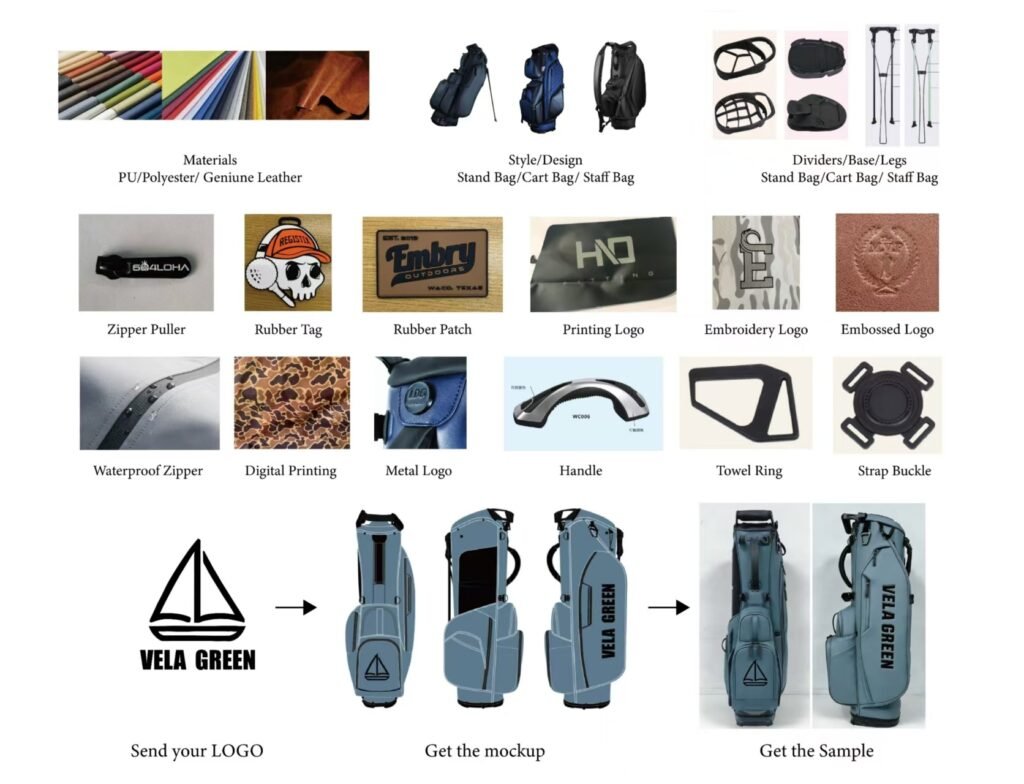
At Vela Green, we provide full-range OEM & ODM services for golf bags, golf headcovers, gloves, towels and other golf accessories. We support custom design, material selection, logo branding, color matching and mass production, strictly complying with CPSC, REACH and other international standards. With mature production experience, reliable quality control and professional export support, we help brands and importers develop market-oriented products with efficient lead times and flexible order quantities.