The global golf bag market is undergoing a fundamental shift. Valued at approximately USD 1.25 billion in 2025 and projected to reach USD 1.66 billion by 2031, the golf bag market is no longer just about price and quality. Today’s B2B buyers are demanding something more: golf bag supply chain transparency. For brands sourcing from overseas manufacturers, golf bag supply chain transparency has become a competitive necessity that protects brand reputation, ensures regulatory compliance, and builds consumer trust.
This guide explains why golf bag supply chain transparency matters in 2026 and how B2B buyers can verify that their manufacturing partners meet the highest ethical and environmental standards.
Why Golf Bag Supply Chain Transparency Matters in 2026
The demand for golf bag supply chain transparency is being driven by multiple forces. Major brands like Callaway and Adidas have launched eco-conscious product lines, emphasizing transparency in supply chains and carbon footprint reduction-. In the golf industry specifically, brands are investing in recycled fabrics, biodegradable packaging, and sustainable manufacturing processes to meet this demand-.
For B2B buyers, golf bag supply chain transparency delivers three critical benefits:
- Brand protection: Consumers are increasingly vocal about ethical sourcing. A supply chain scandal can destroy years of brand building.
- Regulatory compliance: REACH, Prop 65, and CPSIA requirements demand documented compliance. Without golf bag supply chain transparency, you risk customs holds and fines.
- Competitive differentiation: Retailers and pro shops increasingly prefer suppliers who can document ethical and sustainable sourcing.
The Four Certifications That Validate Golf Bag Supply Chain Transparency
A golf bag factory’s environmental claim is only as credible as the third-party certification behind it-12. For B2B buyers serious about golf bag supply chain transparency, four certification systems matter most:
GRS (Global Recycled Standard)
GRS verifies recycled content percentage, chain of custody, and social and environmental criteria. It certifies that RPET fabric, recycled nylon, and recycled polyester linings actually contain the claimed recycled material. For golf bag supply chain transparency, GRS is the gold standard for verifying recycled content claims.
OEKO-TEX® Standard 100
OEKO-TEX certifies that finished textile components do not contain harmful substances above threshold levels. Every fabric panel, lining, zipper tape, and strap padding that contacts skin or gear must pass these tests.
bluesign®
bluesign certifies input chemical management, consumer safety, environmental emissions, and occupational health. It traces chemical compliance from fiber to finish, making it essential for golf bag supply chain transparency in dye houses and fabric mills.
ISO 14001
ISO 14001 certifies that the factory has an Environmental Management System (EMS)—structured policies, objectives, monitoring, and legal compliance. It confirms the facility has processes to manage waste, emissions, energy, and legal obligations.
Critical distinction: These four certifications are complementary, not interchangeable. A factory claiming “certified eco-friendly” with only ISO 14001 has no verified recycled content or chemical safety data for the products they ship you.
Regional Sourcing and Supply Chain Transparency
Golf bag supply chain transparency also means understanding where your materials come from. The global supply chain is being redrawn, and golf bag manufacturing is no exception.
In 2026, a “China+1” hybrid strategy—maintaining 60–70% of production in China while establishing a secondary base in Vietnam or Cambodia—is the optimal path for risk-managed sourcing. This approach offers:
- China: Unmatched supply chain completeness, with every component sourced within a 100-kilometer radius, and quality consistency of 96–98% first-pass rates
- Vietnam: Strongest tariff arbitrage through 17 free trade agreements
- Cambodia: Duty-free access to the EU and UK
For golf bag supply chain transparency, knowing where each component originates is essential. Even bags stamped “Made in Vietnam” often contain Chinese-made zippers, fabrics, buckles, and internal frames. True transparency means tracing every component to its source.
Ethical Labor and Social Compliance
Beyond environmental standards, golf bag supply chain transparency requires ethical labor practices. BSCI (Business Social Compliance Initiative) certification demonstrates a factory’s commitment to fair wages, safe working conditions, and responsible supply chain management.
Major golf brands are building their reputations on ethical sourcing. Callaway’s fundamental belief is that “Good Ethics Is Good Business,” with a dedication to cultivating a responsible supply chain-. Acushnet has built an 11-policy compliance framework around ESG principles-.
For B2B buyers, golf bag supply chain transparency means verifying that your manufacturing partner holds current BSCI certification and undergoes regular social audits.
How to Verify Golf Bag Supply Chain Transparency
Implementing golf bag supply chain transparency in your sourcing process requires a systematic approach:
1. Request Certification Documentation
Ask every potential supplier for current PDFs of GRS, OEKO-TEX, bluesign, ISO 14001, ISO 9001, and BSCI certifications. Check expiry dates—ISO 9001 expires after three years; BSCI audits are valid for two years.
2. Verify Test Reports
Request third-party test reports from accredited laboratories including SGS, TÜV Rheinland, and Intertek. Test reports should be available for each production batch.
3. Conduct Factory Audits
On-site or virtual audits verify that certification claims match actual factory conditions. Evaluate production lines, material storage, quality control stations, and worker conditions.
4. Demand Chemical Compliance Documentation
For EU-bound shipments, verify REACH compliance—no substances of very high concern (SVHC) above threshold levels. For US-bound shipments, verify California Proposition 65 compliance.
The Business Case for Golf Bag Supply Chain Transparency
Investing in golf bag supply chain transparency delivers measurable ROI. Globally, 78% of golfers factor sustainability into their purchasing decisions, and 65% are willing to pay 15–20% more for eco-conscious products.
Brands that prioritize golf bag supply chain transparency build reputations for reliability and responsibility. Those that ignore it risk regulatory penalties, customs holds, and reputational damage that can take years to repair.
The golf bag market is growing—from USD 1.25 billion to USD 1.66 billion by 2031. Brands that master golf bag supply chain transparency today will capture the premium segment of this growth. Those that don’t will compete on price alone.
With 20 years of golf bag manufacturing experience, ISO 9001 and BSCI certifications, GRS-certified sustainable materials, and documented REACH and Prop 65 compliance, we provide complete supply chain transparency for every order. Contact us to request our certification documentation and supplier due diligence packet.
OEM & ODM Service
Whether you’re planning to build your own brand, develop new products, or find a stable manufacturing partner for the US and European markets, working with a professional OEM & ODM factory can significantly improve your product quality and market competitiveness.
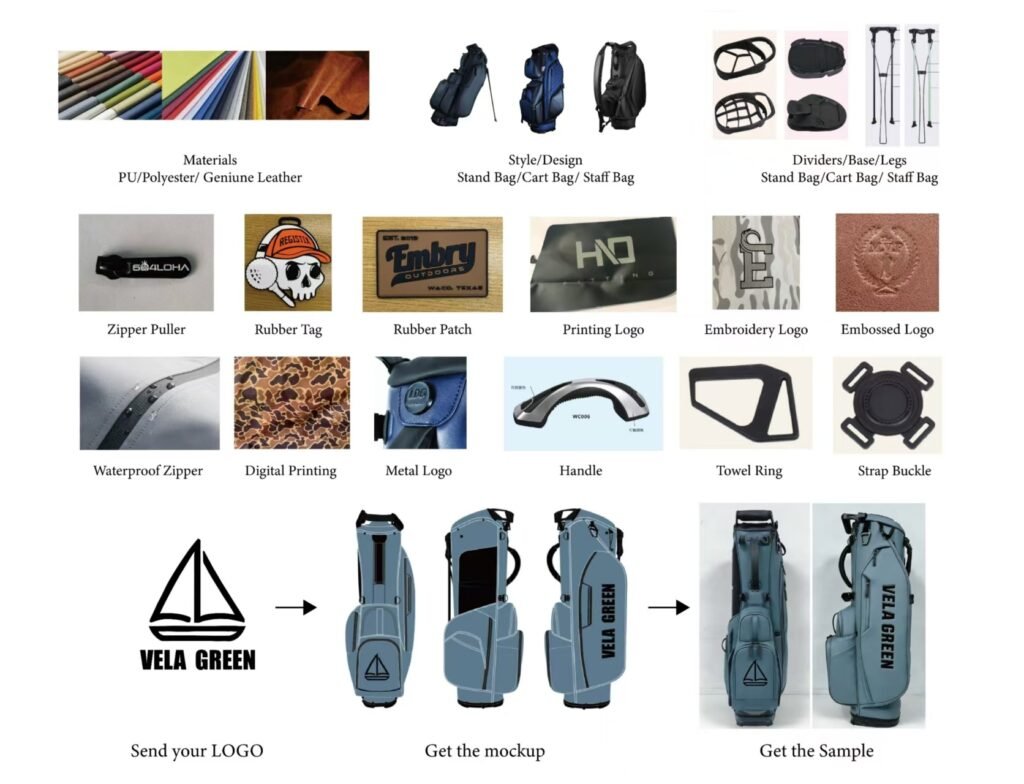
At Vela Green, we provide full-range OEM & ODM services for golf bags, golf headcovers, gloves, towels and other golf accessories. We support custom design, material selection, logo branding, color matching and mass production, strictly complying with CPSC, REACH and other international standards. With mature production experience, reliable quality control and professional export support, we help brands and importers develop market-oriented products with efficient lead times and flexible order quantities.