For B2B golf bag manufacturers and exporters, golf bag export compliance has become one of the most complex and costly challenges in 2026. The global golf bag market is projected to grow from USD 1.25 billion in 2025 to USD 1.66 billion by 2031, but this growth comes with a labyrinth of regulations that can trap unprepared exporters. From US tariffs exceeding 50% to new EU packaging rules, mastering golf bag export compliance is no longer optional—it’s essential for protecting your margins and your reputation.
This guide breaks down five critical golf bag export compliance regulations that every exporter must master in 2026.
Regulation #1: US Tariffs — The 4.5% Base That Can Become 50%+
The foundation of US golf bag export compliance starts with correct HS code classification. Golf bags are primarily classified under HTS 4202.91.10.00 (Golf bags), which carries a Most-Favored-Nation (MFN) base duty rate of 4.5%-. However, this base rate is only the beginning for golf bag export compliance.
For shipments from China, Section 301 tariffs add additional layers. In July 2026, the Section 122 flat 10% surcharge was replaced by a two-tier 10%/12.5% duty under Section 301-. For China-origin shipments, the total effective duty can push well beyond 50% when all layers are combined-. Even for non-China origins, Section 301 and Section 122 measures must be reviewed as separate layers-.
What This Means for Golf Bag Export Compliance
The first rule of golf bag export compliance for US-bound shipments is: never assume your duty rate is just 4.5%. You must verify:
- Country of origin (China, Vietnam, Taiwan, etc.)
- Applicable Section 301 tariffs
- Any Section 122 or Section 232 measures
- Correct HS code classification (leather vs. textile outer surface can create 10+ percentage points of duty and trigger CBP penalties)-
Regulation #2: US CPSC eFiling — Mandatory Electronic Compliance
A major new requirement in US golf bag export compliance took effect on July 8, 2026. The US Consumer Product Safety Commission (CPSC) now requires all imported consumer goods to complete an electronic compliance declaration (eFiling) before arrival-.
What CPSC eFiling Means for Golf Bag Export Compliance
- All regulated consumer products must have compliance data submitted electronically
- Data must be filed before cargo arrives at the US port
- Unfiled shipments will be detained at the port
- Compliance costs have risen approximately 30% for shipments under the $800 de minimis threshold-
How to Stay Compliant
For golf bag export compliance with CPSC eFiling, you need to:
- Ensure your factory maintains CPSIA compliance documentation-
- Work with a customs broker familiar with eFiling requirements
- Submit compliance data well before the cargo departure date
- Verify that children’s product regulations apply to any junior golf bags
Regulation #3: EU REACH — Chemical Safety Compliance
For golf bag exporters targeting the European market, golf bag export compliance requires adherence to the EU REACH regulation (EC 1907/2006). REACH restricts over 200 hazardous substances in products sold in Europe-.
Key REACH Requirements for Golf Bag Export Compliance
- SVHC (Substances of Very High Concern): Any SVHC content exceeding 0.1% triggers notification and communication requirements-
- Annex XVII restrictions: Heavy metals, phthalates, azo dyes, formaldehyde are strictly controlled-
- Testing: All materials—fabric, PU leather, hardware, foam, adhesives—must be tested
What REACH Means for Golf Bag Export Compliance
If your golf bags contain SVHCs above 0.1%, they will not be allowed to be sold in the EU market-. Penalties can include fines, product recalls, and market bans. For serious golf bag export compliance, you need:
- REACH test reports from accredited laboratories
- Documentation showing all materials are SVHC-free below threshold levels
- Ongoing monitoring as the SVHC list is updated regularly
Regulation #4: EU PPWR — Packaging Compliance
A new regulation that many exporters overlook in golf bag export compliance is the EU Packaging and Packaging Waste Regulation (PPWR, Regulation (EU) 2025/40). This regulation became fully enforceable on August 12, 2026-.
What PPWR Means for Golf Bag Export Compliance
PPWR applies to all packaging associated with golf bag exports to the EU:
- Sales packaging: Polybags, cartons, and inserts
- Transport packaging: Master cartons and pallet wrapping
- Packaging materials: Labels, hang tags, and cushioning materials-
How to Achieve PPWR Compliance
For comprehensive golf bag export compliance with EU PPWR:
- Ensure all packaging is recyclable
- Verify that packaging materials meet EU sustainability standards
- Document packaging composition for compliance verification
- Work with suppliers who offer FSC-certified or recycled packaging options
Regulation #5: California Proposition 65 — US State-Level Compliance
Even within the US, golf bag export compliance includes state-level regulations. California Proposition 65 requires businesses to provide warnings before exposing consumers to chemicals known to cause cancer or reproductive toxicity-.
Prop 65 Requirements for Golf Bag Export Compliance
- Testing for lead, cadmium, phthalates, and other restricted substances
- Warning labels if any listed chemical exceeds safe harbor levels
- Compliance applies to all products sold in California, regardless of where they are manufactured
Why Prop 65 Matters
Penalties for Prop 65 violations can reach $2,500 per violation per day. For a container of golf bags, this can amount to hundreds of thousands of dollars. Professional golf bag export compliance includes:
- Prop 65 test reports from accredited laboratories
- Documentation showing all materials are below safe harbor limits
- Proper labeling when required
Golf Bag Export Compliance Checklist
| Regulation | Key Requirement | Target Market |
|---|---|---|
| US Tariffs (HTS 4202.91.10.00) | Correct HS code + Section 301 review | USA |
| CPSC eFiling | Electronic compliance declaration before arrival | USA |
| EU REACH | SVHC below 0.1%; Annex XVII compliance | EU |
| EU PPWR | Recyclable packaging; sustainability documentation | EU |
| California Prop 65 | Chemical testing; warning labels when required | USA (CA) |
Common Golf Bag Export Compliance Mistakes to Avoid
| Mistake | Consequence | Solution |
|---|---|---|
| Assuming 4.5% is the total duty | Unexpected 50%+ tariff bills | Calculate all tariff layers |
| Missing CPSC eFiling deadline | Shipment detained at port | File compliance data early |
| No REACH testing | Product banned from EU market | Request lab test reports |
| Ignoring PPWR | Packaging non-compliance fines | Verify packaging sustainability |
| No Prop 65 documentation | $2,500/day penalties | Maintain current test reports |
Conclusion: Make Golf Bag Export Compliance a Priority
Golf bag export compliance in 2026 is more complex than ever. US tariffs can exceed 50% when all layers are applied-. CPSC eFiling is mandatory for all shipments-. EU REACH requires rigorous chemical testing-. PPWR mandates sustainable packaging-. And California Prop 65 carries daily penalties for non-compliance-.
But compliance is not just about avoiding penalties—it’s about building trust with your B2B customers. European and American buyers increasingly demand documented compliance as a condition of doing business. The brands that master golf bag export compliance today will be the ones winning contracts tomorrow.
With 20 years of golf bag manufacturing experience and documented compliance across US tariffs, CPSC eFiling, EU REACH, EU PPWR, and California Prop 65, we help B2B clients navigate every export compliance requirement. Contact us to request our compliance documentation.
OEM & ODM Service
Whether you’re planning to build your own brand, develop new products, or find a stable manufacturing partner for the US and European markets, working with a professional OEM & ODM factory can significantly improve your product quality and market competitiveness.
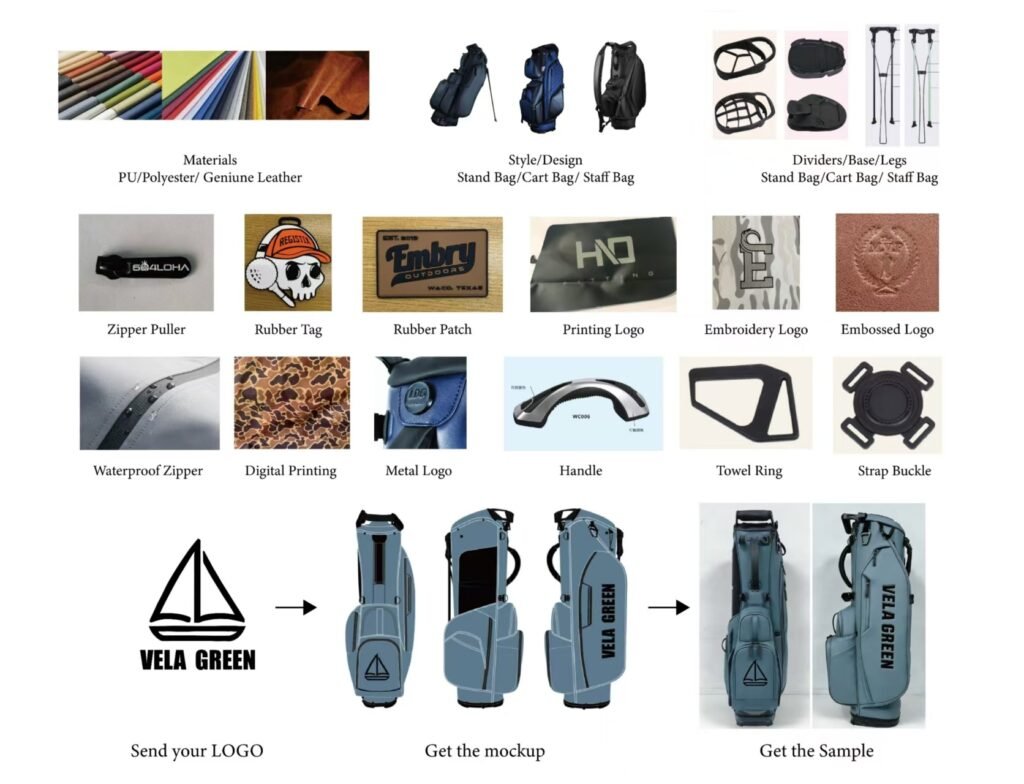
At Vela Green, we provide full-range OEM & ODM services for golf bags, golf headcovers, gloves, towels and other golf accessories. We support custom design, material selection, logo branding, color matching and mass production, strictly complying with CPSC, REACH and other international standards. With mature production experience, reliable quality control and professional export support, we help brands and importers develop market-oriented products with efficient lead times and flexible order quantities.