For B2B buyers sourcing stand bags, golf bag stand mechanism quality is one of the most important yet overlooked factors. A stand bag that won‘t stand is useless—and a mechanism that fails after a few rounds generates returns, warranty claims, and damaged brand reputation. The global golf bag market is projected to reach USD 1.66 billion by 2031, and in the competitive stand bag segment, golf bag stand mechanism reliability is a key differentiator. This guide outlines five critical tests every B2B buyer should require before approving bulk production.
Why Golf Bag Stand Mechanism Quality Matters for B2B Buyers
The golf bag stand mechanism is the most mechanically complex component of any stand bag. It consists of legs, hinges, springs, pivot points, and a base actuator. When a golfer sets the bag down, the mechanism must deploy smoothly and lock securely. When lifted, it must retract fully and quickly.
Poor golf bag stand mechanism design leads to legs that collapse mid-round, won’t retract, or jam with sand and grass. These failures generate customer complaints and returns. For B2B buyers, investing in golf bag stand mechanism quality protects margins and builds retailer confidence.
Test #1: Leg Deployment and Retraction Cycles
The first test for golf bag stand mechanism is cycle testing. A quality mechanism should withstand thousands of deployments without failure.
What to Test
- Deployment smoothness: Legs should extend fully with minimal effort when the bag is tilted
- Retraction speed: Legs should snap back quickly when the bag is lifted
- Cycle count: Premium mechanisms exceed 3,000 cycles; budget mechanisms fail at 500–800
- Consistency: The 1st cycle and the 3,000th cycle should feel the same
Ask your supplier for documented cycle test results. A golf bag stand mechanism that cannot pass 3,000 cycles is not suitable for daily-use stand bags.
Test #2: Locking Mechanism Stability
The second critical test for golf bag stand mechanism is locking stability. Once deployed, the legs must lock firmly and not collapse under weight.
What to Test
- Lock engagement: Audible or tactile click when legs reach full extension
- Weight test: Apply downward pressure equivalent to a loaded bag (10–15kg)
- Slope test: Place the bag on a 10-degree slope—legs should not slip or collapse
- Vibration test: Simulate cart vibration—locking mechanism should not disengage
A golf bag stand mechanism that fails the locking test creates a safety hazard and will generate immediate returns.
Test #3: Load-Bearing Capacity
The third test for golf bag stand mechanism is load-bearing capacity. The legs and hinges must support the bag‘s weight plus clubs and accessories without bending or deforming.
What to Test
- Static load: 20kg applied to the bag while on stand
- Dynamic load: Simulate setting the bag down repeatedly with full weight
- Leg deflection: Measure bending under load—should not exceed 2mm
- Hinge integrity: No cracking, loosening, or deformation
Cheap golf bag stand mechanism often uses thin aluminum or plastic hinges that bend under load. Premium mechanisms use reinforced nylon or metal alloys.
Test #4: Corrosion Resistance
The fourth test for golf bag stand mechanism is corrosion resistance. Golf bags are exposed to rain, dew, sand, and sweat. Metal components must resist rust.
What to Test
- Salt spray test: 48–96 hours per ASTM B117
- Coating integrity: No chipping or peeling on painted or plated parts
- Material selection: Stainless steel or anodized aluminum preferred
A golf bag stand mechanism that rusts after one season will fail within two. Specify corrosion-resistant materials in your purchase contract.
Test #5: Material Fatigue and Stress Points
The fifth test for golf bag stand mechanism is material fatigue. Repeated stress on hinges, pivot points, and spring anchors causes micro-cracks that lead to sudden failure.
What to Test
- Spring fatigue: Springs should maintain tension after 3,000+ cycles
- Pivot wear: No excessive play or wobble at pivot points
- Base actuator: No cracking at attachment points
- Stress point inspection: Magnifying glass or dye penetrant testing for micro-cracks
A professional golf bag stand mechanism uses high-carbon steel springs and reinforced pivot bushings.
Common Golf Bag Stand Mechanism Failures to Avoid
| Failure Mode | Cause | Prevention |
|---|---|---|
| Legs won‘t retract | Weak springs, sand jam | Sealed spring housing, cycle testing |
| Legs collapse under weight | Thin hinges, poor locking | Load testing, reinforced materials |
| Rust and corrosion | Uncoated metal parts | Salt spray testing, stainless hardware |
| Spring breakage | Low-carbon springs | High-carbon steel, fatigue testing |
| Base cracking | Poor material, stress concentration | Reinforced base design |
How to Evaluate Golf Bag Stand Mechanism in Samples
When reviewing stand bag samples, test the golf bag stand mechanism yourself:
- Deploy and retract the legs 50 times—check for smoothness and consistency
- Load the bag with clubs and set it down 20 times—watch for leg deflection
- Place on a slope—verify locking stays engaged
- Inspect hinges and springs—look for rough edges or poor plating
- Leave in a humid environment for 48 hours—check for rust
Suppliers who welcome this scrutiny are the ones who deliver reliable golf bag stand mechanism quality.
Conclusion: Make Golf Bag Stand Mechanism a Quality Priority
Golf bag stand mechanism quality is not a minor detail—it is a primary driver of customer satisfaction and B2B sales. The five tests in this guide—deployment cycles, locking stability, load-bearing, corrosion resistance, and material fatigue—provide a complete framework for evaluating any stand bag.
The stand bag segment is growing, and buyers who prioritize golf bag stand mechanism reliability will capture market share. Those who ignore it will compete on price alone—and lose. Start requiring these tests from your supplier today.
With 20 years of golf bag manufacturing experience and rigorous testing protocols for every stand mechanism, we help B2B clients deliver bags that stand the test of time. Contact us to discuss your stand bag requirements and request test documentation.
OEM & ODM Service
Whether you’re planning to build your own brand, develop new products, or find a stable manufacturing partner for the US and European markets, working with a professional OEM & ODM factory can significantly improve your product quality and market competitiveness.
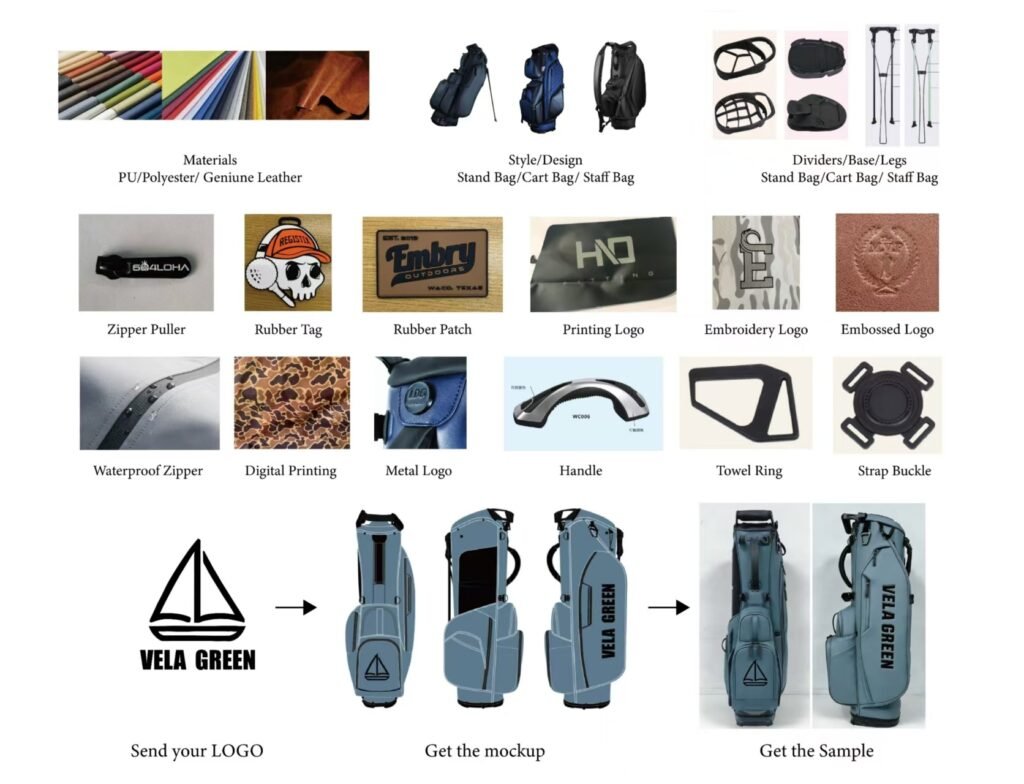
At Vela Green, we provide full-range OEM & ODM services for golf bags, golf headcovers, gloves, towels and other golf accessories. We support custom design, material selection, logo branding, color matching and mass production, strictly complying with CPSC, REACH and other international standards. With mature production experience, reliable quality control and professional export support, we help brands and importers develop market-oriented products with efficient lead times and flexible order quantities.