Golf bags OEM compliance for US & European markets is a non-negotiable prerequisite for all B2B wholesalers, private label brands, and golf equipment suppliers exporting to Western mature markets. The US and European regions enforce strict, updated regulatory standards for sports bags, covering material safety, chemical restriction, physical performance, factory audit, and packaging labeling rules. Non-compliant golf bag OEM orders will face customs detention, product recalls, heavy fines, retail platform removal, and irreversible brand reputation losses. This 2026 complete B2B guide breaks down every mandatory OEM compliance rule for US and European golf bag shipments, helping global suppliers standardize production, eliminate export risks, and secure long-term stable Western market orders.
Most small and medium-sized golf bag OEM factories only focus on appearance customization and production speed while ignoring market-specific compliance details. With the continuous upgrading of EU REACH regulations and US consumer product safety laws in 2026, traditional low-compliance customized products can no longer enter mainstream pro shops, golf clubs, and cross-border e-commerce channels. Mastering standardized golf bags OEM compliance for US & European markets allows B2B buyers to screen qualified manufacturers, optimize supply chain quality control, and build compliant, high-reputation private label golf bag product lines.
Why OEM Compliance Is Critical for US & EU Golf Bag Exports
Golf bags belong to daily outdoor consumer sports products, which are strictly supervised by European and American market regulatory authorities. Unlike industrial products, consumer-grade golf bags involve direct skin contact and outdoor long-term use, so material safety and environmental protection compliance are core market access thresholds. In recent years, EU and US customs and retail platforms have significantly strengthened random inspection intensity for imported sports bags. Unqualified OEM products will not only be returned at high costs but also cause suppliers to be included in the local risk blacklist, permanently restricting subsequent market entry.
In addition to market access qualifications, complete compliance certification and test reports are core bidding conditions for high-end golf club procurement, chain retail brand cooperation, and large corporate gift orders. B2B suppliers with standardized OEM compliance systems have obvious competitive advantages in market screening, effectively avoiding homogeneous price competition and obtaining higher wholesale profit margins.
US Market Golf Bags OEM Compliance Requirements (2026 Updated)
The US golf bag OEM compliance system focuses on consumer product safety, harmful substance restriction, and physical durability testing. All customized golf bags sold in the US market must meet the following mandatory regulatory standards and testing specifications:
1. California Proposition 65 Restriction
California Prop 65 is the most fundamental compliance rule for all consumer bags entering the US market. It strictly limits harmful substances such as lead, cadmium, phthalates, and azo dyes contained in golf bag fabrics, zippers, plastic buckles, PU leather, and adhesives. All OEM golf bag accessories and composite materials must pass third-party laboratory testing to ensure no excessive harmful substance precipitation. Suppliers need to provide complete Prop 65 test reports for customs clearance and retail shelf review.
2. CPSIA & ASTM Physical Safety Standards
Subject to the US Consumer Product Safety Improvement Act (CPSIA), golf bags (especially junior and youth golf bags) must comply with ASTM F963 series safety standards. The OEM production process needs to strictly control small parts firmness to prevent falling off and causing choking hazards, and implement surface coating heavy metal solubility testing. Meanwhile, adult golf bags need to pass professional physical performance tests including stitching tensile strength, strap load-bearing capacity, and bottom compression resistance to meet US outdoor sports product durability requirements.
3. Labeling & Packaging Compliance
US OEM golf bag orders require standardized permanent labeling, including manufacturer information, production batch number, material composition, and safety warning statements. Outer packaging must be printed with compliant origin marks and product identification information. Unstandardized labeling is one of the most common reasons for US customs clearance failure and retail shelf removal.
European Market Golf Bags OEM Compliance Requirements (2026 Updated)
European golf bag OEM compliance is stricter in environmental protection and sustainable production, centered on EU REACH regulations, coupled with environmental certification and social responsibility factory audit standards. For B2B wholesale orders targeting the EU market, the following compliance requirements must be fully implemented in OEM customization and production:
1. EU REACH & RoHS Chemical Compliance
EU REACH regulation restricts more than 2000 high-concern substances (SVHC) in consumer products. All OEM golf bag fabrics, hardware accessories, printing inks, and bonding materials must pass REACH full-item testing to eliminate harmful chemical residues. For golf bags with electronic accessories such as charging ports and luminous decorations, RoHS environmental protection testing is mandatory to limit heavy metal content. This is the core threshold for golf bags to enter EU mainstream retail channels.
2. Eco-Friendly Material & GRS Certification Requirements
With the popularization of EU green consumption policies in 2026, more European pro shops and brand clients require golf bags to adopt GRS-certified recycled fabrics. OEM manufacturers need to provide complete GRS material certification documents and traceability reports to prove that the product fabrics meet EU low-carbon and recyclable standards. Non-certified ordinary fabrics will gradually be eliminated from the European mid-to-high-end market.
3. BSCI/SEDEX Social Responsibility Factory Audit
European brand buyers and large distributors take factory social responsibility as a key evaluation indicator for OEM cooperation. Qualified golf bag OEM factories must pass BSCI or SEDEX audits, complying with EU labor protection, working environment safety, and production environmental protection emission standards. Complete factory audit reports are essential for long-term bulk OEM order cooperation with European high-quality clients.
Key Differences Between US & EU Golf Bag OEM Compliance
To avoid compliance errors in cross-border bulk orders, B2B buyers need to clearly distinguish the core differences between US and European OEM compliance standards. The US system focuses on consumer physical safety and harmful substance limit, emphasizing product durability, part safety, and Prop 65 testing. The EU system focuses on environmental sustainability and production standardization, emphasizing REACH chemical compliance, GRS material certification, and factory social responsibility audits. Targeted compliance adjustments according to sales regions can effectively reduce export risks.
B2B OEM Compliance Sourcing & Production Checklist
Combined with the 2026 latest regulatory updates, here is a standardized compliance checklist for golf bag OEM bulk orders, helping B2B buyers verify factory qualifications efficiently:
- Confirm material test reports: US Prop 65 / EU REACH & RoHS full compliance documents
- Verify physical performance reports: ASTM stitching strength, load-bearing and wear resistance test data
- Check environmental certification: GRS recycled fabric certificate for EU market orders
- Audit factory qualifications: Valid BSCI/SEDEX and ISO9001 quality management system certificates
- Standardize labeling and packaging: Comply with US/EU exclusive marking and warning rules
- Reserve complete compliance documents for customs clearance and retail platform review
Common OEM Compliance Mistakes to Avoid in 2026
Many B2B suppliers make compliance mistakes that lead to order losses. The most common errors include: only doing logo customization without material compliance testing, ignoring updated SVHC substance lists in EU REACH regulations, missing mandatory warning labels for US market products, and failing to provide complete factory audit reports for European brand orders. Avoiding these low-level errors is the key to stable export of golf bag OEM orders in 2026.
Final Thoughts
In 2026 and beyond, Golf bags OEM compliance for US & European markets will become the core competitiveness of global golf equipment supply chains, replacing simple price and craftsmanship advantages. US market compliance focuses on product safety and harmful substance control, while European compliance focuses on environmental protection, sustainability and standardized factory production. B2B wholesalers and brand owners who strictly implement market-specific OEM compliance rules can effectively eliminate export risks, meet mainstream channel access standards, and achieve long-term profitable growth in the US and European high-value golf markets.
OEM & ODM Service
Whether you’re planning to build your own brand, develop new products, or find a stable manufacturing partner for the US and European markets, working with a professional OEM & ODM factory can significantly improve your product quality and market competitiveness.
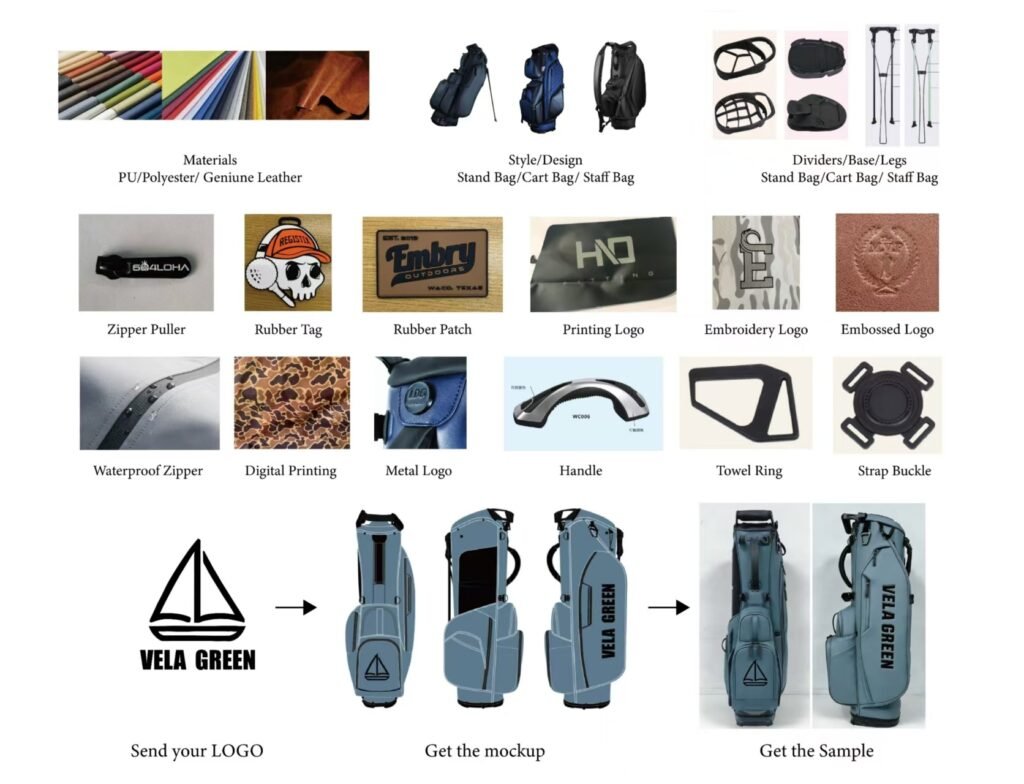
At Vela Green, we provide full-range OEM & ODM services for golf bags, golf headcovers, gloves, towels and other golf accessories. We support custom design, material selection, logo branding, color matching and mass production, strictly complying with CPSC, REACH and other international standards. With mature production experience, reliable quality control and professional export support, we help brands and importers develop market-oriented products with efficient lead times and flexible order quantities.