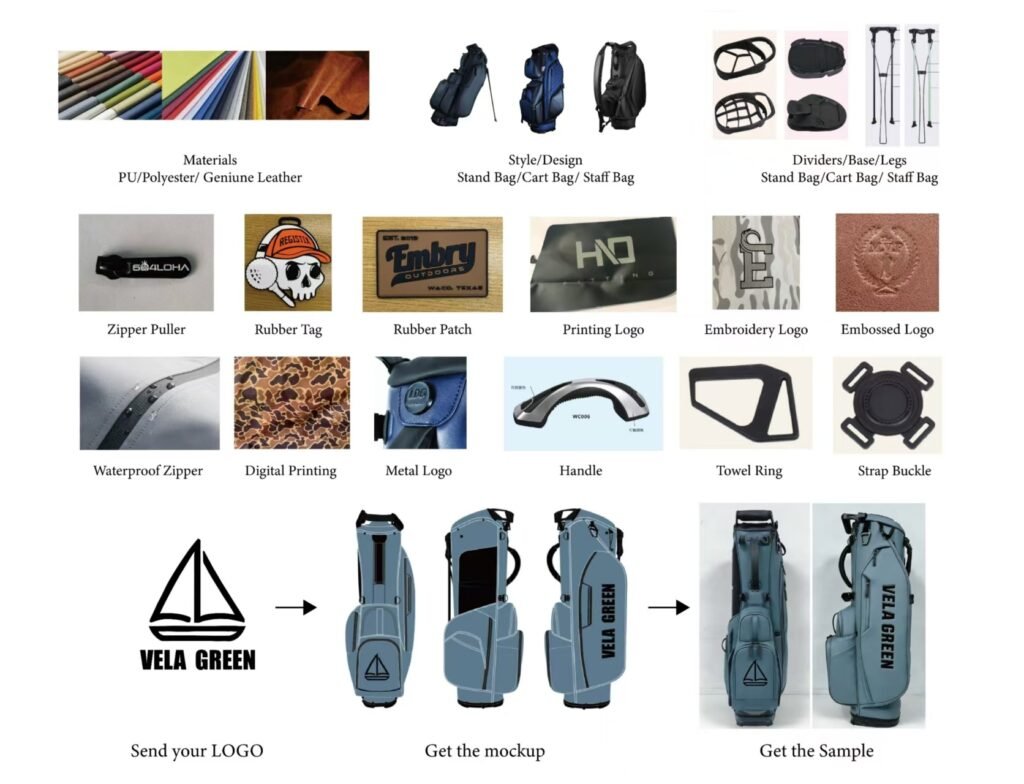
Great golf bag design can make your brand stand out on any course. Poor golf bag design leads to frustrated customers, costly returns, and damaged reputation. Many brands rush into production without validating their golf bag design against real-world use cases, only to discover fatal flaws after thousands of units are already in transit. This guide reveals seven costly golf bag design mistakes that B2B buyers make—and exactly how to avoid them, from initial sketches to final production.
Mistake #1: Ignoring the Golf Bag Design for Proper Club Protection
The single most important function of any golf bag design is protecting the clubs. Yet many brands prioritize external aesthetics over internal club protection, delivering bags that look beautiful but fail at their primary purpose.
What to Check in Your Golf Bag Design for Club Protection:
- Dividers: A proper golf bag design requires individual full-length dividers (14-way is ideal). Partial dividers allow club heads to tangle and shafts to rub against each other, causing visible wear after just a few rounds.
- Padding thickness: Dividers need at least 3–5mm of closed-cell EVA foam to cushion club shafts. Without adequate padding, graphite shafts in particular can develop stress fractures.
- Base reinforcement: The bottom of the club compartment must be reinforced. A weak base allows club heads to hit the ground when the bag is set down, damaging both clubs and bag structure.
The best golf bag design for club protection includes a reinforced, padded bottom and full-length dividers that extend completely to the base. Validate your golf bag customization by loading a sample with a full set of clubs (including driver, fairway woods, hybrids, and putter) and walking 18 holes before approving production.
Mistake #2: Overlooking Strap Ergonomics in Golf Bag Design
A bag that is painful to carry will never earn customer loyalty. Golf bag design for walking golfers must prioritize strap comfort and weight distribution.
Critical Golf Bag Design Elements for Straps:
- Padding: Straps require high-density memory foam at least 10–12mm thick. Thin padding compresses completely under load, transferring all pressure to the shoulder.
- Shape: Contoured S-curve straps distribute weight more evenly across the shoulder and chest than straight straps. The top curve should sit behind the neck, while the bottom curve wraps under the arm.
- Dual-strap configuration: For stand bags, proper golf bag design requires a balanced dual-strap system where each strap attaches to opposite sides of the bag. When worn, the bag should sit centered on the back, not tilted to one side.
- Adjustability: Buckles and sliders must operate smoothly under load. Test by loosening and tightening the straps with a fully loaded bag—if adjustment is difficult or slips during walking, the design needs revision.
Walk at least one mile with your sample before approving golf bag design. Pay attention to pressure points, strap slippage, and whether the bag bounces excessively with each step.
Mistake #3: Neglecting Pocket Functionality in Golf Bag Design
Pockets look simple but are a common failure point in golf bag design. Poor pocket placement, insufficient capacity, or weak closures turn a functional bag into a daily frustration.
Golf Bag Design Pocket Requirements:
- Accessibility: Pockets on the front of a cart bag should be accessible while the bag is strapped to a cart. Pockets on a stand bag must not interfere with the stand mechanism when deployed.
- Capacity: A dedicated water bottle pocket must fit standard 20oz or larger bottles. A cooler pocket requires at least 6–8 liters of insulated capacity. A valuables pocket needs a soft-lined interior (velour or similar) and a secure closure.
- Closure durability: Zippers on high-use pockets (ball pocket, accessory pocket) require self-healing YKK zippers with corrosion-resistant sliders. Avoid plastic zippers on weight-bearing pockets—they fail under tension.
- Seam reinforcement: Pocket attachment points must be bar-tacked, not simply backstitched. Bar tacking uses multiple zigzag stitches to distribute load and prevent tearing.
Mistake #4: Choosing the Wrong Materials in Golf Bag Design
Material selection is the most visible element of golf bag design—and the easiest to get wrong. Common material mistakes include:
- Using 420D nylon on high-wear areas: 420D nylon is appropriate for lightweight Sunday bags or accent panels. For a stand bag or cart bag that will be set down on concrete, loaded repeatedly, and dragged across parking lots, 1680D ballistic nylon is the minimum standard. The base of the bag—which contacts the ground most frequently—should use at least 900D material or reinforced TPU rubber.
- Selecting PU leather without considering climate: PU leather looks premium but cracks over time if not conditioned. For bags destined for hot, dry climates (Arizona, Spain, Australia), specify automotive-grade or marine-grade PU with UV stabilizers and higher flexibility ratings.
- Ignoring zipper quality: The difference between a $0.50 zipper and a $2.00 YKK Vislon zipper determines whether pockets function for one season or five. Test every zipper on the sample at least 100 cycles.
Mistake #5: Failing to Test Stand Mechanism in Golf Bag Design
For stand bags, the stand mechanism is the most mechanically complex part of golf bag design. A poorly designed stand leads to legs that won’t deploy, don’t retract, or collapse under weight.
Stand Mechanism Golf Bag Design Testing:
- Deployment: Legs should extend smoothly when the bag is tilted. No sticking, grinding, or hesitation.
- Locking: Once deployed, the stand must lock firmly. Apply downward pressure—the stand should not collapse.
- Retraction: When the bag is lifted, legs should retract fully and quickly. Slow or partial retraction creates tripping hazards.
- Durability: The mechanism should survive 3,000+ cycles without failure. Ask your manufacturer for test data or run your own test on the sample.
Mistake #6: Ignoring Weight Distribution in Golf Bag Design
Poor weight distribution is a subtle but critical flaw in golf bag design. A bag that feels balanced when empty can become uncomfortable or unstable once loaded.
Golf Bag Design Weight Distribution Checklist:
- Stand bags: The heaviest clubs (driver, fairway woods) should sit at the top of the bag, closest to the shoulders when worn. Heavier items (water bottle, rangefinder) should be in lower pockets to keep center of gravity low.
- Cart bags: Pockets should be distributed on both sides of the bag to prevent tipping on uneven ground. The putter well should be easily accessible from the side, not the front.
- Travel bags: Reinforcement should be concentrated at the top (club head area) and bottom (wheel or handle attachment points).
Load your sample with a full set of clubs, 14 balls, a water bottle, and accessories before approving golf bag design. Walk with it (for stand bags) or mount it on a cart (for cart bags). Adjust pocket or divider layout if the bag feels unbalanced.
Mistake #7: Forgetting About Manufacturing Constraints in Golf Bag Design
The most beautiful golf bag design in the world is worthless if it cannot be manufactured consistently and cost-effectively. Many brands design in a vacuum, then struggle to find a factory willing or able to produce their vision.
Design for Manufacturing in Golf Bag Design:
- Curves and contours: Sharp curves and tight radii are difficult to sew consistently. Specify minimum bend radius of 20mm for fabric panels.
- Material compatibility: Laminating fabric to foam requires specialized equipment. Confirm your custom golf bag factory has the capability before designing complex quilted or padded panels.
- Hardware availability: Custom-molded hardware (branded zipper pulls, custom feet, proprietary clips) requires mold tooling costing $1,000–$5,000 per part. Use standard hardware where possible for lower MOQ and faster production.
- Embroidery limitations: Small or highly detailed logos may not stitch clearly at size. Provide your OEM design process partner with vector artwork and discuss minimum size requirements before committing.
Always involve your golf bag design factory early in the process. A good golf bag customization partner can flag manufacturing issues before you invest in full samples and tooling.
The Golf Bag Design Process: From Concept to Production
Avoiding the seven mistakes above requires a structured golf bag design process. Here is the industry-standard workflow:
Phase 1: Concept Development
Define the bag type (stand, cart, tour, travel, junior), target price point, required features, and aesthetic direction. Create a design brief with dimensions, divider configuration (4-way, 6-way, 14-way), pocket count and locations, and material preferences.
Phase 2: Technical Drawing and CAD
Work with your manufacturer‘s design team to produce detailed technical drawings. Specify every dimension, material callout, stitch type, and hardware location. Review and revise until the golf bag design matches your vision exactly.
Phase 3: Material Selection and Sourcing
Review material swatches from the factory’s library. For custom colors, provide Pantone codes. Allow 2–3 weeks for custom-dyed fabric or custom-molded hardware. Confirm REACH, Prop 65, or other compliance requirements at this stage.
Phase 4: Sample Production
The factory produces a pre-production sample (PPS). Test the sample thoroughly using all the criteria above—club protection, strap ergonomics, pocket functionality, stand mechanism, weight distribution. Expect 1–3 sample rounds before final approval.
Phase 5: Pilot Run
Before committing to full bulk production, consider a pilot run of 50–200 units. This validates that production processes can consistently replicate the approved sample.
Phase 6: Bulk Production and QC
Only after pilot run approval should you proceed to full production with AQL-based quality control at every stage.
Golf Bag Design Checklist for B2B Buyers
Use this checklist when reviewing any golf bag design:
| Design Element | Pass | Fail |
|---|---|---|
| Full-length dividers (14-way preferred) | ☐ | ☐ |
| Dividers padded with 3–5mm EVA foam | ☐ | ☐ |
| Reinforced bag base | ☐ | ☐ |
| Contoured, padded straps (10–12mm foam) | ☐ | ☐ |
| Dual-strap balanced attachment | ☐ | ☐ |
| YKK zippers on all pockets | ☐ | ☐ |
| Bar-tacked pocket seams | ☐ | ☐ |
| Insulated cooler pocket (if specified) | ☐ | ☐ |
| Stand mechanism cycles 3,000+ times | ☐ | ☐ |
| Weight distribution balanced when loaded | ☐ | ☐ |
| Material durability verified (1680D minimum on wear areas) | ☐ | ☐ |
| Compliance documentation available (REACH, Prop 65) | ☐ | ☐ |
Case Study: How a Brand Saved $50,000 by Fixing Golf Bag Design Early
A mid-sized golf accessories brand approached a manufacturer with a golf bag design featuring custom-molded feet and a proprietary stand mechanism. The factory flagged that the mold tooling would cost $4,500 per part and take 25 days—plus the stand mechanism had not been tested for durability.
Rather than approving the golf bag design as proposed, the brand worked with the factory to substitute standard feet (saving $4,500) and modify the mechanism using proven components. The revised golf bag design also added full-length dividers and reinforced strap padding based on the factory‘s recommendations.
The result: a $50,000 savings on tooling and rework, production lead time reduced from 90 to 55 days, and a final product with zero design-related returns in the first season. The investment in golf bag design validation paid for itself many times over.
Conclusion: Master Golf Bag Design for Brand Success
A well-executed golf bag design protects clubs, pleases customers, and builds brand loyalty. A flawed design leads to returns, negative reviews, and lost sales. By avoiding the seven mistakes outlined in this guide—poor club protection, weak strap ergonomics, dysfunctional pockets, wrong materials, untested stand mechanisms, imbalanced weight distribution, and ignoring manufacturing constraints—you ensure your golf bag design delivers on every promise.
The best golf bag design results from close collaboration between your brand and an experienced manufacturer. Start with a clear brief, test samples rigorously, and always design with manufacturing realities in mind.
*With 20 years of golf bag design and manufacturing experience, we help B2B clients avoid these costly mistakes. Our in-house design team provides free consultations on your golf bag design, including material selection, durability testing, and design-for-manufacturing optimization. Contact us to start your custom golf bag project.*
OEM & ODM Service
Whether you’re planning to build your own brand, develop new products, or find a stable manufacturing partner for the US and European markets, working with a professional OEM & ODM factory can significantly improve your product quality and market competitiveness.
At Vela Green, we provide full-range OEM & ODM services for golf bags, golf headcovers, gloves, towels and other golf accessories. We support custom design, material selection, logo branding, color matching and mass production, strictly complying with CPSC, REACH and other international standards. With mature production experience, reliable quality control and professional export support, we help brands and importers develop market-oriented products with efficient lead times and flexible order quantities.