For B2B golf bag buyers, understanding golf bag Incoterms is just as important as understanding product quality and pricing. Incoterms (International Commercial Terms) are the globally recognized rules published by the International Chamber of Commerce (ICC) that define who pays for shipping, insurance, customs clearance, and at what point risk transfers from seller to buyer. A common mistake in the bag and luggage industry is comparing quotations without comparing the same delivery responsibility. The lowest quotation is not always the lowest landed cost.
This guide breaks down the four most critical golf bag Incoterms—EXW, FOB, CIF, and DDP—and explains which one makes sense for your sourcing strategy.
EXW (Ex Works): Maximum Buyer Control, Maximum Buyer Responsibility
EXW is often the lowest factory price you will see, but it comes with maximum responsibility. Under EXW, the seller simply makes the goods available at their factory or warehouse-. The buyer arranges everything from that point forward: pickup, export clearance, inland transport to the port, international freight, import clearance, and delivery.
What EXW Means for Golf Bag Importers
- Seller responsibility: Pack goods and make them available at the factory
- Buyer responsibility: Everything else—truck loading, export customs, inland transport, international freight, import duties, insurance
- Risk transfer: At the seller’s premises
- Best for: Buyers with their own logistics agents in China
- Risk level for buyers: HIGH—you handle everything including Chinese export clearance
For a 500-unit golf bag order, choosing EXW may save a few dollars per bag on the factory quote. But unless you have a freight forwarder who can handle Chinese export documentation, inland haulage, and customs clearance, those savings will be erased by coordination costs and delays. EXW is typically recommended only for experienced importers who have local agents in Guangdong or Fujian.
FOB (Free On Board): The Industry Standard for Golf Bag Imports
FOB is the most widely used golf bag Incoterm for ocean freight shipments from China-. Under FOB, the seller delivers the goods on board the vessel at the named port of shipment (e.g., FOB Shenzhen, FOB Xiamen)-. Once the goods are on board, risk and cost transfer to the buyer.
What FOB Means for Golf Bag Importers
- Seller responsibility: Pack goods, deliver to port, load on vessel, handle export clearance
- Buyer responsibility: International freight, insurance, import clearance, import duties, delivery to warehouse
- Risk transfer: When goods are loaded on the vessel at the named port
- Best for: Bulk ocean freight, standard container shipments
- Risk level for buyers: MODERATE—you control freight and insurance but seller handles export
For 2025 China imports, FOB offers the best balance of cost control and compliance amid HS code changes. For a golf bag importer ordering 500–1,000 units, FOB allows you to negotiate your own freight rates, choose your insurance provider, and maintain control over the supply chain once the goods leave China. Ports like Xiamen and Shenzhen offer seamless sea freight integration, and most established Chinese suppliers have experience shipping globally under FOB terms-.
Important note: For container shipments, some experts recommend FCA (Free Carrier) instead of FOB. FCA is the recommended replacement for FOB for containerized cargo. However, FOB remains the dominant term in traditional China trade.
CIF (Cost, Insurance, and Freight): Simplicity That Hides Hidden Costs
CIF may seem like the easiest option—the seller handles shipping and insurance to the destination port. Under CIF, the seller pays for cost, insurance, and freight to the destination port. But the buyer still pays import duties, taxes, and destination charges.(golf bag Incoterms)
What CIF Means for Golf Bag Importers
- Seller responsibility: Pack goods, export clearance, ocean freight, basic insurance to destination port
- Buyer responsibility: Import clearance, import duties, destination port charges, inland delivery
- Risk transfer: When goods are loaded on the vessel (same as FOB)
- Best for: Small orders, buyers new to importing
- Risk level for buyers: MODERATE TO HIGH—seller may inflate freight costs
The problem with CIF for golf bag Incoterms is lack of control. The seller chooses the shipping line, negotiates the freight rate, and selects the insurance—often at marked-up prices. For a golf bag order, the difference between FOB and CIF can be significant, as the seller’s freight markup may be 15–30% above market rates.
DDP (Delivered Duty Paid): Maximum Seller Responsibility, Maximum Price
DDP places the maximum obligation on the seller-. The seller handles everything—export clearance, international freight, import clearance, import duties, and delivery to the buyer‘s door-. The buyer simply receives the goods.
What DDP Means for Golf Bag Importers
- Seller responsibility: Everything—export clearance, freight, insurance, import clearance, duties, taxes, delivery-
- Buyer responsibility: Unload goods
- Risk transfer: At the buyer’s door
- Best for: Buyers who want turnkey delivery with no logistics involvement-
- Risk level for buyers: LOW—seller bears all responsibility
DDP is buyer-friendly but carries high customs and tax risk for the seller if not handled properly. In the EU and US, DDP shipments expose sellers to potential customs holds, incorrect duty classification, and VAT surprises-. DDP pricing is typically 20–50% higher than DAP (Delivered at Place) because the seller must factor in duties, taxes, and compliance risk-.
For most golf bag importers, DDP is best reserved for small trial orders or buyers who lack customs clearance capability at the destination.
Golf Bag Incoterms: Comparison Summary
| Incoterm | Seller Responsibility | Buyer Responsibility | Best For |
|---|---|---|---|
| EXW | Goods at factory | Everything else | Experienced buyers with China agents |
| FOB | Export clearance, port loading | Freight, insurance, import | Standard ocean shipments (500+ units) |
| CIF | Freight + insurance to destination port | Import clearance, duties | Small orders, new importers |
| DDP | Door-to-door including duties | Unload goods | Trial orders, no logistics capability |
How to Choose the Right Golf Bag Incoterms
When selecting golf bag Incoterms for your next order, ask your supplier these questions:
- “What Incoterm and named place are included in this quotation?”
- “What costs are included—and what costs are excluded—from this price?”
- “Who handles export customs clearance? Who handles import clearance?”
Practical Recommendation
For most golf bag importers ordering 300–1,000 units via ocean freight, FOB offers the optimal balance. You control freight costs and insurance, while the supplier handles export clearance and port loading—the steps where they have local expertise. A Hong Kong exporter using FCA Shanghai to a US importer in 2025 saved 18% versus DDP, with on-time delivery and no disputes.
For trial orders under 100 units, EXW with a freight forwarder can work if you have logistics support in China. For buyers with no customs capability, DDP may be worth the premium despite higher costs.
Common Golf Bag Incoterms Mistakes to Avoid
| Mistake | Consequence | Solution |
|---|---|---|
| Comparing EXW vs FOB prices directly | Hidden costs not factored into comparison | Request all quotes on the same Incoterm basis |
| Choosing CIF thinking it includes all costs | Surprise duties and destination charges | Ask supplier to define excluded costs clearly |
| Using FOB for air freight | FOB is sea-only; FCA is for air | Match Incoterm to transport mode- |
| Not specifying exact port or place | Risk transfer point unclear | Specify “FOB Xiamen” not just “FOB” |
| Ignoring 2025 tariff and HS code changes | Unexpected duties, customs holds | Align Incoterms with current tariff compliance |
Conclusion: Master Golf Bag Incoterms for Smarter Sourcing
Understanding golf bag Incoterms is not just about shipping terminology—it is about protecting your margins. A $2 difference in ex-works price between suppliers can become a $5–8 difference in landed cost depending on the Incoterm chosen.
For most B2B golf bag buyers, FOB offers the best combination of cost control and supplier accountability. It is the industry standard for ocean freight from China, supported by established suppliers in Guangdong and Fujian-. When comparing supplier quotes, always ensure you are comparing the same Incoterm. And remember: the cheapest quotation is not always the lowest landed cost.
With 20 years of golf bag manufacturing experience and full-service shipping coordination under FOB, EXW, and CIF terms, we help B2B clients navigate every step of the import process. Contact us to discuss your Incoterm requirements and request a landed cost estimate.
OEM & ODM Service
Whether you’re planning to build your own brand, develop new products, or find a stable manufacturing partner for the US and European markets, working with a professional OEM & ODM factory can significantly improve your product quality and market competitiveness.
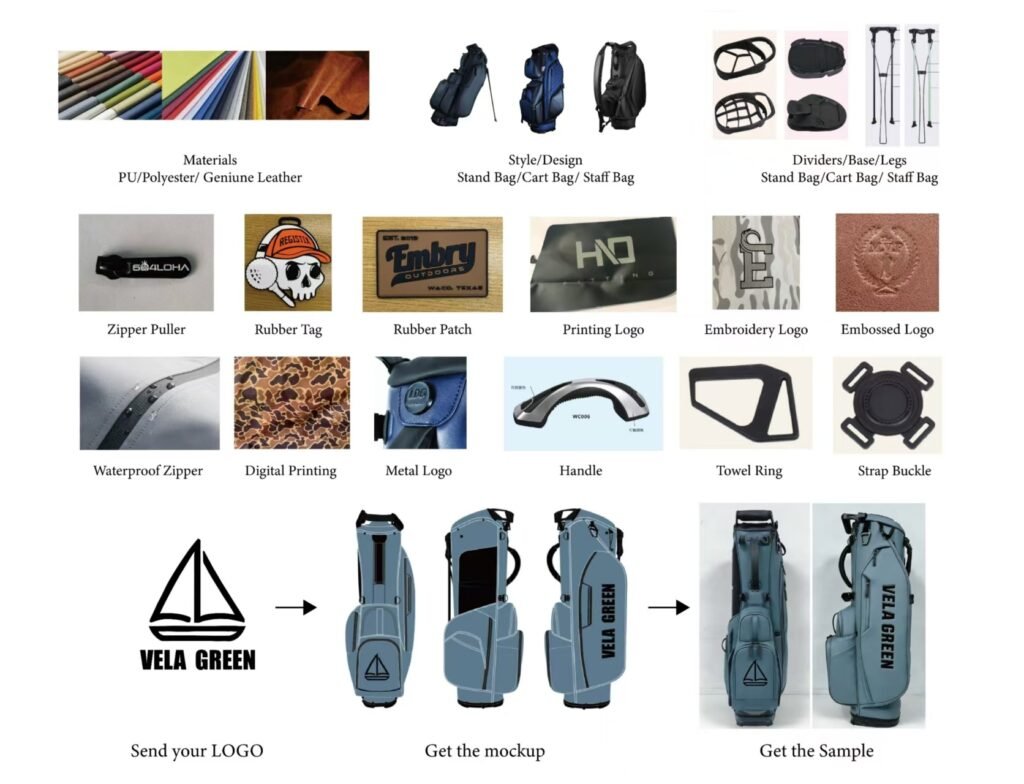
At Vela Green, we provide full-range OEM & ODM services for golf bags, golf headcovers, gloves, towels and other golf accessories. We support custom design, material selection, logo branding, color matching and mass production, strictly complying with CPSC, REACH and other international standards. With mature production experience, reliable quality control and professional export support, we help brands and importers develop market-oriented products with efficient lead times and flexible order quantities.