The global golf bag market growth story in 2026 is one of remarkable momentum. The global market for golf bags was estimated at US$1.1 billion in 2025 and is projected to reach US$1.9 billion by 2032, growing at a CAGR of 8.4%. This golf bag market growth is part of a broader surge in the golf equipment sector, which grew to an estimated $20.9 billion in 2026 and is predicted to reach $26.7 billion by 2031. For B2B buyers, understanding the engines behind golf bag market growth is essential for making informed sourcing decisions and capturing emerging opportunities.
This guide examines three key drivers fueling golf bag market growth in 2026: technology-enabled smart bags, surging golf participation, and the sustainability revolution reshaping materials and consumer expectations.
Engine #1: Smart Technology — The Acceleration of Golf Bag Market Growth
Perhaps the most transformative force in golf bag market growth is the integration of smart technology. The adoption of AI-driven technology has been identified as one of the most influential factors driving the projected rise of the golf equipment market. From the club-factory floor to the fairway, AI is reshaping how golfers interact with their equipment.
What Smart Features Are Driving Golf Bag Market Growth?
Club tracking systems using RFID technology keep track of clubs and alert golfers if any are left behind. Mobile app integration connects golf bags to smartphones for personalized statistics and course information. Biometric locking systems with fingerprint recognition offer security in 0.3 seconds, addressing the security anxieties of golfers carrying equipment worth tens of thousands of dollars. Built-in GPS units provide course maps and yardages without needing a separate device.
The 2026 PGA Show’s new product section featured smart equipment as the absolute star. Golf bags, as the golfer’s “mobile equipment depot,” have become a natural platform for this innovation. Smart modules such as GPS positioning and swing analysis are projected to achieve over 20% penetration in golf bags by 2028. Integrated smart golf bags can command prices 3 to 5 times higher than traditional products, driving industry average gross margins above 45%.
For B2B buyers, this golf bag market growth engine means sourcing partners with electronics integration capabilities. The smart golf bag segment is no longer a niche—it is becoming a baseline expectation for premium products.
Engine #2: Surging Golf Participation — The Foundation of Golf Bag Market Growth
The second major engine of golf bag market growth is unprecedented participation expansion. More than 160 million people worldwide played some form of golf in 2025, marking an almost 50% rise from 2023. The US alone is projected to pass 50 million participants across 2026. This surge in players directly translates into golf bag market growth, as every new golfer needs equipment—and as players advance, they upgrade their bags.
Demographic Shifts Reshaping Golf Bag Market Growth
The number of female golfers in the United States has grown significantly, reaching nearly 7.9 million in 2024, increasing from 20% in 2012 to 28% in 2024. Globally, Asia leads in engagement, with 26.2 million adults participating in golf as of 2023, and women accounting for 43% of off-course participants.
China is emerging as a pivotal growth engine, with the China Golf Association projecting golf participation to surpass five million registered players by 2025. The Asia-Pacific region is the fastest-growing regional market for golf equipment, projected to expand at a CAGR of approximately 7.2% through 2033.
This demographic transformation represents a critical structural shift influencing equipment demand. Manufacturers are developing gender-specific product lines and targeted marketing strategies. For B2B buyers tracking golf bag market growth, this means sourcing product lines tailored to these growing segments—lighter bags for female golfers, entry-level options for new players, and premium upgrades for the expanding mid-market.
Engine #3: Sustainability — The High-Margin Driver of Golf Bag Market Growth
The third engine of golf bag market growth is the sustainability revolution. Eco-friendly golf bag sales surged 145% from 2023 to 2025, with 78% of golfers factoring sustainability into their purchasing decisions.
How Sustainability Is Driving Golf Bag Market Growth
Recycled polyester (rPET) is a standout material in sustainable design, crafted from plastic bottles and textile waste. It reduces carbon emissions by 60% compared to nylon while maintaining durability and water resistance-. Switching to sustainable materials can slash the carbon footprint of a golf bag by up to 85%-.
Advanced bio-based materials are pushing the boundaries further. Sugarcane-based polyethylene removes CO₂ from the atmosphere during production. Algae-based polymers offer renewable, sturdy components. Recycled ocean plastics deliver 95% of the durability and 92% of the water resistance of new materials. These sustainable alternatives are proving that eco-friendly does not mean compromising performance.
Consumer willingness to pay is accelerating golf bag market growth. 65% of golfers are willing to pay a 15–20% premium for eco-friendly gear. 82% demand sourcing transparency, and 71% prefer repairable designs. Major manufacturers are integrating recycled and bio-based materials, aligning with the eco-conscious goals of prominent golf associations and course operators.
For B2B buyers, this golf bag market growth engine means prioritizing suppliers with GRS (Global Recycled Standard) certification, access to rPET and bio-based materials, and documented sustainability credentials. The premium consumers are willing to pay for sustainable products represents a direct margin opportunity.
What Golf Bag Market Growth Means for B2B Buyers
The three engines of golf bag market growth—smart technology, surging participation, and sustainability—point to a clear conclusion: the industry is evolving toward more technologically advanced, more inclusive, and more environmentally responsible products.
Actionable Takeaways
| Growth Engine | Sourcing Implication | Priority |
|---|---|---|
| Smart technology | Partner with suppliers experienced in electronics integration | High |
| Surging participation | Develop product lines for female, junior, and Asian markets | High |
| Sustainability | Require GRS certification and rPET/bio-based material options | Medium |
B2B Sourcing Priorities
- Evaluate smart feature capabilities. Ask suppliers about their experience with RFID tracking, GPS integration, and biometric locking. Smart bags command 3–5x price premiums.
- Develop demographic-specific product lines. Female participation has grown from 20% to 28% of US golfers. Asia-Pacific is the fastest-growing region.
- Incorporate sustainability criteria. GRS certification, rPET fabrics, and bio-based materials should be part of supplier scorecards. Consumers are willing to pay premiums for eco-friendly gear.
- Plan for premiumization. The market’s growth is not just in volume but in value—premium bags with smart features and sustainable materials capture higher margins.
Common Golf Bag Market Growth Sourcing Mistakes to Avoid
| Mistake | Consequence | Solution |
|---|---|---|
| Ignoring smart features | Missing the premium segment | Evaluate suppliers with electronics integration |
| One-size-fits-all product line | Losing growing demographic segments | Develop targeted lines for women and Asian markets |
| No sustainability requirements | Missing premium opportunities and regulatory compliance | Include GRS and rPET in supplier evaluation |
| Chasing volume without value | Lower margins, commodity positioning | Balance volume with premium features |
Conclusion: Capitalize on Golf Bag Market Growth in 2026
Golf bag market growth is being driven by three powerful engines: smart technology integration, surging global participation, and the sustainability revolution. The market is projected to grow from US$1.1 billion to US$1.9 billion by 2032. B2B buyers who align their sourcing strategies with these engines—partnering with suppliers who offer smart features, demographic-specific products, and sustainable materials—will capture disproportionate share of this growth.
The brands that master these golf bag market growth drivers today will be the ones leading the market tomorrow. The opportunity is clear: innovate, include, and sustain.
With 20 years of golf bag manufacturing experience and capabilities spanning smart feature integration, demographic-specific product development, and GRS-certified sustainable materials, we help B2B clients capture golf bag market growth. Contact us to discuss how our capabilities align with your 2026 sourcing strategy.
OEM & ODM Service
Whether you’re planning to build your own brand, develop new products, or find a stable manufacturing partner for the US and European markets, working with a professional OEM & ODM factory can significantly improve your product quality and market competitiveness.
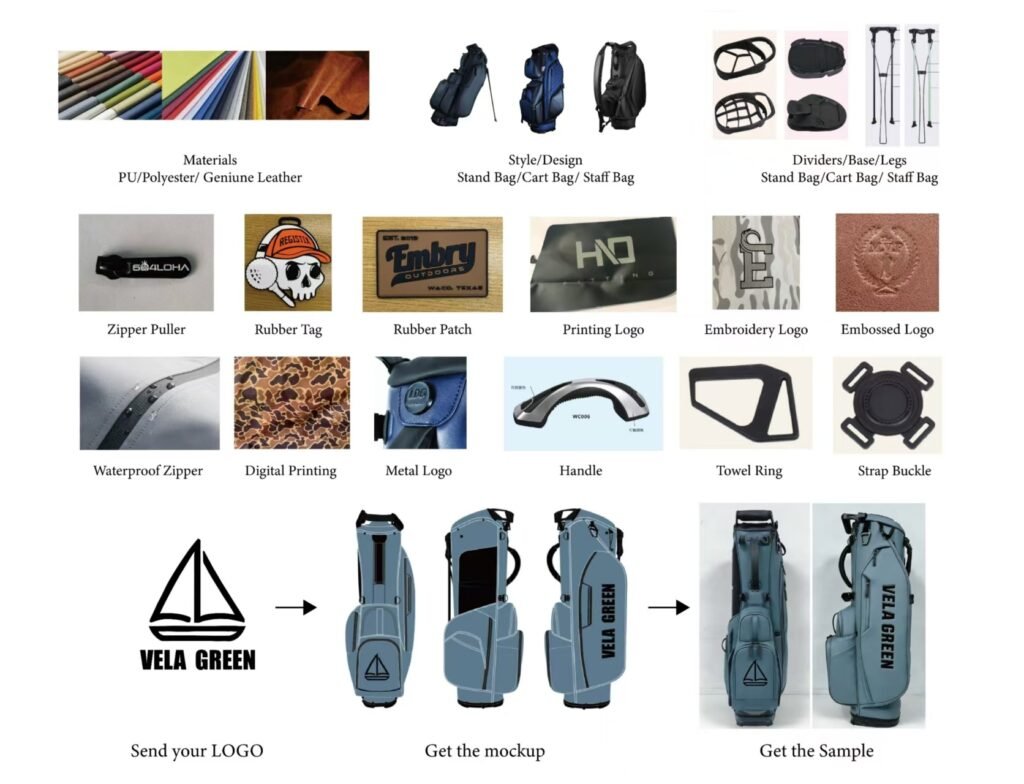
At Vela Green, we provide full-range OEM & ODM services for golf bags, golf headcovers, gloves, towels and other golf accessories. We support custom design, material selection, logo branding, color matching and mass production, strictly complying with CPSC, REACH and other international standards. With mature production experience, reliable quality control and professional export support, we help brands and importers develop market-oriented products with efficient lead times and flexible order quantities.