For B2B buyers sourcing golf bags from overseas manufacturers, golf bag quality control is the single most important factor separating profitable orders from costly disasters. The global golf bag market is projected to grow from USD 1.43 billion in 2025 to USD 1.75 billion by 2031. Yet without rigorous golf bag quality control, that growth opportunity can quickly become a liability when defective products reach your customers.
This guide outlines five critical golf bag quality control inspection points that every B2B buyer should verify before approving bulk production.
Why Golf Bag Quality Control Is Non-Negotiable in 2026
The stakes for golf bag quality control have never been higher. In 2026, fading and yellowing are among the most common quality complaints for outdoor golf bags-. Zipper failures and fraying seams have been reported on premium bags within months of purchase-. Customers are increasingly vocal about quality issues, and negative reviews spread fast.
A single defective shipment can cost you thousands in returns, replacement shipping, and lost customer trust. Effective golf bag quality control catches these issues before they leave the factory — protecting your margins and your brand reputation.
Inspection Point #1: Material Quality and Durability Testing
The foundation of any golf bag quality control program is material verification. Top-tier golf bags in 2026 require specific performance benchmarks:
Key Material Tests for Golf Bag Quality Control
Water resistance is critical. Premium bags must withstand rain and moisture. Industry benchmarks require hydrostatic pressure ≥10,000mm H₂O and IPX7-level immersion testing. Many bags rely on DWR coatings that degrade after 1-2 seasons. Your golf bag quality control process should verify waterproofing through standardized spray testing.
UV stability prevents fading and material degradation. Quality bags must maintain color retention ≥85% after prolonged outdoor exposure. Without proper UV testing, fabrics can fade or become brittle after just one season.
Abrasion resistance ensures durability. Leading manufacturers achieve 10,000+ Martindale abrasion cycles without damage. Cheap materials may fail at 5,000 cycles, leading to premature wear.
Tear strength is essential for longevity. Top products maintain 12.7kg tear strength while keeping weight under 1.8kg. Your golf bag quality control should verify that materials meet these standards.
Inspection Point #2: Stitching and Seam Integrity
Stitching quality is one of the most visible indicators of overall golf bag quality control. Poor stitching leads to returns and damaged reputation.
What to Check in Golf Bag Quality Control
Seam alignment is critical. Misaligned seams suggest rushed assembly and poor quality control. Template-based cutting can achieve precision within 1mm and reduce fabric waste by up to 15%.
Stitch consistency matters. A complete golf bag quality control inspection checks for uniform stitch density, no skipped stitches or loose threads, and reinforced bar-tacking at stress points. Forceful pull tests on strap attachments and handle connections can reveal weaknesses before bulk production.
Stress point reinforcement prevents failure. High-wear areas like strap attachments, pocket corners, and handle bases require reinforced stitching. This is non-negotiable in professional golf bag quality control.
Inspection Point #3: Hardware and Component Functionality
Hardware failure is one of the most common complaints in golf bag reviews-. Your golf bag quality control process must include thorough hardware testing.
Hardware Tests in Golf Bag Quality Control
Zipper function is critical. Test each zipper through 5–10 open/close cycles to ensure smooth operation. Check for teeth alignment, slider function, and fabric catching. Zipper failure is a major source of customer complaints-.
Stand mechanism for stand bags requires testing: multiple deployment and retraction cycles, stability on flat and sloped surfaces, and locking function with weight applied.
Strap and buckle systems need verification: smooth length adjustment, secure locking and quick release, and connection strength under load.
Inspection Point #4: Appearance and Workmanship
Appearance defects are the most visible failures in golf bag quality control. They damage brand perception even if the bag functions perfectly.
Appearance Checks in Golf Bag Quality Control
Overall shape and symmetry: The bag should stand upright without sagging or distortion.
Cleanliness: No glue stains, oil marks, pen marks, or dust.
Color consistency: Colors must match the approved sample with no batch-to-batch variation.
Printing and embroidery: Logos should be clear and correctly positioned, with embroidery firmly attached.
Adhesive bonds: All glued areas must be secure with no peeling or delamination.
Inspection Point #5: Packaging and Labeling
The final step in golf bag quality control is verifying packaging and labeling. Even perfect bags can be damaged by poor packaging.
Packaging Checks for Golf Bag Quality Control
Individual bag protection: Each bag should be in a polybag to prevent dust and moisture damage.
Carton integrity: Master cartons must be strong enough for stacking — container shipments stack boxes 8–10 high.
Labeling accuracy: Verify barcode labels, color/SKU stickers, country of origin tags, and care instructions.
Implementing Golf Bag Quality Control: A Practical Framework
Professional golf bag quality control follows a three-stage approach:
Stage 1: IQC (Incoming Quality Control)
Inspect all materials before production — fabric, zippers, hardware, foam. This catches defects before they enter production.
Stage 2: IPQC (In-Process Quality Control)
Random checks during assembly. Verify stitch quality, seam alignment, hardware installation. The first-article inspection ensures the first unit matches the golden sample exactly.
Stage 3: PSI (Pre-Shipment Inspection)
Final 100% visual inspection before packing. Use AQL (Acceptable Quality Level) Level II, 2.5/4.0 standards — the industry benchmark for golf bag quality control-. Appearance defects use AQL 2.5; functional defects (broken zippers, failed stands) use AQL 1.5 or 0-.
The Business Case for Rigorous Golf Bag Quality Control
Investing in golf bag quality control protects your margins. A $1 increase in QC cost per unit can save $5–10 in returns, replacements, and customer dissatisfaction. Top manufacturers with ISO9001 certification achieve batch pass rates above 99.5% and client reorder rates of 70%.
The brands that prioritize golf bag quality control build reputations for reliability. Those that skip it compete on price alone — and lose.
With 20 years of golf bag manufacturing experience and a multi-stage quality control system — IQC, IPQC, and PSI with AQL standards — we help B2B clients protect their brands through rigorous quality assurance. Contact us to discuss your quality control requirements.
OEM & ODM Service
Whether you’re planning to build your own brand, develop new products, or find a stable manufacturing partner for the US and European markets, working with a professional OEM & ODM factory can significantly improve your product quality and market competitiveness.
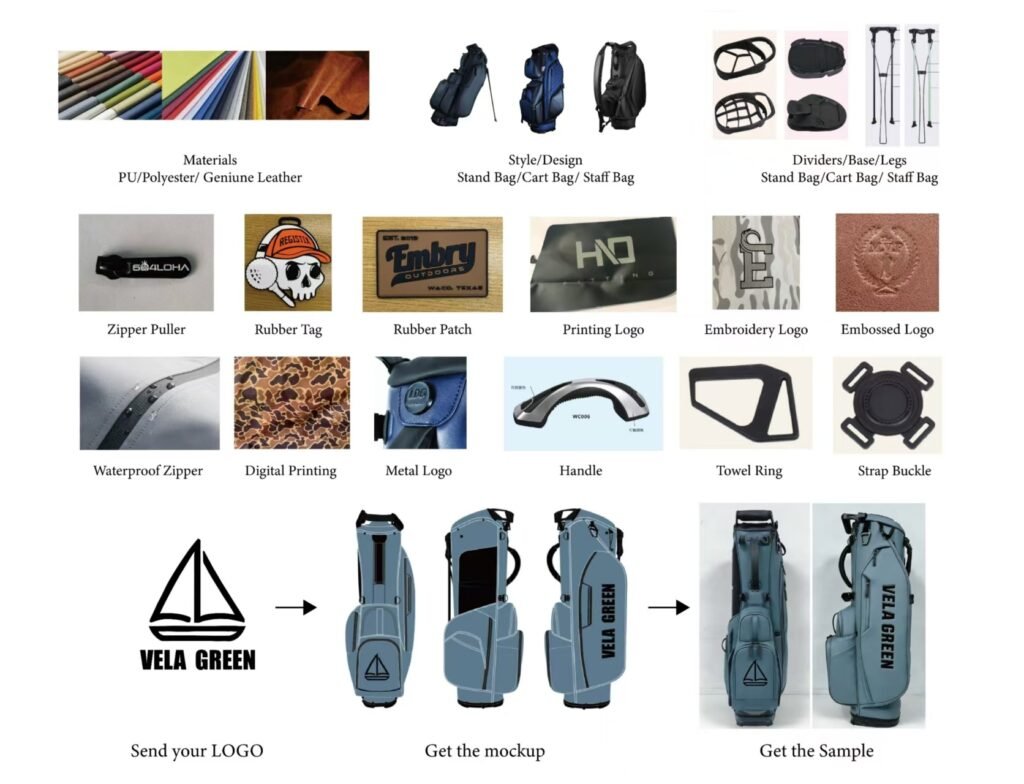
At Vela Green, we provide full-range OEM & ODM services for golf bags, golf headcovers, gloves, towels and other golf accessories. We support custom design, material selection, logo branding, color matching and mass production, strictly complying with CPSC, REACH and other international standards. With mature production experience, reliable quality control and professional export support, we help brands and importers develop market-oriented products with efficient lead times and flexible order quantities.