Golf Bags B2B: How to Choose Golf Bags for Different Shipping & Resale Scenarios 2026 is a critical decision-making skill for every global golf equipment wholesaler, Amazon/e-commerce reseller, and bulk procurement manager in 2026. Most B2B buyers only focus on golf bag styles and unit prices when sourcing, while ignoring shipping adaptability and resale scenario matching. This common mistake leads to high shipping costs, container space waste, in-transit damage, slow inventory turnover, and low resale profit margins. This comprehensive B2B guide explains how to select the right golf bag types, structures, and packaging solutions to fit different shipping methods and target resale markets, helping suppliers cut logistics costs and maximize retail conversion.
The profitability of B2B golf bag wholesale business depends not only on product quality but also on scenario matching capabilities. Different shipping scenarios—including sea freight, air freight, express delivery, and LCL shipping—require completely different golf bag designs and packaging standards. Meanwhile, offline pro shop resale, cross-border e-commerce resale, gift bulk sales, and club supporting sales have distinct product selection logic. Mastering how to match golf bags with shipping and resale scenarios allows B2B sellers to avoid inventory stagnation, reduce logistics loss, and build a high-profit, low-risk product line in 2026.
Why Scenario-Based Golf Bag Selection Matters for B2B Profitability
Many B2B golf bag wholesalers face hidden profit losses caused by mismatched product and shipping scenarios. Bulky staff bags ordered for air freight will generate huge volumetric weight surcharges; non-foldable rigid golf bags are prone to extrusion damage during LCL transportation; thick oversized products suitable for offline club sales cannot adapt to e-commerce small-package shipping rules. All these problems reduce overall profit margins and increase after-sales disputes.
In terms of resale scenarios, consumer demands vary greatly across sales channels. E-commerce customers prioritize lightweight, foldable, and easy-to-pack golf bags, while offline pro shop buyers prefer three-dimensional, high-texture display-style golf bags. Only by implementing scenario-based selection in B2B golf bag procurement can buyers achieve lower shipping loss, faster inventory turnover, and higher resale premiums.
How to Choose Golf Bags for Different B2B Shipping Scenarios
Shipping method is the primary factor determining golf bag style selection. Each logistics mode has strict restrictions on product volume, weight, hardness, and packaging. Below are targeted golf bag selection standards for mainstream B2B shipping scenarios.
1. Sea Freight & Full Container Load (FCL) Shipping
Sea freight FCL is the first choice for large-batch regular wholesale orders, featuring low unit logistics costs and large loading space. For this shipping scenario, B2B buyers can prioritize high-volume, high-texture, and multi-functional golf bags, including full-size cart bags, premium staff bags, and thickened travel golf bags. These bulky, high-value products will not cause excessive cost pressure under sea freight pricing rules and can maximize single-container order profits.
When selecting golf bags for sea freight, focus on structural compression resistance and stackable performance. Long-term container transportation and stacked storage require golf bags to have reinforced bottom structures and rigid support frameworks to avoid overall deformation. Meanwhile, customized outer carton packaging and bulk waterproof film wrapping are recommended to resist humid sea wind and container extrusion, ensuring intact product conditions for offline resale.
2. LCL Sea Freight & Bulk Consolidated Shipping
LCL shipping is suitable for small-batch mixed orders and new product trial sales. Due to mixed loading of diverse goods and frequent handling extrusion, fragile and non-compressible golf bags have high damage risks. For LCL scenarios, B2B buyers should avoid oversized hard staff bags and choose flexible, foldable, and compression-resistant golf bags such as lightweight stand bags and portable Sunday bags.
These golf bags feature foldable structures and flexible fabrics, which can save container space, reduce LCL volume charges, and effectively resist extrusion damage during mixed transportation. It is the most cost-effective product selection strategy for small-batch cross-border wholesale and multi-style mixed orders.
3. Air Freight & International Express Shipping
Air freight and DHL/FedEx express have strict volumetric weight calculation rules, making bulky products extremely costly. For urgent orders and small-batch sample shipments, lightweight, ultra-thin, and foldable golf bags are the only viable option. B2B buyers must select ultra-light stand bags, mini golf bags, and collapsible travel golf bags with compressible volume.
Avoid any golf bags with fixed hard supports, oversized frames, and thick cotton padding. Such products will lead to sky-high air freight fees and erode all profit margins. Golf bags customized for air shipping focus on lightweight fabric and detachable structures, balancing product usability and logistics cost control perfectly.
How to Choose Golf Bags for Different B2B Resale Scenarios
Matching golf bag styles with target resale channels is the core of improving inventory turnover and profit margins. Combined with actual B2B wholesale operation experience, we sort out professional selection standards for mainstream resale scenarios in European and American markets.
1. Cross-Border E-Commerce Resale (Amazon, Shopify, eBay)
E-commerce resale has strict requirements on product packaging size, weight, defect rate, and return rate. Consumers prioritize lightweight, easy-to-carry, versatile, and zero-damage products during transportation. For e-commerce store stocking, B2B buyers should focus on standardized lightweight stand bags, mini Sunday bags, and foldable travel golf bags.
These golf bags have unified specifications, low damage rates in long-distance transportation, and low after-sales complaint rates. Meanwhile, they meet the portable usage needs of mainstream amateur golfers, with wide audience coverage and fast sales speed. Avoid high-defect-rate staff bags and oversized cart bags that are not suitable for e-commerce small-package logistics.
2. Offline Pro Shop & Golf Course Resale
Physical pro shops and golf course retail focus on product display texture, high-end sense, and scenario matching. Customers are mostly high-spending golf enthusiasts and professional players, with low sensitivity to unit price but high requirements for product grade. For this resale scenario, B2B buyers need to stock full-size cart bags, premium leather staff bags, and multi-functional high-end travel bags.
These three-dimensional, well-structured golf bags have excellent display effects, can highlight brand grade, and support high retail premium pricing. Offline physical sales have no strict volume and weight restrictions, allowing full play to the advantages of high-end golf bags in texture and functionality, maximizing single-piece profit margins.
3. Corporate Gift & Promotional Bulk Resale
Corporate customized gifts and promotional activity sales focus on cost performance, high appearance consistency, and flexible customization. Suitable golf bag types include entry-level lightweight stand bags, conventional cart bags, and portable mini golf bags. These products have stable quality, low MOQ for private label customization, and moderate procurement costs, meeting large-batch gift order demands.
Gift-oriented golf bag selection prioritizes neat appearance, uniform color difference control, and durable basic performance, without pursuing excessive high-end functions, helping B2B buyers control overall order costs and win more customized bulk orders.
4. Golf Club Supporting & Training Institution Resale
Golf clubs and training institutions need durable, wear-resistant, and highly practical golf bags suitable for long-term repeated use by students and members. B2B selection should prioritize high-density fabric stand bags and wear-resistant cart bags with reinforced stitching, UV anti-aging, and waterproof functions. These products have long service life, low maintenance costs, and extremely low failure rates, perfectly matching the long-term use scenario of training institutions.
2026 B2B Golf Bag Scenario Matching Cheat Sheet
To help B2B buyers quickly complete accurate selection, we summarize the core matching rules ofgolf bags B2B for different shipping and resale scenarios:
- Large-Batch Sea FCL + Offline Resale: Full-size cart bags, premium staff bags, high-end travel bags
- Small-Batch LCL + E-Commerce Trial Sales: Foldable stand bags, mini Sunday golf bags
- Air Freight/Express + Sample & Urgent Orders: Ultra-light compressible golf bags with detachable structures
- Cross-Border E-Commerce Resale: Standard lightweight, low-defect, versatile golf bag series
- Corporate Gift Customization: Cost-effective customizable entry-level and mid-range golf bags
- Club & Training Institution Supply: High-durability, anti-aging, wear-resistant practical golf bags
Final Thoughts
In 2026’s competitive global golf wholesale market, pure price-based sourcing is no longer viable. Precise selection of Golf Bags B2B: How to Choose Golf Bags for Different Shipping & Resale Scenarios is the key to reducing logistics costs, lowering inventory risks, and improving resale profits. Every B2B wholesale buyer must match golf bag styles, structures, and specifications according to actual shipping methods and resale channels to achieve low-risk, high-return sustainable wholesale business growth.
OEM & ODM Service
Whether you’re planning to build your own brand, develop new products, or find a stable manufacturing partner for the US and European markets, working with a professional OEM & ODM factory can significantly improve your product quality and market competitiveness.
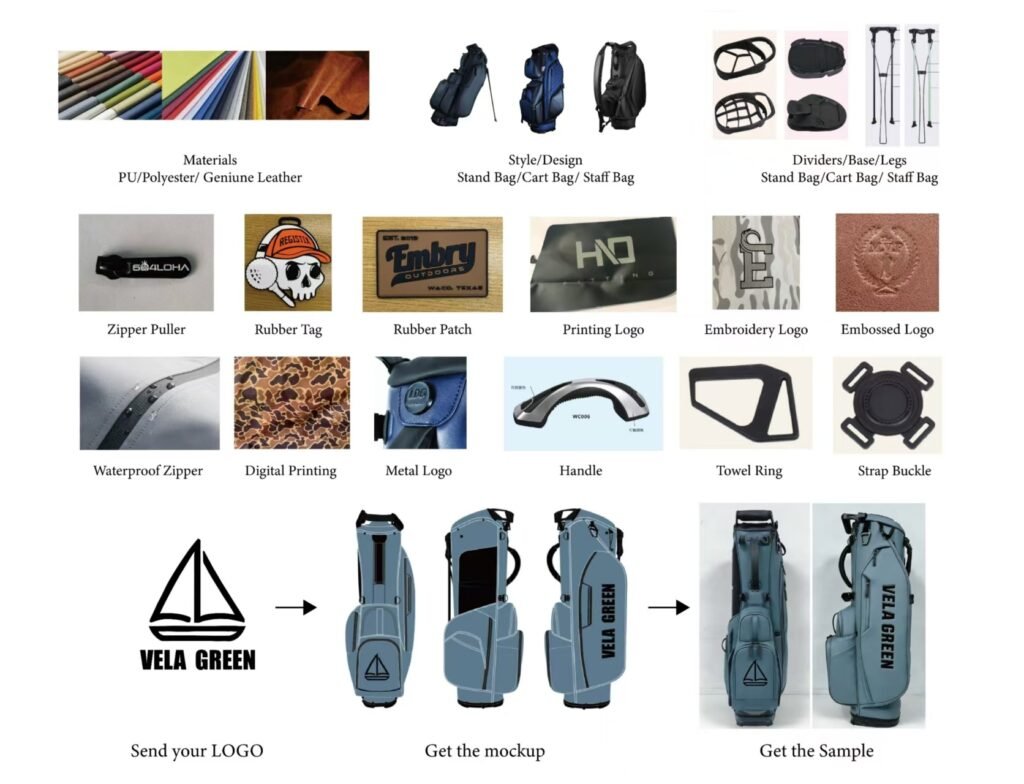
At Vela Green, we provide full-range OEM & ODM services for golf bags, golf headcovers, gloves, towels and other golf accessories. We support custom design, material selection, logo branding, color matching and mass production, strictly complying with CPSC, REACH and other international standards. With mature production experience, reliable quality control and professional export support, we help brands and importers develop market-oriented products with efficient lead times and flexible order quantities.