
For golf brand owners and distributors, balancing production costs and product quality is a constant challenge. Reducing costs is essential to improving profit margins and competitiveness, but it should never come at the expense of quality— poor-quality golf bags will damage your brand reputation and lose customers in the long run. The good news is that there are several practical ways to reduce golf bag production costs without sacrificing quality, especially when working with a professional manufacturer. In this article, we’ll share 5 key tips to help you optimize costs and maximize profits.
Optimize material selection to balance cost and quality. The material of a golf bag is one of the biggest contributors to production costs— so choosing the right material can significantly reduce costs without compromising quality. For example, instead of using high-cost full-grain leather, you can use PU leather (which has a similar appearance to leather but is much cheaper) for mid-range products. For nylon or polyester bags, choose a medium-density fabric (instead of high-density) for casual golf bags— it’s still durable but more affordable. Additionally, work with your manufacturer to source materials in bulk— they often have long-term relationships with suppliers and can get better prices, which can be passed on to you. Avoid over-specifying materials (e.g., using water-resistant fabric for products that don’t need it) to save unnecessary costs.
Increase order quantity to get bulk discounts. Most golf bag manufacturers offer bulk discounts for large orders— the more you order, the lower the unit cost. This is because manufacturers can optimize the production process, reduce setup costs, and source materials in larger quantities when handling large orders. If you have a stable market demand, consider increasing your order quantity to take advantage of bulk discounts. For example, if your usual order is 500 units, increasing it to 1000 units may reduce the unit cost by 10-15%. If you’re worried about stock, you can split the order into multiple shipments (e.g., 500 units now, 500 units in 2 months) to avoid overstocking while still getting the bulk discount.
Simplify design and functionality to reduce production complexity. Complex designs and excessive functionality can increase production costs— more seams, more hardware, and more customization details require more labor and materials. To reduce costs, simplify your golf bag design without losing key functionality. For example, instead of having 10 pockets, keep 5-6 essential pockets (for clubs, balls, valuables, etc.). Avoid unnecessary decorative details (such as complex embroidery or metal accents) that add to the cost but don’t improve performance. For OEM orders, work with your manufacturer to optimize the design for production— they can suggest changes (such as simplifying seams) that reduce costs while maintaining the design’s integrity.
Choose the right production location and manufacturer. The production location affects labor and material costs— manufacturers in regions with lower labor costs (such as China) can offer more competitive prices than those in Western countries. However, it’s important to choose a manufacturer with strict quality control to ensure the products meet your standards. Working with a direct manufacturer (instead of a middleman) can also reduce costs— middlemen add a markup, which increases your production costs. A direct manufacturer can also provide personalized support and cost-saving suggestions, as they have full control over the production process.
Optimize packaging and shipping to reduce logistics costs. Packaging and shipping are often overlooked but can add significant costs to production. To reduce packaging costs, use simple, lightweight packaging materials (such as poly bags or cardboard boxes) that still protect the product. Avoid over-packaging (e.g., using large boxes for small bags) to save on material and shipping costs. For shipping, work with your manufacturer to choose the most cost-effective logistics option— for example, sea freight is cheaper than air freight for large orders, even though it takes longer. Additionally, consolidate multiple orders into one shipment to reduce shipping costs per unit.
In summary, reducing golf bag production costs requires a combination of material optimization, order quantity management, design simplification, and logistics optimization. By following these tips and working with a reliable manufacturer, you can reduce costs without sacrificing quality— improving your profit margins and competitiveness in the global golf market. As a professional golf bag manufacturer, we are committed to helping our partners optimize costs and achieve their business goals. Contact us today to discuss how we can help you reduce production costs for your golf bags.
Whether you’re planning to launch your own golf product line, upgrade existing designs, or find a stable manufacturing partner for the US and European markets, working with a professional OEM & ODM factory can greatly improve your product quality and brand competitiveness.
At Vela Green, we specialize in full-range OEM & ODM services for golf bags, golf headcovers, gloves, towels and other golf accessories. We support custom design, material selection, logo branding, color matching and mass production, strictly following CPSC, REACH and other international compliance standards. With mature production experience, stable quality control and professional export support, we help brands and importers develop reliable, market-oriented golf products with efficient lead times and flexible order quantities.
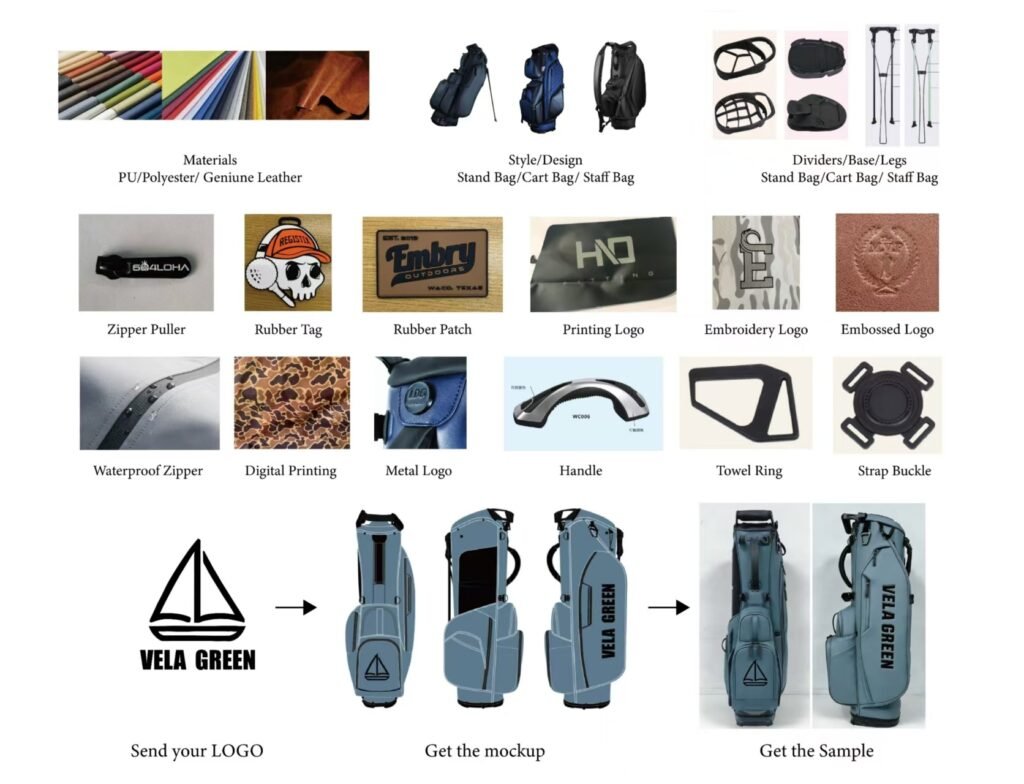
Feel free to contact us today for a custom solution or detailed quotation.