
Learning how to reduce golf bag production costs without sacrificing quality is a core survival skill for global golf bag wholesalers, brand owners, and bulk procurement buyers. The golf equipment wholesale industry faces increasingly fierce price competition, rising raw material prices, and unstable shipping costs. Many B2B buyers fall into a dilemma: lowering procurement costs often leads to defective fabrics, poor craftsmanship, and higher after-sales returns, while high-quality customized golf bags come with excessive production expenses that compress profit margins. This professional 2026 B2B guide shares practical, factory-verified methods to cut golf bag manufacturing and bulk production costs effectively, while maintaining premium product quality, durability, and market competitiveness.
For long-term B2B wholesale business growth, cost reduction does not mean quality reduction. Blindly cutting material and craft costs will only damage brand reputation and cause continuous customer loss. Instead, scientific production optimization, reasonable structural adjustment, and standardized sourcing strategies can help buyers achieve a perfect balance between low production costs and high product quality, maximizing net profits in every bulk golf bag order.
Why Balancing Cost and Quality Matters for Golf Bag Bulk Orders
Golf bags are functional outdoor sports products that require strict durability, waterproof performance, structural stability, and wear resistance. Inferior cost-cutting measures such as thin fabrics, cheap hardware, simplified stitching, and insufficient inner support will directly lead to fabric tearing, zipper rusting, club compartment deformation, and water leakage problems. These quality issues trigger high return rates, negative reviews, and after-sales compensation losses, which are far more costly than the production savings gained.
On the contrary, mastering standardized cost control methods allows B2B buyers to reduce unnecessary redundant production expenses, retain core functional craftsmanship, and launch cost-effective high-quality golf bags. This balanced solution helps wholesalers gain price advantages in market competition while maintaining stable retail word-of-mouth.
Practical Ways to Reduce Golf Bag Production Costs Without Sacrificing Quality
All the following cost reduction strategies are verified by professional golf bag manufacturing factories. They avoid quality attenuation and focus on optimizing redundant production links, suitable for OEM, ODM, and stock bulk wholesale orders.
1. Optimize Fabric Selection Without Lowering Grade
Fabric cost accounts for 60% of the total production cost of golf bags. Many buyers blindly choose high-gram heavy fabrics for all styles, causing unnecessary cost waste. The scientific solution is classified fabric matching: adopt standard 420D/600D high-density polyester fabric for daily retail stand bags and cart bags, which balances waterproof and wear-resistant performance with low cost. For high-end professional bags, use upgraded composite fabrics only for stress-bearing and outer surfaces, and match qualified conventional fabrics for inner lining and hidden parts. This targeted fabric collocation cuts redundant material costs while ensuring overall durability.
2. Simplify Redundant Functional Structures
Many customized golf bags are equipped with over-designed redundant functions that end consumers do not actually use, increasing stitching, assembly and material costs. B2B buyers can remove unnecessary decorative pockets, extra decorative stitching, and non-essential hardware accessories according to market positioning. Retain core functions including club divider systems, waterproof performance, wearable bottom pads, and adjustable shoulder straps. Simplifying over-designed structures will not affect product quality but effectively reduce manual and material consumption.
3. Standardize Customization to Avoid Modification Costs
Temporary repeated modifications, personalized trivial adjustments, and non-standard customized details are the main causes of increased production costs and delayed delivery. To control expenses, B2B buyers can adopt standardized fixed molds for conventional styles and unify logo sizes, hardware specifications, and color matching systems. Concentrating customization on core brand logo and exclusive color schemes avoids scattered trivial modifications, saves mold adjustment and manual correction costs, and stabilizes product batch quality.
4. Batch Consolidation & Reasonable MOQ Allocation
Dispersed small-batch orders and multiple style separate production will increase factory setup costs and unit production prices. B2B wholesalers can consolidate similar style orders, unified fabric specifications and accessory models for batch production. Stable large-batch production greatly reduces the unit cost of labor and machine loss. Meanwhile, reasonably arranging MOQ according to sales volume avoids repeated small-batch replenishment and extra production costs, with zero impact on product quality standards.
5. Optimize Hardware & Accessory Matching
High-priced imported hardware is not required for all golf bag products. Factory-matched standard electroplated zippers, nylon buckles and aluminum alloy brackets fully meet daily outdoor use standards, with the same anti-rust, smooth and durable performance as high-end hardware. Replace overqualified high-cost accessories with standard qualified accessories for mass retail products, and reserve high-end hardware only for premium customized orders. This hierarchical matching method greatly reduces accessory costs without sacrificing product service life.
6. Streamline Packaging Process to Cut Logistics Costs
Excessive luxury inner packaging and oversized cartons increase packaging material costs and volumetric shipping costs. For bulk wholesale orders, adopt standardized unified cartons, conventional dust bags and necessary shockproof filling, remove redundant gift packaging materials, and optimize packaging dimensions to fit container loading standards. Optimized packaging reduces overall order comprehensive costs, while ensuring product transportation safety and intact quality.
Common Wrong Cost-Cutting Methods to Avoid
To protect product quality and brand reputation, B2B buyers must abandon these harmful cost-cutting methods that damage core performance:
- Reducing fabric density and coating thickness, leading to poor waterproof and wear resistance
- Cutting stitching times and canceling reinforced stitching at stress points
- Using recycled inferior hardware that is prone to rust and fracture
- Canceling inner divider buffer pads and bottom protection structures
- Saving quality inspection processes, resulting in high defective product rates
Key Benefits of Scientific Cost Control for B2B Business
Adopting reasonable golf bag production cost reduction strategies brings long-term value to B2B wholesale business. It effectively improves unit product profit margins, helps brands launch more cost-effective products to occupy the mid-end mainstream market, and avoids homogeneous high-price or low-quality competition. Stable and controllable production costs with guaranteed quality also reduce after-sales risks, enhance customer trust, and promote long-term repeat cooperation with global buyers.
Final Thoughts
Reducing golf bag production costs without sacrificing quality is a crucial supply chain optimization capability for modern golf bag B2B wholesalers and brand owners. Abandoning blind low-price competition and adopting scientific optimization in fabric matching, structural design, customization standards, batch production and packaging can effectively cut redundant costs while retaining core product quality and functions. By implementing these practical strategies, global golf bag B2B buyers can build high-cost-performance product lines, expand market share, and achieve sustainable profitable growth.
Whether you’re planning to launch your own golf product line, upgrade existing designs, or find a stable manufacturing partner for the US and European markets, working with a professional OEM & ODM factory can greatly improve your product quality and brand competitiveness.
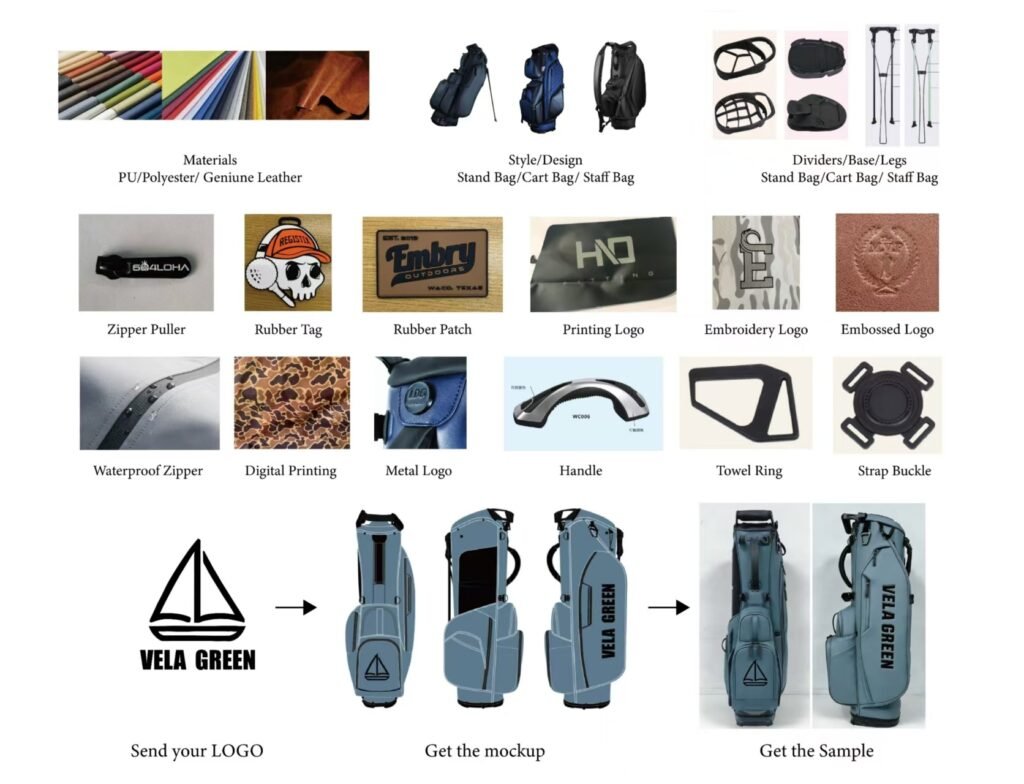
At Vela Green, we specialize in full-range OEM & ODM services for golf bags, golf headcovers, gloves, towels and other golf accessories. We support custom design, material selection, logo branding, color matching and mass production, strictly following CPSC, REACH and other international compliance standards. With mature production experience, stable quality control and professional export support, we help brands and importers develop reliable, market-oriented golf products with efficient lead times and flexible order quantities.
Feel free to contact us today for a custom solution or detailed quotation.