Key Compliance Standards for Golf Bags OEM: US & European Markets are non-negotiable rules for every B2B wholesaler, private label brand, and OEM factory exporting golf bags to Western regions. The US and European golf retail markets enforce strict safety, environmental, and material compliance regulations for sporting goods. Non-compliant OEM golf bags will face customs detention, platform listing removal, warehouse rejection, mass returns, and heavy penalty fees. For 2026 cross-border golf equipment sourcing, mastering these key compliance standards for golf bags OEM is the core foundation for smooth customs clearance, stable shelf sales, and long-term B2B cooperative growth.
Most B2B buyers focus excessively on OEM pricing, MOQ, and customization styles while ignoring compliance verification, triggering avoidable supply chain risks. Unlike generic luggage, golf bags use special waterproof coatings, colored fabrics, plastic accessories, and metal hardware, all of which are regulated by regional safety and environmental laws. Understanding and implementing standardized golf bags OEM compliance standards for US and European markets helps wholesale buyers screen qualified factories, eliminate batch compliance risks, and build a trustworthy and profitable Western market supply chain.
Why OEM Golf Bag Compliance Determines Your Western Market Success
Compliance is the first entry threshold for US and European golf markets, far more important than appearance and price advantages. Amazon, Shopify, offline pro shops, and large golf retail chains conduct regular compliance spot checks on sporting goods inventory. Any unqualified materials, restricted chemical residues, or uncertified accessories will lead to product delisting, store penalties, and brand reputation damage.
For OEM golf bag orders, compliance must be locked at the production stage. Unlike ODM ready-made products, customized OEM golf bags involve personalized materials, custom printing, and upgraded accessories, which increase variable compliance risks. Only cooperating with factories that fully follow US and European compliance standards can B2B buyers achieve zero-risk bulk export and stable repeated orders in 2026.
Core US Market Compliance Standards for OEM Golf Bags
The United States adopts strict consumer product safety and chemical control regulations for imported golf bags. Three standards dominate OEM production and inspection, covering material safety, chemical residue, and juvenile product protection.
CPSIA (Consumer Product Safety Improvement Act) is the basic safety standard for all US imported sporting goods. OEM golf bags must meet lead and phthalate limit requirements, with strict restrictions on lead content in fabrics, zippers, plastic buckles, and printed logos. All customized accessories must pass third-party testing to ensure no excessive heavy metals, avoiding retail safety hazards and regulatory penalties.
California Prop 65 is the most frequently inspected compliance rule for US golf bag OEM orders. It prohibits excessive harmful chemicals such as formaldehyde, heavy metals, and volatile compounds in fabrics, coatings, and adhesive materials. Non-compliant products will receive warning letter penalties and cannot be sold in California, the largest US golf consumption market. Qualified OEM factories must provide complete Prop 65 test reports for batch orders.
In addition, US cross-border shipments require clear origin labeling and standardized product safety labels. All custom OEM golf bags must be printed with “Made in China” marks and durable safety instructions to meet US customs and retail shelf requirements.
Core European Market Compliance Standards for OEM Golf Bags
European markets focus more on environmental protection and sustainable material compliance, with REACH and eco-friendly certification as the core inspection indicators for 2026 golf bag OEM exports.
EU REACH Regulation restricts hundreds of harmful substances in imported sporting goods. OEM golf bag fabrics, waterproof coatings, printing inks, and hardware surface treatments must not contain prohibited SVHC substances. For bulk customized OEM orders, factories need to provide REACH test reports to prove material safety, ensuring smooth EU customs clearance.
GRS (Global Recycled Standard) Certification has become a mainstream compliant advantage for European high-end retail. More EU golf brands and offline pro shops prioritize recycled eco-friendly golf bags. OEM buyers targeting European mid-to-high-end markets need to select GRS-certified factories to support sustainable material customization, improving product market competitiveness and meeting local green consumption trends.
Meanwhile, EU markets require non-toxic and low-odor production standards. OEM golf bags with pungent chemical odors and unqualified mildew-proof treatment will be rejected by local retailers, forming after-sales quality disputes.
2026 Key OEM Production Compliance Details Easily Missed
In golf bags OEM compliance for US and European markets, many small details easily cause batch non-compliance issues. First, custom logo printing and silicone embossing must use environmentally friendly ink without excessive chemical residues. Low-cost inferior printing materials are the main cause of Prop 65 and REACH failures.
Second, waterproof and UV-resistant coating materials must adopt certified environmentally friendly formulas. Unqualified coatings will cause excessive volatile substances and fail Western environmental testing. Third, metal hardware and plastic accessories need anti-rust and non-toxic treatment to meet CPSIA safety standards. Fourth, seasonal sea freight orders must pass mildew-proof compliance treatment to avoid EU quarantine rejection.
How B2B Buyers Avoid OEM Compliance Risks
To ensure 100% compliant OEM golf bag bulk orders, B2B buyers need to establish standardized supplier audit processes. First, verify factory qualification certificates including REACH, Prop 65, and CPSIA test reports before placing orders. Second, confirm all customized materials and crafts comply with target market regulations in the sample stage to avoid batch losses.
Third, require pre-shipment random testing for bulk orders to ensure consistent batch compliance. Fourth, reserve complete test documents and customs clearance materials to cope with retail platform and customs random inspections. Strict compliance management is the cheapest risk control method for 2026 golf bag wholesale business.
Final Thoughts
Key Compliance Standards for Golf Bags OEM: US & European Markets summarizes all must-know regulatory rules for 2026 cross-border golf bag customized exports. US safety standards represented by CPSIA and Prop 65, and European environmental standards represented by REACH and GRS, constitute the basic threshold for Western market sales. B2B buyers who strictly implement these OEM compliance standards can effectively cut customs risks, reduce after-sales losses, and build long-term stable competitive advantages in the global golf equipment wholesale market.
OEM & ODM Service
Whether you’re planning to build your own brand, develop new products, or find a stable manufacturing partner for the US and European markets, working with a professional OEM & ODM factory can significantly improve your product quality and market competitiveness.
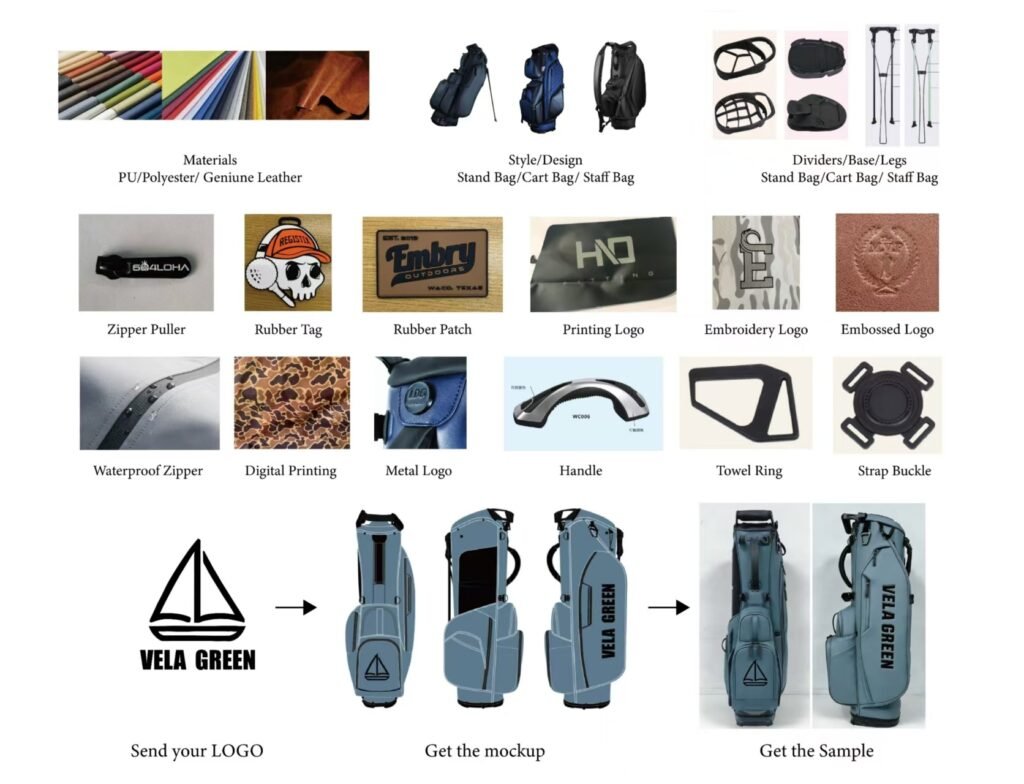
At Vela Green, we provide full-range OEM & ODM services for golf bags, golf headcovers, gloves, towels and other golf accessories. We support custom design, material selection, logo branding, color matching and mass production, strictly complying with CPSC, REACH and other international standards. With mature production experience, reliable quality control and professional export support, we help brands and importers develop market-oriented products with efficient lead times and flexible order quantities.