Choosing the right golf bag for every course is a key factor that determines player experience and practicality, making it a critical product selling point for B2B golf bag wholesalers and retailers. Different golf course types — including walking courses, cart-only courses, resort courses, and professional tournament courses — require completely different golf bag functions, sizes, weights, and structural designs. Supplying one-size-fits-all golf bags fails to meet segmented market demands and increases retail return rates. This 2026 B2B guide elaborates on how to match the perfect golf bag style for each golf course type, helping global wholesale buyers stock targeted products, enrich differentiated product lines, and boost retail conversion rates.
Most generic wholesale golf bags are designed with universal functions, lacking targeted optimization for specific course scenarios. Casual players and professional golfers have distinct usage habits on different courses, leading to clear demand gaps for lightweight, portable, large-capacity, and travel-friendly golf bags. For B2B pro shop owners, golf course procurement managers, and sports equipment distributors, mastering course-matched golf bag sourcing standards helps avoid homogeneous price competition and creates unique market competitive advantages.
Why Course Type Determines Golf Bag Selection & Retail Sales
Golf courses vary greatly in terrain, walking distance, supporting facilities, and gameplay modes. A lightweight stand bag suitable for walking courses may lack enough storage capacity for resort courses with multi-scene needs, while a bulky staff bag cannot be used conveniently for casual street golf and short-distance walking courses. When B2B buyers supply course-matched golf bags, products can precisely fit end users’ actual usage scenarios, effectively reducing functional complaints, improving user satisfaction, and increasing repurchase rates.
In addition, targeted course-matched product positioning helps retailers carry out precise marketing, attract different customer groups including amateur walkers, tourist golfers, and professional players, and maximize the profit margin of each sales channel.
Best Golf Bag Types for Different Golf Course Scenarios
To help B2B wholesale buyers complete accurate product stocking and market matching, we classify and analyze the most suitable golf bags for mainstream golf course types worldwide:
1. Walking Golf Courses: Lightweight Stand Golf Bags
Walking golf courses feature long hole distances and require players to walk 18 holes entirely. Portability and light weight are the core demands of end consumers. For this course type, lightweight stand golf bags are the most ideal option. Weighing only 1.8kg to 2.5kg, these bags are equipped with ergonomic double shoulder straps and stable foldable stand legs, allowing free placement on grass and slope terrain without tipping over.
These golf bags retain core storage functions for clubs, balls, tees, and personal items, removing redundant heavy structures. They are compact, labor-saving, and highly adaptable to long-distance walking scenarios. B2B buyers focusing on local community courses and amateur player markets can prioritize stocking lightweight stand bags to meet mass daily golf needs.
2. Cart-Only Golf Courses: Spacious Cart Golf Bags
Most standard commercial golf courses mandate cart riding, where players do not need to carry golf bags manually. For cart-only courses, cart golf bags are the mainstream choice. Different from stand bags, cart bags cancel stand leg structures and adopt enlarged capacity design, with more independent pockets for storing golf apparel, rain gear, food, rangefinders, and sports accessories.
Cart golf bags feature stable widened bases and anti-slip bottom designs, which can be firmly fixed on golf cart trays without shaking or falling during driving. Their high-capacity and multi-functional design perfectly fits all-day golf gameplay on commercial courses. This product is the best-selling inventory for regular pro shop retail and golf course supporting procurement.
3. Resort & Vacation Golf Courses: Travel-Friendly Golf Bags
Resort golf courses are mainly for tourist golfers, who often need cross-city or cross-country travel. Golfers require golf bags with travel protection and airline compatibility. Padded golf travel bags are exclusively customized for resort course scenarios. Equipped with thickened shockproof padding, hard club shaft protection structures, and lockable designs, these bags can protect golf clubs from extrusion and damage during air transportation.
Most resort golf travel bags support flexible size adjustment and meet international airline checked baggage standards. For B2B buyers serving resort stores, tourist areas, and travel equipment retailers, stocking travel golf bags can capture high-value tourist golfer groups and obtain high retail profit margins.
4. Professional Tournament & High-End Club Courses: Premium Staff Bags
Professional tournament courses and high-end private golf clubs pursue professionalism, aesthetics and brand display effects. Premium golf staff bags are the standard equipment for professional players and caddies. With oversized capacity, full-length 14-way divider systems, high-grade leather or textured fabric, and exquisite hardware decoration, staff bags present a high-end and ceremonial visual effect.
These bags support full sets of professional golf equipment storage and are suitable for tournament display, club image matching, and high-end customer supporting services. They are high-margin customized products for B2B high-end market layout, perfectly matching the positioning of top golf courses and private clubs.
5. Short-Distance & Beginner Practice Courses: Mini & Sunday Golf Bags
Beginner practice courses and short-distance 9-hole courses focus on convenient and fast golf experience. Mini Sunday golf bags are lightweight, ultra-portable, and simple in structure, suitable for storing a small number of conventional clubs. They are low-cost, fashionable, and easy to carry, very suitable for golf training institutions, beginner teaching supporting equipment, and casual daily golf scenarios.
For B2B buyers targeting golf training markets and student groups, mini golf bags have low procurement costs and large market demand, which can effectively enrich low-end product lines and cover all customer groups.
B2B Sourcing Tips for Course-Matched Golf Bags
- Regional Market Matching: Stock more lightweight stand bags for areas with more walking courses; prioritize cart bags and staff bags for mature commercial golf course clusters.
- Scenario Differentiated Customization: Add waterproof and breathable functions for outdoor course products, and upgrade shockproof protection for travel course golf bags.
- Batch Combination Stocking: Adopt mixed stocking of multiple types of golf bags to cover beginner, amateur and professional player groups, avoiding single product sales limitations.
- Market Upgrade Iteration: Update trendy colors and ergonomic structures according to annual course player consumption habits to maintain product market competitiveness.
Final Thoughts
Different golf course types correspond to completely different golf bag functional demands. Matching a professional golf bag for every course type is the core of segmented market operation for 2026 B2B golf bag wholesale business. By sorting out walking course, cart course, resort course, tournament course and practice course product matching rules, global golf bag buyers can achieve precise stocking, avoid inventory backlog caused by mismatched scenarios, and continuously improve retail sales volume and comprehensive profit margins in the competitive golf equipment market.
OEM & ODM Service
Whether you’re planning to build your own brand, develop new products, or find a stable manufacturing partner for the US and European markets, working with a professional OEM & ODM factory can significantly improve your product quality and market competitiveness.
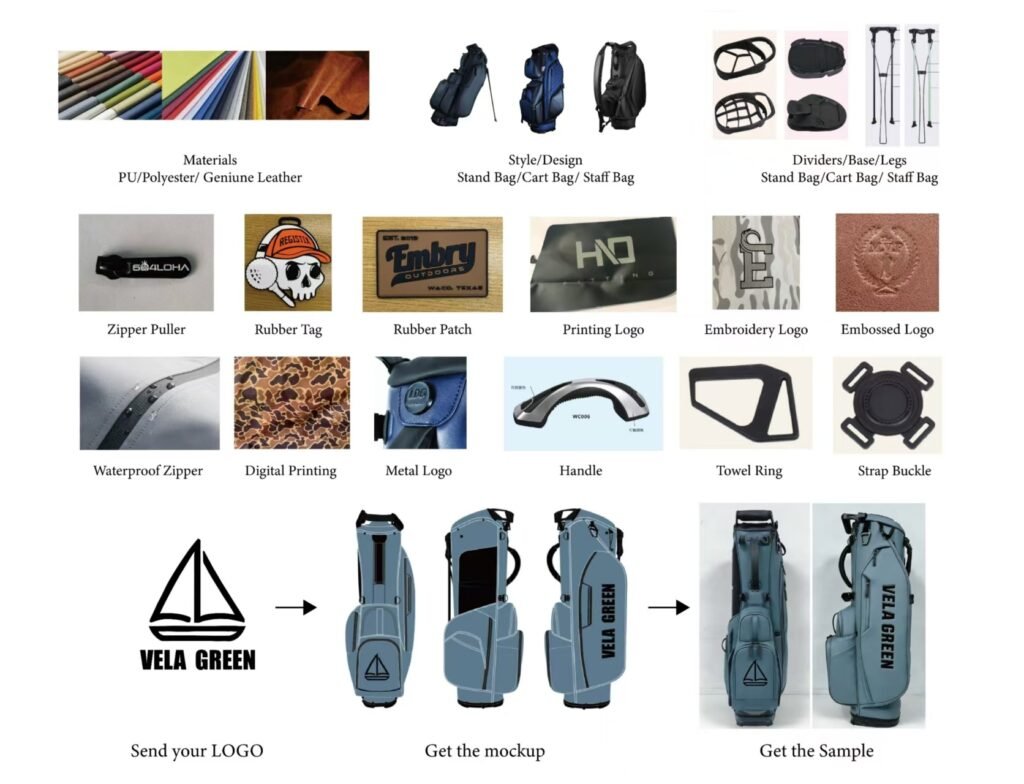
At Vela Green, we provide full-range OEM & ODM services for golf bags, golf headcovers, gloves, towels and other golf accessories. We support custom design, material selection, logo branding, color matching and mass production, strictly complying with CPSC, REACH and other international standards. With mature production experience, reliable quality control and professional export support, we help brands and importers develop market-oriented products with efficient lead times and flexible order quantities.