After you’ve secured the perfect product from your golf bag manufacturer, the next critical hurdle is golf bag logistics—getting your bags from the factory floor to your warehouse efficiently and cost-effectively. Poor golf bag logistics planning can turn a profitable order into a financial disaster, with hidden fees, unexpected delays, and damaged goods eating away at your margins. In 2026, rising tariffs, volatile freight rates, and strict customs regulations make mastering golf bag logistics more important than ever.
This guide provides six proven strategies for optimizing your golf bag logistics—from selecting the right shipping method to managing customs compliance and landed cost—so you can protect your margins and deliver product on time.
Why Golf Bag Logistics Is Different from Other Products
Golf bags present unique golf bag logistics challenges that other consumer goods don’t. A standard golf bag weighs only 4–8 pounds but occupies a large volume due to its dimensions (typically 35–50 inches in height and 12–18 inches in width). This means carriers often charge based on volumetric weight (dim weight) rather than actual weight.
The volumetric weight trap: A typical staff golf bag measuring 38 x 14 x 12 inches has a volumetric weight of approximately 10.6 kg, even if the actual bag weighs only 4.5 kg. The carrier will charge for the higher of the two. A bag that weighs 10 pounds could be billed at a 35-pound rate due to its dimensions. Failure to optimize packaging in golf bag logistics means you end up paying for “air” rather than your actual product. Properly compressed packaging or vacuum-bagging techniques can reduce volume by up to 30% for soft-shell bags, dramatically lowering freight costs.
Additionally, golf bags belong to sports goods HS code category 9506.39 or textile-based bag classification 4202.92. Choosing the wrong HS code can trigger penalties or shipment holds in customs. Many B2B buyers overlook these nuances and end up overpaying by thousands of dollars per container.
Strategy #1: Choose Between FCL and LCL for Your Golf Bag Logistics
The first major decision in any golf bag logistics plan is whether to use FCL (Full Container Load) or LCL (Less than Container Load).
FCL means you rent an entire container exclusively for your golf bags—typically a 20-foot or 40-foot container. A 20-foot container holds approximately 400–600 golf bags (depending on how well they are nested). FCL minimizes handling, reduces damage risk, and offers lower per-unit cost. A full 20-foot container to the US West Coast runs approximately $2,000–$3,000 in freight charges, equating to roughly $0.35–$0.50 per kilogram for a fully loaded shipment.
LCL means your golf bags share container space with other cargo. This is ideal for smaller orders under 200–300 pieces. LCL is billed by CBM (cubic meter) rather than container. A typical LCL rate ranges from $50–$100 per CBM. However, LCL requires multiple handling steps—loading at factory, deconsolidation at origin port, consolidation at destination—which increases damage risk and extends delivery timeline by 5–10 days compared to FCL.
Selection rule for golf bag logistics: If your order exceeds 300 pieces, FCL is almost always more cost-effective and safer. If you‘re testing a new design with 100–200 pieces, LCL allows you to avoid the fixed cost of a full container. Some manufacturers offer mix-and-match options, allowing you to consolidate multiple designs into one FCL shipment.
Strategy #2: Understand Sea Freight vs. Air Freight for Golf Bag Logistics
For most B2B buyers, sea freight is the backbone of golf bag logistics due to its cost advantage. However, air freight becomes necessary in certain situations: urgent replenishments to avoid stockouts, sample or test orders where speed outweighs cost, and high-value custom bags with tight delivery windows.
2026 sea freight benchmarks for golf bag logistics:
| Route | Approximate Transit | Typical Cost |
|---|---|---|
| Asia to US West Coast | 15–20 days | $0.35–$0.50/kg (FCL) |
| Asia to US East Coast | 25–30 days | $0.45–$0.65/kg (FCL) |
| Asia to Europe | 30–40 days | $0.50–$0.70/kg (FCL) |
2026 air freight benchmarks for shipments over 100kg run $4.50–$7.00 per kilogram, making air freight 10–20 times more expensive per unit than sea freight—but 10–15 times faster.
Smart golf bag logistics trade-off: For a typical 500-piece order, using air freight would add approximately $15–$25 per bag in logistics cost compared to $2–$4 per bag by sea. Air freight should only be used for emergency replenishment or very high-value products where margins can absorb the premium. Many buyers adopt a hybrid approach: air freight the first 20% to meet launch deadlines, then sea freight the remainder for inventory build.
Strategy #3: Master Landed Cost Calculation for Golf Bag Logistics
Understanding your landed cost is the single most important skill in golf bag logistics. Landed cost is the total price of a product once it has arrived at your buyer’s door, including manufacturing cost, freight, insurance, duties, and all other charges.
Complete Landed Cost Breakdown for Golf Bag Logistics:
| Cost Component | Typical Range | Notes |
|---|---|---|
| Ex-works price | $15–$50 | Factory price before logistics |
| Ocean freight | $2–$6 per bag | Depends on volume and route |
| Insurance (110% of invoice) | 0.3–0.5% of cargo value | Covers damage or loss in transit |
| Import duties (EU/US) | 10–30% | Varies by origin and material |
| Customs clearance fees | $150–$300 per shipment | Broker fees, MPF, etc. |
| Inland delivery | $1–$3 per bag | Port to warehouse |
Example landed cost calculation: A factory quotes $20 per bag ex-works. Adding $4 ocean freight, $1 insurance, $5 duties (at 25% on $20), and $2 inland delivery brings your landed cost to $32 per bag—60% higher than the factory price. A $2 difference in ex-works price becomes a $3.20 difference in landed cost after applying duties.
Many golf bag logistics disasters begin when buyers compare ex-works prices without considering total landed cost. A “cheaper” factory often becomes more expensive once higher freight rates (due to remote inland location) or higher duties (due to incorrect HS code classification) are factored in.
Pro tip: Ask every supplier to quote FOB (Free on Board) port price rather than ex-works. FOB includes all costs to load the container at the origin port, giving you a more complete baseline for comparing golf bag logistics options.
Strategy #4: Navigate 2026 Tariffs and Customs Compliance
The 2026 tariff environment for golf bag logistics is significantly more complex than previous years. Golf bags imported into the US are typically classified under HS Code 4202.92 for textile-based bags. The base Most-Favored-Nation (MFN) rate is 17.6%. However, products from China face additional Section 301 tariffs, raising the total duty for general sports bags under 4202.92.91 to 27.6%—combining the 17.6% base rate with additional surcharges. For bags made from man-made fibers like nylon or polyester, total duties from China can reach 52.6%.
This massive duty differential is reshaping golf bag logistics decisions. Some buyers are shifting sourcing to Vietnam or Taiwan, where similar golf bags attract only the 10% baseline tariff, no China-specific surcharges. However, these regions have fewer specialized golf bag factories and longer lead times for complex designs.
EU golf bag logistics compliance: The European Union now requires 10-digit TARIC codes for customs clearance, and a flat €3 duty per tariff sub-heading will apply starting July 1, 2026. Additionally, the General Product Safety Regulation (GPSR), effective since December 13, 2024, requires non-EU manufacturers to appoint an EU-based Responsible Person—another compliance layer that must be managed before goods can enter the market.
Smart golf bag logistics move: If you continue sourcing from China, verify that your supplier can provide country of origin certificates and accurate HS code classifications before shipment. Misclassification is one of the most common reasons for customs holds. An independent customs broker can help you audit HS codes before you commit to shipping.
Strategy #5: Protect Your Shipments with Proper Insurance and Documentation
A frequently overlooked but critical component of golf bag logistics is insurance and documentation. Ocean freight containers face real risks: rough handling during loading and unloading (especially for LCL shipments), exposure to moisture in container condensation, theft at intermediate ports, and cargo shift during heavy seas.
Most standard freight contracts cover only a fraction of your cargo’s actual value—typically **$0.50 per pound** or approximately $500 per standard pallet, far below the value of a container of custom golf bags. You need all-risk marine cargo insurance, typically costing 0.3–0.5% of the invoice value plus freight.
Documentation essentials for golf bag logistics:
- Commercial invoice (exact value, HS codes, origin certification)
- Packing list (quantity per carton, carton dimensions, total weight)
- Bill of Lading (original or telex release)
- Certificate of origin (required for preferential tariff treatments)
- Inspection certificate (if using third-party QC)
Missing documentation is a primary cause of customs delays. For example, failing to include the correct country of origin certificate can trigger a 10–14 day customs hold while additional documentation is requested, potentially missing your retail launch window entirely.
Strategy #6: Consider Bonded Warehousing for Strategic Golf Bag Logistics
One sophisticated golf bag logistics strategy that sophisticated B2B buyers use is bonded warehousing. A bonded warehouse is a secure facility authorized by customs authorities to store imported goods before duties are paid. Duty payment is deferred until goods are actually withdrawn for sale.
Benefits of Bonded Warehousing for Golf Bag Logistics:
- Deferred duty payment: Instead of paying duties at the port of entry (potentially weeks or months before you actually need the inventory), you pay only when you remove goods from the bonded warehouse. This directly improves cash flow—a major advantage for high-volume importers.
- Flexible distribution: As orders come in from different customers, you can withdraw only the exact quantity needed. If the first customer needs 200 bags and a second needs 150 bags one month later, you pay duties only on the 200 and 150 respectively, not on the full 1,000-piece container upfront.
- Compliance buffer: If customs questions a shipment’s classification or documentation, bonded goods remain in a controlled environment while issues are resolved—avoiding costly storage penalties at the port.
For brands importing multiple container shipments per year, bonded warehousing can improve golf bag logistics efficiency and reduce working capital tied up in duty payments.
Golf Bag Logistics Best Practices Summary Table
| Logistics Decision | Recommended Option | When to Choose Alternative |
|---|---|---|
| Shipping mode | Sea freight FCL for orders 300+ pieces | LCL for trial orders under 300; air only for urgent replenishment |
| Insurance | All-risk marine cargo insurance (0.3-0.5% of value) | Basic coverage only for very low-value goods |
| Incoterms | FOB origin port for cost control | EXW for total control over logistics chain |
| HS code verification | Use customs broker before booking | Self-classify only if highly experienced |
| Documentation | Request documents before shipment release | Accept post-shipment only from trusted suppliers |
| Warehousing | Bonded warehouse for cash flow optimization | Standard warehouse if duties are minimal |
Common Golf Bag Logistics Mistakes to Avoid
Even experienced buyers make errors in golf bag logistics. The most frequent and costly mistakes include:
Mistake #1: Underestimating volumetric weight penalties. A golf bag that weighs 4.5 kg may be charged at 10–12 kg volumetric weight. Always request quotes based on packed dimensions, not empty measurements. Some carriers charge $150–$220 for international shipping of a single golf bag due to volumetric weight.
Mistake #2: Ignoring port and inland charges. FOB price doesn‘t include destination charges—terminal handling fees (THC), customs clearance fees, Merchandise Processing Fee (MPF, typically 0.3464% of value), and inland trucking. These can add $1,500–$3,000 per container. Always request a delivered price estimate from your freight forwarder.
Mistake #3: Failing to account for seasonal surcharges. During peak season (August–October for holiday inventory, March–May for spring launch), carriers add Peak Season Surcharges (PSS) of 15–30% to ocean freight rates. Air freight peak surcharges can reach 20–50% during November–December. If you’re planning golf bag logistics for these windows, build surcharges into your budget.
Mistake #4: No contingency for port congestion. Major ports (Los Angeles/Long Beach, Rotterdam, Shanghai) experience congestion during peak periods, adding 5–15 days to transit. Build a 2–3 week buffer into your golf bag logistics timeline for unforeseen delays. Chinese New Year (February) also shuts down manufacturing for 2–4 weeks—orders placed in late January may not ship until March.
Regional Golf Bag Logistics Considerations
China-based sourcing: China remains the dominant source for custom golf bags due to its vertically integrated supply chains, mature quality systems, and competitive production costs. The Pearl River Delta (Guangdong) and Fujian provinces offer the highest concentration of specialized golf bag factories, with most major logistics hubs in Shenzhen and Xiamen providing efficient sea freight connections to global markets. However, high US tariffs on Chinese-made golf bags (potentially reaching 52.6% for synthetic fiber bags) have led some importers to explore alternative sourcing.
Vietnam and Taiwan: These regions offer lower tariff exposure (approximately 10% baseline rate for US-bound shipments), making them attractive for price-sensitive buyers. However, the specialized golf bag supplier ecosystem in these regions is less developed than China‘s, with fewer factories offering complex customization (14-way dividers, proprietary stand mechanisms, smart features). Lead times are often 15–30% longer for complex designs.
US/EU local warehousing: For brands with established US or EU operations, holding safety stock in a local bonded warehouse can dramatically reduce replenishment lead times from 30–45 days to 3–5 days for reorders. The key is balancing carrying costs against the risk of stockouts.
The Role of Freight Forwarders in Golf Bag Logistics
Most B2B buyers use a freight forwarder to manage the complexity of golf bag logistics. A good forwarder handles booking carriers, consolidating LCL shipments, preparing customs documentation, managing insurance, and tracking the shipment from factory to warehouse. They also advise on Incoterms and help you avoid costly mistakes.
Incoterms are standardized trade terms that define who pays for what and when risk transfers from seller to buyer. The most relevant Incoterms for golf bag logistics include:
| Incoterm | Seller Responsibility | Buyer Responsibility | Best For |
|---|---|---|---|
| EXW | Makes goods available at factory | All transport, export clearance, insurance, import clearance | Buyers with strong in-house logistics |
| FOB | Loads goods onto vessel at origin port | Main carriage, insurance, import clearance | Most standard B2B transactions |
| CIF | Covers cost, insurance, freight to destination port | Import clearance, inland delivery | Buyers who want seller to arrange shipping |
| DDP | Handles everything to buyer’s door | Unloads goods | Buyers wanting turnkey delivery |
When selecting a freight forwarder, ask about their experience with sports equipment and golf bags specifically. Forwarders familiar with golf bag logistics know how to minimize volumetric weight costs, classify HS codes correctly, and navigate the specific compliance requirements of your target market.
Conclusion: Master Golf Bag Logistics for 2026 Success
Effective golf bag logistics is not just about moving boxes from point A to point B—it’s a strategic capability that protects your margins, ensures on-time delivery, and builds customer trust.
The six strategies covered in this guide provide a complete framework:
- Choose FCL for orders over 300 pieces; use LCL for trial quantities
- Use sea freight for cost efficiency; air freight only for urgent emergencies
- Calculate landed cost before comparing supplier quotes
- Stay current on 2026 tariff changes and compliance requirements
- Insure shipments properly and keep documentation in order
- Consider bonded warehousing to improve cash flow
By implementing these golf bag logistics strategies, you transform shipping from a cost center into a competitive advantage. The brands that master logistics in 2026 will be the ones delivering on time, protecting their margins, and winning repeat business.
*With 20 years of experience in golf bag manufacturing and logistics for 15+ countries, we help B2B buyers optimize every step of their supply chain—from production scheduling to container loading to customs documentation. Contact us to discuss your logistics requirements and request a landed cost estimate for your next order.*
OEM & ODM Service
Whether you’re planning to build your own brand, develop new products, or find a stable manufacturing partner for the US and European markets, working with a professional OEM & ODM factory can significantly improve your product quality and market competitiveness.
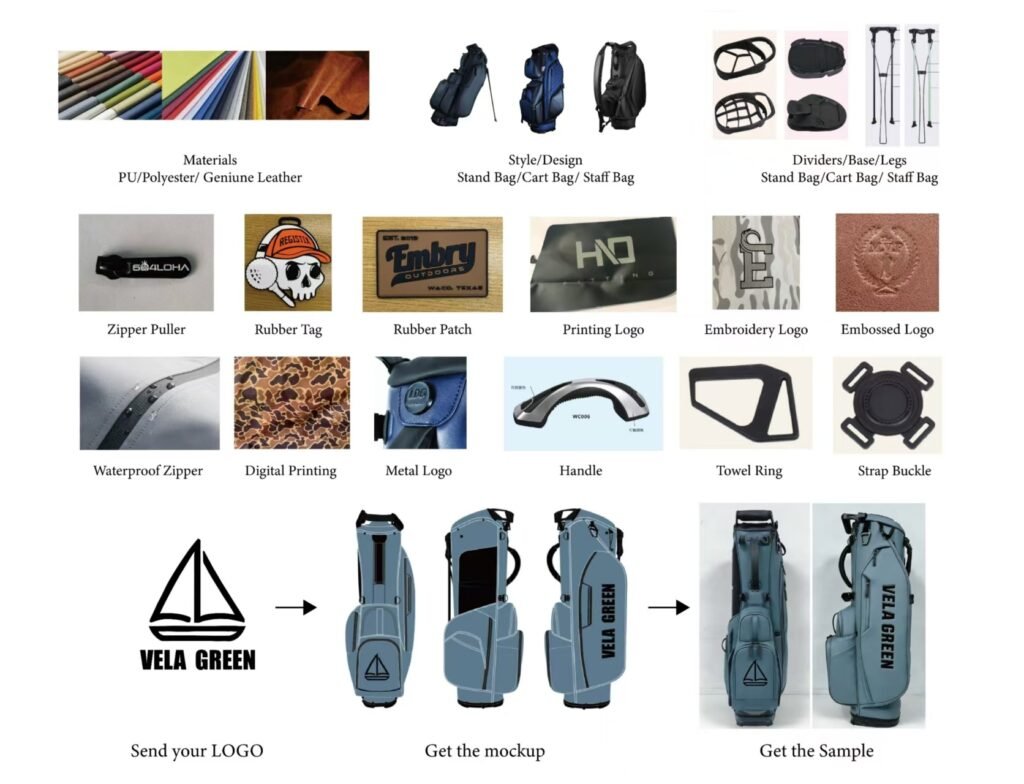
At Vela Green, we provide full-range OEM & ODM services for golf bags, golf headcovers, gloves, towels and other golf accessories. We support custom design, material selection, logo branding, color matching and mass production, strictly complying with CPSC, REACH and other international standards. With mature production experience, reliable quality control and professional export support, we help brands and importers develop market-oriented products with efficient lead times and flexible order quantities.