Effective wholesale golf bag negotiation separates profitable retail buyers from those who leave thousands of dollars on the table. Every invoice contains negotiable elements—not just the unit price, but freight terms, payment schedules, return policies, and ongoing support. Yet many buyers treat wholesale golf bag negotiation as a simple question of asking, “Can you lower the price?” before accepting the supplier‘s default terms.
A successful wholesale golf bag negotiation requires a structured approach. Prepare with data. Know your open-to-buy and target margins. Be aware of current tariff realities that can drastically affect your landed cost. Bring sales history and past vendor performance data to the conversation. Familiarize yourself with typical freight, discount, and payment terms for each vendor category. Most importantly, decide in advance what is non-negotiable versus flexible before you begin the dialogue.
This guide presents eight proven wholesale golf bag negotiation tactics that experienced buyers use—from volume tier strategies to payment term optimization—so you can lower your landed cost, protect margins, and build supplier relationships that deliver lasting value.
Tactic #1: Prepare Before You Begin the Wholesale Golf Bag Negotiation
Preparation is the foundation of any successful wholesale golf bag negotiation. Before engaging with a supplier, define your non-negotiables and flexible zones. Understand your open-to-buy budget and target margin—these numbers dictate how far you can move on price before the deal stops making financial sense.
Gather historical data that gives you real leverage. Bring documented sales history and past vendor performance—volume trends and sell-through rates demonstrate value and commitment. Be familiar with market averages for freight, discount, and dating terms—ignorance of standard ranges leads to leaving money on the table. Decide in advance what terms are absolutely essential, such as free freight on the opening order or extended dating for seasonal inventory, versus which terms are flexible, like cosmetic logo colors or packaging preferences. A buyer who walks into negotiation knowing their numbers is a buyer who walks out with better terms.
Tactic #2: Master Key Vendor Terms in Wholesale Golf Bag Negotiation
A wide range of terms are negotiable beyond the base unit price. Understanding each gives you multiple levers to pull during wholesale golf bag negotiation.
F.O.B. Terms: These determine who pays for shipping and where ownership transfers. FOB origin means the buyer assumes risk once goods leave the factory. FOB destination means the supplier pays freight and bears risk until delivery. A skilled wholesale golf bag negotiation pushes for FOB destination on trial orders, shifting freight costs and risk to the supplier until you verify quality.
Freight Negotiation: Free freight on opening orders or orders exceeding a certain value is often available. For larger orders, even partial freight coverage (e.g., 50% of ocean freight) reduces your landed cost without requiring a unit price reduction. Some buyers negotiate free freight for the first order as a relationship-building concession, then revisit the term on subsequent orders.
Volume Discount Tiers: Wholesale pricing typically drops as order quantity increases. For example, one supplier offers R 91.15 per unit at 100 units, dropping to R 89.35 at 250 units, and R 87.55 at 500 units. Negotiate the tier thresholds themselves—perhaps 400 units qualifies for the 500-unit price.
Extended Dating (Payment Terms): Net 30, Net 60, and Net 90 terms give you time to sell inventory before payment is due. Seasonal buyers should negotiate extended dating to match cash flow cycles—order spring inventory on Net 90 to pay after the peak selling season. Beyond extended dating, you can negotiate anticipation allowances—early payment discounts such as 2/10 Net 30, where you receive a 2% discount for paying within 10 days rather than the full 30 days.
Tactic #3: Negotiate Tariff and Compliance Costs in Wholesale Golf Bag Negotiation
One of the most overlooked components of wholesale golf bag negotiation is tariff management. Since April 2026, golf bags imported into the US face a layered tariff system. Goods classified under HS code 9506.39 carry the standard base rate, plus Section 301 duties of 25% and an additional Section 122 global surcharge of 10%. For bags classified under HS 4202.92 (textile-based bags), the combined duty can reach 27.6% or more.
These tariffs add directly to your landed cost—typically $5 to $15 per bag, depending on the base price. A skilled wholesale golf bag negotiation does not simply absorb these costs; it works with suppliers to mitigate them.
Strategies for Wholesale Golf Bag Negotiation in a Tariff Environment
First, ensure correct HS code classification. Misclassification can result in automatic customs holds and penalties. In a wholesale golf bag negotiation, request documentation of the factory‘s HS code for your product and cross-verify with a customs broker.
Second, consider sourcing diversification. Some buyers now source from Vietnam or Taiwan, where similar golf bags attract only baseline tariffs without China-specific surcharges. If a supplier has manufacturing facilities outside tariff-impacted regions, use that as leverage for better pricing on orders destined for affected markets.
Third, negotiate shared tariff costs. Ask the supplier to absorb a portion of tariff increases, especially if you are a repeat customer. While suppliers rarely cover 100% of new tariffs, many will share 25–50% of the increase to preserve the relationship.
Fourth, consolidate shipments. Larger, less frequent orders reduce per-unit logistics costs, freeing budget to absorb tariff impacts without raising retail prices.
Tactic #4: Optimize Minimum Order Quantities (MOQ) in Wholesale Golf Bag Negotiation
MOQ is often presented as fixed, but it is highly negotiable in wholesale golf bag negotiation. Factories establish MOQs based on production setup costs—machine calibration, pattern creation, and material cutting. These fixed costs are recouped across the order quantity, so smaller orders mean higher per-unit prices.
MOQ Negotiation Strategies
Ask for tiered MOQ pricing. Get quotes at 100 units, 250 units, 500 units, and 1,000 units so you can see where the marginal savings diminish. Use volume projections. Even if your first order is 300 units, share your 12-month forecast of 1,200 units. Suppliers will often lower the first-order MOQ to secure the long-term commitment. Combine multiple SKUs into one order. If you need 200 units of one color and 200 of another, ask the factory to count it as one 400-unit order for pricing purposes, even if shipped separately. Negotiate trial MOQs. For new designs, start with 100 units on a trial basis, with pricing improving on subsequent orders as volume builds.
Low-MOQ flexibility is particularly valuable for testing new markets. Some factories now offer entry-level MOQs as low as 50 units for simple logo customizations on existing bag patterns. This reduces initial risk while allowing you to validate demand before committing to larger volumes.
Tactic #5: Negotiate Return, Exchange, and Markdown Terms in Wholesale Golf Bag Negotiation
Returns and markdowns quietly erode margins, yet many buyers skip negotiating these terms. A complete wholesale golf bag negotiation includes protections against defective product and seasonal overstock.
Negotiate a clear damage return policy. The supplier should cover return freight for damaged goods, especially for bulky items like golf bags. For international orders, negotiate immediate replacement or refund for verified defects rather than waiting weeks for resolution. For seasonal merchandise, some suppliers offer mark-down money—financial support to discount slow-moving inventory without reducing your margin. This is especially valuable for fashion colors or tournament-specific designs with limited selling windows.
For online sales, discuss customer accommodation policies. If a customer returns an undamaged bag due to change of mind, will the supplier share the cost of that return? Many suppliers will split return costs 50/50 to maintain the relationship, but you must ask.
Tactic #6: Structure Payment Terms for Cash Flow in Wholesale Golf Bag Negotiation
Payment terms are one of the most powerful levers in wholesale golf bag negotiation, yet many buyers accept standard terms without discussion. The industry baseline for new international relationships is 30% deposit and 70% before shipment. Stronger buyers negotiate better.
Extended dating means you keep cash in your bank account longer. Net 30, Net 60, or Net 90 terms allow you to sell inventory before paying for it. Seasonal buyers should push for Net 90—order spring inventory in January and pay in April after the March–May selling season. Early payment discounts reward accelerated cash flow to the supplier. Terms like 2/10 Net 30 give you a 2% discount for paying within 10 days instead of 30. On a $20,000 order, that is $400 directly to your bottom line.
For larger orders or established relationships, negotiate the deposit percentage down. Offer 20% deposit, 80% on proof of shipment or third-party inspection approval. For trusted long-term partners, some buyers negotiate open account terms, where the supplier ships goods and invoices you Net 30 or Net 60 with no deposit required. Always confirm negotiated terms in writing, attached to the purchase order, with clear references to payment timing and the relevant invoice date.
Tactic #7: Negotiate Freight and Incoterms in Wholesale Golf Bag Negotiation
Freight costs are often the second-largest expense after the product itself. A skilled wholesale golf bag negotiation treats freight as a distinct negotiable item, separate from unit pricing.
Understanding Incoterms is essential. FOB (Free on Board) means the supplier covers costs up to loading the container at the origin port; the buyer pays sea freight, insurance, and destination charges. CIF (Cost, Insurance, Freight) means the supplier arranges and pays for carriage to the destination port. DDP (Delivered Duty Paid) means the supplier delivers goods to your door, including all duties and taxes—the highest supplier responsibility and therefore the highest per-unit price. For most wholesale golf bag negotiation, FOB strikes the right balance: suppliers are familiar with it, and buyers maintain control over freight routing and costs.
Freight Negotiation Tips for Wholesale Golf Bag Negotiation
Ask about free freight on opening orders. Many suppliers will waive or reduce freight costs for a first-time customer to build the relationship. Bundle larger orders with a freight ask. When placing a larger-than-average order, request freight coverage as part of the package. Negotiate consolidated container shipments. If you are ordering multiple designs or colors, ask the supplier to combine them into a single container to avoid LCL (Less-than-Container-Load) surcharges, which can increase per-unit freight costs by 30–50%. For buyers in certain markets, container fill rates of 400–600 bags per 20-foot container and 800–1,200 per 40-foot container are the benchmarks for cost efficiency.
Source from factories with good port access. A supplier whose factory is 50 kilometers from a major port will have lower inland freight costs than one located 300 kilometers inland. Use this geographic advantage in your wholesale golf bag negotiation—ask for pricing that reflects the shorter supply chain.
Tactic #8: Build Long-Term Partnerships Beyond Price in Wholesale Golf Bag Negotiation
The most effective wholesale golf bag negotiation does not end when the order is placed—it evolves into an ongoing partnership that delivers value beyond the current transaction. Many successful retailers are moving away from constantly changing suppliers in search of marginal cost savings. Long-term partnerships lead to better communication, greater flexibility, improved product development opportunities, and a deeper understanding of business requirements over time.
In wholesale golf bag negotiation, communicating long-term intent changes the dynamic. When a supplier knows you plan to order 5,000 units over the next two years, not 500 units once, they become more flexible on first-order MOQ, sample fees, and payment terms. They see you as a growth partner, not a one-time buyer.
Partnership benefits include priority production slots during peak seasons, better pricing through volume loyalty, faster sampling as the factory learns your preferences, exclusive access to new materials or features before competitors, and priority support for defect and warranty claims. The best suppliers also offer joint product development—working with you to reduce costs through design optimizations that you might not have considered.
Strong supplier relationships deliver tangible benefits: shorter order cycle times, improved forecast accuracy, and enhanced reliability. According to industry research, collaborative approaches with suppliers demonstrate clear benefits including improved economic performance and sales growth. Pay invoices on time. Communicate forecasts 3–6 months ahead. Provide feedback on products and suggest improvements. Consolidate orders to reduce their logistics burden. These small acts build goodwill that pays dividends when you need flexibility or favors.
Putting It All Together: Your Wholesale Golf Bag Negotiation Checklist
The most successful buyers approach wholesale golf bag negotiation systematically. Use this checklist before each negotiation:
- Preparation: Know your open-to-buy, target margin, and sales history
- Price: Negotiate tiered volume discounts. Know where marginal savings taper off
- Freight: Push for free freight on opening orders. Understand FOB vs. CIF vs. DDP
- Payment terms: Request extended dating (Net 60–90). Negotiate lower deposits
- MOQ: Ask for tiered pricing. Combine multiple SKUs. Start with trial orders
- Returns: Secure pre-paid return freight for damages. Negotiate mark-down money
- Tariffs: Verify HS code classification. Discuss tariff-sharing options
- Partnership: Communicate long-term volume forecasts. Build relationship capital
Conclusion: Master Wholesale Golf Bag Negotiation for 2026 Success
Effective wholesale golf bag negotiation is not about aggressive tactics or adversarial postures. It is about understanding the full range of negotiable terms—freight, payment schedules, return policies, MOQ flexibility, tariff management, and partnership benefits—and constructing a deal that works for both parties. The buyers who master wholesale golf bag negotiation are those who prepare thoroughly, negotiate multiple terms simultaneously, and build long-term supplier relationships that deliver value beyond the current order.
Start your next wholesale golf bag negotiation with the eight tactics in this guide. Know your numbers. Ask for terms beyond price. Build partnerships, not transactions. The margin difference between average and exceptional negotiation is real—and it goes directly to your bottom line.
*With 20 years of wholesale golf bag manufacturing experience, we approach every negotiation as the start of a long-term partnership. We offer flexible MOQs, transparent pricing tiers, FOB and DDP shipping options, and cooperative tariff management. Contact us to begin your wholesale golf bag negotiation today.*
OEM & ODM Service
Whether you’re planning to build your own brand, develop new products, or find a stable manufacturing partner for the US and European markets, working with a professional OEM & ODM factory can significantly improve your product quality and market competitiveness.
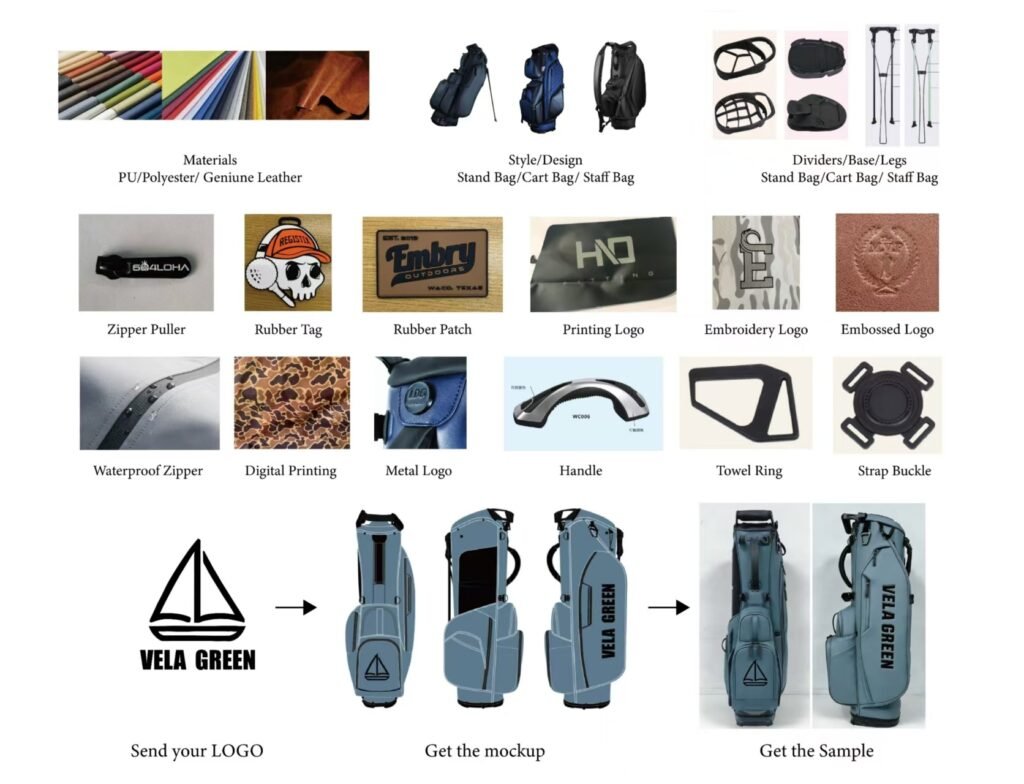
At Vela Green, we provide full-range OEM & ODM services for golf bags, golf headcovers, gloves, towels and other golf accessories. We support custom design, material selection, logo branding, color matching and mass production, strictly complying with CPSC, REACH and other international standards. With mature production experience, reliable quality control and professional export support, we help brands and importers develop market-oriented products with efficient lead times and flexible order quantities.