Choosing the right golf bag order quantity is one of the most critical decisions in B2B procurement. Order too few, and you face stockouts, missed sales, and higher per-unit costs. Order too many, and you tie up cash flow, pay unnecessary storage fees, and risk markdowns on unsold inventory. Yet many buyers default to whatever MOQ the factory offers—without considering the hidden costs of each golf bag order quantity decision.
This guide provides a framework for optimizing your golf bag order quantity across four dimensions: cost efficiency, cash flow management, inventory risk, and supply chain reliability. Whether you are a startup testing your first design or an established retailer managing multiple SKUs, these strategies will transform your approach to golf bag order quantity planning.
Why Golf Bag Order Quantity Matters More Than Ever in 2026
The traditional approach to golf bag order quantity—place one large preseason order and hope it sells—is increasingly risky. Retailers are shifting to in-season reorders to reduce inventory risk, and successful brands are leaving 30% of their buying budget open to chase proven winners rather than locking everything in months before demand is known. More than 60% of B2B buyers now prefer suppliers who offer flexible golf bag order quantity options rather than rigid high-MOQ requirements.
At the same time, the margin for error has shrunk. Overbuying ties up cash that could be used for faster-moving products. Underbuying means lost revenue and disappointed customers when hot items sell out. The right golf bag order quantity sits at the intersection of cost per unit, cash flow availability, and demand forecast accuracy.
The Economics of Golf Bag Order Quantity: Understanding the Cost Curve
Every golf bag order quantity decision starts with the cost-per-unit curve. Larger volumes spread fixed costs—material setup, machine calibration, pattern creation, and quality control—across more units, lowering per-unit price. However, the curve flattens beyond certain thresholds, and the savings from ordering additional units may not justify the added inventory carrying costs.
MOQ Ranges in the Golf Bag Industry
Minimum order quantities for golf bag order quantity vary by factory type and customization level:
- Ultra-low MOQ (5–50 units): Some manufacturers offer entry-level MOQs as low as 5–10 pieces for simple logo updates on existing bag patterns. These work for corporate gifts or tournament small orders but carry the highest per-unit cost.
- Entry-level MOQ (50–100 units): The starting point for most custom golf bag orders. Simple designs with standard materials (nylon, polyester) fall into this range.
- Standard MOQ (100–500 units): The most common range for B2B buyers. At this volume, per-unit costs become competitive, and factories can justify custom materials or moderate design complexity.
- Advanced MOQ (500–1,000+ units): Required for premium materials (PU leather, eco-friendly fabrics), complex divider systems (14-way full-length), or custom-molded hardware. Per-unit costs are lowest at this tier.
Understanding where your golf bag order quantity falls on this spectrum is the first step toward optimization. At the entry-level tier (50–100 units), you are paying a premium for flexibility. At the advanced tier (500–1,000 units), you are gaining cost efficiency at the expense of flexibility.
Bulk Pricing Tiers in Golf Bag Order Quantity
Unit costs drop significantly as golf bag order quantity increases. Industry examples show that a bag priced at $12.10 per unit at 100 pieces may fall to $7.50 per unit at 500+ pieces-. A mid-range custom stand bag might follow this pattern: $35 at 100 units, $28 at 300 units, $24 at 500 units, and $22 at 1,000 units. The marginal saving from 500 to 1,000 units ($2 per unit, or $1,000 total) is often smaller than the saving from 100 to 300 units ($7 per unit, or $1,400 total). This matters because carrying an extra 500 units of inventory requires warehouse space and ties up capital that could otherwise be deployed elsewhere.
Factor #1: Cash Flow and Working Capital in Golf Bag Order Quantity Decisions
The most overlooked variable in golf bag order quantity planning is cash flow. A larger order reduces per-unit cost but requires a larger upfront payment—typically 30% deposit followed by 70% before shipment. For a $30,000 order, you need $9,000 cash for deposit and $21,000 cash within 45–60 days. For a $100,000 order, those numbers become $30,000 and $70,000.
Working Capital Impact by Order Size
| Golf Bag Order Quantity | Unit Cost | Total Order Value | 30% Deposit | 70% Balance |
|---|---|---|---|---|
| 100 units | $30.00 | $3,000 | $900 | $2,100 |
| 300 units | $24.00 | $7,200 | $2,160 | $5,040 |
| 500 units | $22.00 | $11,000 | $3,300 | $7,700 |
| 1,000 units | $20.00 | $20,000 | $6,000 | $14,000 |
The difference between ordering 500 units and 1,000 units is $9,000 in additional working capital tied up—for only $2,000 in cost savings. This example shows why the optimal golf bag order quantity is not always the largest you can afford, but rather the quantity that balances unit cost with cash flow capacity.
For brands with limited working capital, a more aggressive strategy is to start with phased ordering—placing smaller initial orders to validate demand and generate revenue before committing to large volumes. Low-MOX factories, such as those offering 50–100 unit minimums, are ideal for Kickstarter creators or first-time brands testing new designs without massive upfront investments. The per-unit cost is higher, but the inventory risk is dramatically lower.
Factor #2: Inventory Carrying Costs in Golf Bag Order Quantity
Every unit in your warehouse costs money beyond the purchase price. Inventory carrying costs include storage (rent, utilities, insurance), capital cost (interest on money tied up in inventory), obsolescence risk (design changes, color trends), and handling costs (receiving, counting, moving). Industry standard carrying cost is 20–30% of inventory value per year.
Carrying Cost Calculation for Golf Bag Order Quantity
If you hold 500 golf bags with a landed cost of $25 each ($12,500 total inventory value), annual carrying costs at 25% are $3,125—or $6.25 per bag per year. If those bags sit for six months before selling, you add $3.13 to the true cost of each bag. A larger golf bag order quantity may lower the purchase price but increase carrying costs if inventory turns slowly. The optimal order quantity is not the one with the lowest purchase price—it is the one that minimizes total cost (purchase + carrying + ordering costs).
This is especially critical for seasonal products. Golf bags ordered in January for spring delivery that do not sell until summer incur months of carrying costs. Brands that shift to phased ordering—placing a smaller initial golf bag order quantity for preseason, then using in-season reorders for replenishment—reduce inventory carrying costs by 20–40% while maintaining shelf presence.
Factor #3: Logistics and Container Efficiency in Golf Bag Order Quantity
Your golf bag order quantity directly affects per-unit logistics costs. A 20-foot container holds approximately 400–600 golf bags, depending on nesting and packaging. A 40-foot container holds 800–1,200 bags.
Logistics Cost per Unit by Container Fill Rate
| Golf Bag Order Quantity | Container Type | Fill Rate | Ocean Freight Cost | Per-Unit Freight |
|---|---|---|---|---|
| 200 units | LCL (shared) | 30–40% | $120–$180/m³ | $2.50–$4.00 |
| 400 units | 20ft FCL | 100% | $1,200–$1,500 | $3.00–$3.75 |
| 800 units | 40ft FCL | 100% | $1,600–$2,000 | $2.00–$2.50 |
| 1,000 units | 40ft FCL + overfill | 110% | $1,800–$2,200 | $1.80–$2.20 |
Orders that fall significantly below a full container incur LCL (Less than Container Load) charges, which add 5–10 days to transit time due to consolidation and deconsolidation at each end-. A 250-unit golf bag order quantity might cost 30–50% more in per-unit freight than a 500-unit order that fills a 20ft container.
When planning golf bag order quantity, consider whether you can combine multiple SKUs (different colors or models) into a single container shipment. Many factories allow MOQ per design as low as 100 units, but a total container volume of 500–800 units across several designs achieves full container efficiency without overcommitting to a single SKU.
Factor #4: Demand Forecasting and Seasonal Planning
Accurate demand forecasting is the foundation of optimal golf bag order quantity. For golf retail, the standard approach is to hold adequate beginning inventory for approximately the first 90 days of the season-, then use in-season reorders for the remainder.
Seasonal Golf Bag Order Quantity Framework
- Core SKUs (50–60% of budget): Proven bestsellers with consistent historical demand. Commit to higher golf bag order quantity early to secure best pricing and delivery assurance.
- Seasonal/tournament SKUs (20–25% of budget): Event-specific designs with predictable but limited demand windows. Moderate order quantities, timed to arrive just before peak demand.
- Test/fashion SKUs (15–20% of budget): New colors or designs with unknown demand. Small initial golf bag order quantity (100–200 units) for testing, followed by in-season reorders if successful. This “test then chase” approach has become the dominant strategy as apparel has grown more fashion-driven.
The ratio is shifting. Successful brands and retailers now hold back about 30% of their open-to-buy budget for in-season chase opportunities. This allows them to reorder proven winners based on real-time sell-through data rather than betting entirely on preseason forecasts.
Phased Ordering: A Strategy for Optimal Golf Bag Order Quantity
The most sophisticated golf bag order quantity strategy is phased ordering—breaking a total annual requirement into smaller, sequential orders placed throughout the year.
The Three-Phase Golf Bag Order Quantity Model
- Phase 1 (Trial Order – 100–200 units): Launch a new design with a small batch. Test the market, gather customer feedback, and validate quality before scaling.
- Phase 2 (Initial Bulk – 300–500 units): Based on trial success, place a moderate order to cover the next 90 days of demand. Negotiate better per-unit pricing while maintaining flexibility.
- Phase 3 (Repeat Orders – 200–300 units each): Establish a recurring reorder cadence (every 45–60 days) for proven SKUs. This keeps inventory fresh, reduces carrying costs, and allows rapid response to demand spikes.
Phased ordering requires a manufacturer that offers flexible MOQs and fast repeat production cycles—typically 30-day bulk lead times for reorders. The key is building a golf bag order quantity plan that gives you the cost advantages of bulk purchasing while retaining the flexibility to adjust based on real-world sell-through.
Factor #5: Supplier Relationships and Reorder Dynamics
Your relationship with your manufacturer directly influences your golf bag order quantity options. Suppliers who know your brand and have your patterns on file can offer faster reorder lead times—sometimes as low as 15–20 days for existing designs. This reliability allows you to hold smaller safety stock and place more frequent, smaller orders.
Supplier Reliability Metrics for Golf Bag Order Quantity Planning
- On-time delivery rate: Target 95%+. Lower rates force you to carry safety stock, increasing your optimal golf bag order quantity.
- Repeat order lead time: How quickly can the factory produce additional units of an existing design? Faster lead times = smaller optimal order quantities.
- MOQ flexibility: Will the factory accept smaller golf bag order quantity for repeat orders of proven designs, even if first order MOQ was higher?
A strong supplier relationship reduces the need for large, infrequent orders. You can shift from “place one big order and hope” to a responsive replenishment model that matches golf bag order quantity to actual demand.
Common Golf Bag Order Quantity Mistakes to Avoid
| Mistake | Consequence | Solution |
|---|---|---|
| Ordering to hit MOQ without demand forecast | Excess inventory, carrying costs, cash flow strain | Validate demand with trial order first |
| Ignoring container fill rates | 30–50% higher per-unit freight cost | Combine multiple SKUs to fill containers |
| No reorder cadence for proven SKUs | Stockouts on bestsellers | Establish 45–60 day reorder schedule |
| Locking 100% of budget preseason | Missed chase opportunities | Reserve 20–30% for in-season reorders |
| Treating all SKUs equally | Overcommitment on unproven designs | Use tiered strategy: core, seasonal, test |
Conclusion: Master Golf Bag Order Quantity for 2026 Success
The optimal golf bag order quantity is rarely the largest you can afford or the smallest the factory offers. It balances cost efficiency (bulk pricing, container fill rates) against cash flow constraints, inventory carrying costs, demand forecast accuracy, and supplier reliability.
The most successful B2B buyers are shifting from single, large orders to phased ordering—starting with trial quantities of 100–200 units for new designs, moving to moderate 300–500 unit orders for validated products, and establishing regular reorder cadences for proven SKUs. They reserve 20–30% of their budget for in-season chase opportunities and partner with suppliers who offer flexible MOQs and fast repeat production.
Whether you are ordering your first 100 units or your 10,000th, these golf bag order quantity strategies will protect your margins, preserve your cash flow, and keep your inventory turning.
With 20 years of golf bag manufacturing experience and flexible MOQ options (as low as 5 pieces for logo updates, 100 units for custom designs), we help B2B clients optimize their order quantities through phased ordering, combined container shipments, and fast repeat production. Contact us for a free order quantity consultation.
OEM & ODM Service
Whether you’re planning to build your own brand, develop new products, or find a stable manufacturing partner for the US and European markets, working with a professional OEM & ODM factory can significantly improve your product quality and market competitiveness.
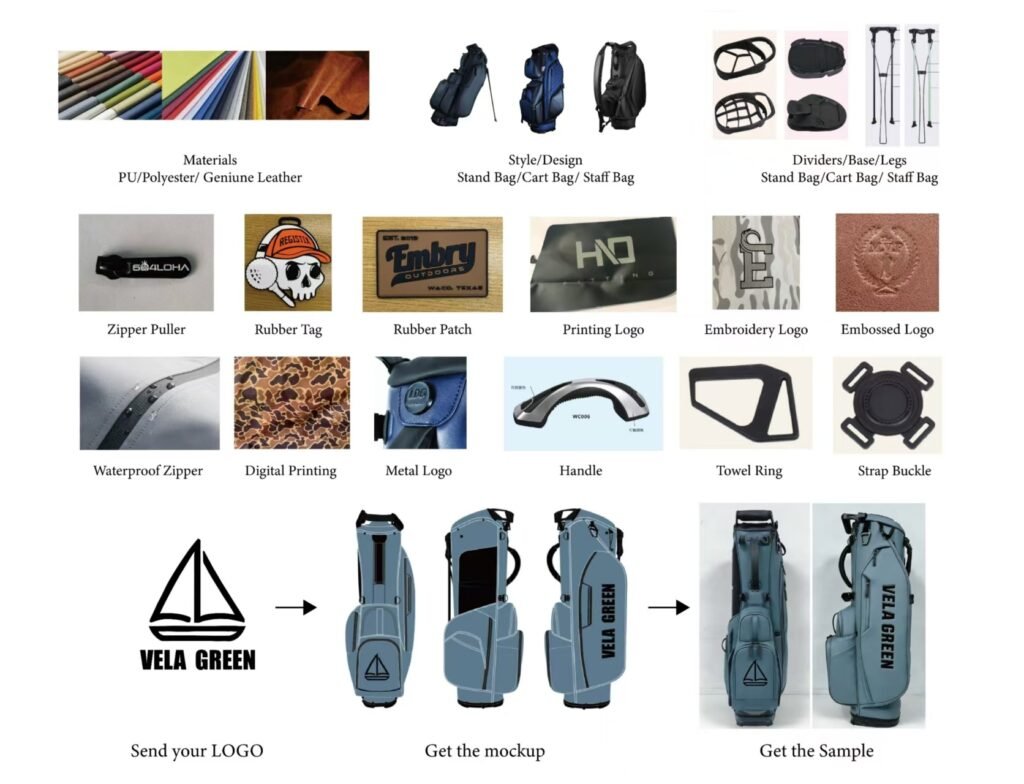
At Vela Green, we provide full-range OEM & ODM services for golf bags, golf headcovers, gloves, towels and other golf accessories. We support custom design, material selection, logo branding, color matching and mass production, strictly complying with CPSC, REACH and other international standards. With mature production experience, reliable quality control and professional export support, we help brands and importers develop market-oriented products with efficient lead times and flexible order quantities.