Reliable golf bag suppliers are the backbone of any successful B2B golf equipment business. In 2026, however, the due diligence landscape for golf bag suppliers has changed dramatically. Tariffs fluctuate. ESG regulations tighten. Supplier reliability directly impacts your margins. Yet many procurement teams continue to evaluate golf bag suppliers using outdated checklists that miss the most expensive risks of all.
This guide outlines six critical risks that B2B buyers must uncover when vetting golf bag suppliers, along with actionable mitigation strategies for each.
The New Reality of Sourcing Golf Bag Suppliers in 2026
The global golf bags market is projected to expand at a CAGR of 3.34%, reaching approximately USD 1.75 billion by 2031-. Yet this growth comes with heightened complexity for procurement teams. Sourcing golf bag suppliers is no longer just about product quality and price—it is about navigating geopolitical tensions, evolving trade tariffs, and stricter ESG (Environmental, Social, and Governance) standards. Brands that master golf bag suppliers risk management consistently achieve higher profit margins, with data showing that companies implementing strong supply chain practices see up to 23% higher profit margins.
The following six risks represent the most common—and most costly—oversights in supplier evaluation today.
Risk #1: Single-Source Dependency in Your Golf Bag Suppliers
Over-reliance on a single manufacturer is the single biggest vulnerability in any golf bag suppliers strategy. If that factory faces a production issue—flooding, labor strike, machine breakdown—your entire supply chain stops. 61% of logistics managers have faced operational disruptions in recent years, many stemming from supplier bottlenecks.
As an example, some brands expand their supplier base to spread risk, while others consolidate suppliers to strengthen partnerships-. For golf bag suppliers, a balanced approach is best. Consider splitting your annual volume across two qualified golf bag suppliers—for instance, 70% with your primary partner and 30% with a secondary supplier. The secondary relationship may cost slightly more, but it functions as a production insurance policy.
How to Assess This Risk:
- Review the supplier‘s reported production capacity (e.g., monthly output between 5,000 and 15,000 units)
- Ask whether they outsource any production steps. Reliable golf bag suppliers maintain in-house control over cutting, sewing, and assembly
- Request a contingency plan. What happens if their fabric supplier fails to deliver? How quickly can they switch to an alternative?
Risk #2: Undisclosed Material Substitutions
Material substitution is a persistent hidden cost in golf bag suppliers relationships. A pre-production sample may use premium 1680D ballistic nylon, but bulk production may substitute cheaper 600D material. This practice erodes durability, damages brand reputation, and triggers customer returns.
China continues to dominate global golf bag production, with manufacturing excellence concentrated in Guangdong and Fujian provinces. However, regional specialization matters. Guangdong‘s integrated supply chains often produce the highest-grade materials, while some emerging clusters may lack the same quality controls.
How to Assess This Risk:
- Require a signed material specification sheet attached to the purchase order, specifying fabric denier, zipper brand, foam density, and thread type
- Demand third-party lab reports for UV resistance, water repellency, and tear strength
- Conduct a mid-production inspection. Surprise visits or video calls during assembly are the surest ways to catch substitutions early
- Cross-reference material invoices. Legitimate golf bag suppliers can trace every fabric roll and zipper batch to an original supplier
Risk #3: Compliance Gaps in Certifications
Compliance failures are among the costliest risks in golf bag suppliers evaluation. An expired ISO 9001 certificate or missing BSCI audit can trigger customs holds, fines, or even destruction of an entire container. For Europe-bound shipments, REACH compliance is mandatory. For California, Prop 65 applies.
Top-tier golf bag suppliers maintain current certifications: ISO 9001 (quality management), BSCI (social compliance and ethical labor), and SEDEX (ethical sourcing). These credentials signal a commitment to standardized processes and responsible manufacturing. Non-compliance with safety, labor, or environmental guidelines can expose manufacturers to lawsuits and harm their reputation.
How to Assess This Risk:
- Request current PDFs of ISO 9001, BSCI, REACH, and any market-specific certifications
- Verify certificate numbers against issuer databases (e.g., BSCI audits are valid for two years; ISO 9001 expires after three years)
- Ask for recent third-party audit reports, not just certificates. Social audits should cover wages, working hours, and child labor prohibitions
- For eco-friendly claims, look for GRS (Global Recycled Standard) certification
Risk #4: Hidden Logistics and Lead Time Vulnerabilities
Logistics risks are often overlooked in golf bag suppliers due diligence, yet they are among the most frequent causes of disruption. Shipping delays, port congestion, and customs clearance problems can add weeks to delivery timelines. 32% of customers abandoned their carts in 2022 due to long shipping times, and 67% of shoppers now expect 2-day delivery.
Supplier location matters. Factories in Guangdong and Fujian provinces benefit from proximity to deep-sea ports like Shenzhen and Xiamen, reducing logistics lead times. Conversely, inland factories add trucking days and risk.
How to Assess This Risk:
- Confirm the supplier’s on-time delivery rate. A figure above 90% signals strong internal coordination and logistics management
- Ask how they manage peak season capacity (May–October). Reliable golf bag suppliers book production slots months in advance
- Discuss contingency shipping. Can they expedite via air freight if sea freight is delayed? What is the cost and lead time difference?
- Review customs documentation readiness. Properly completed commercial invoices and certificates of origin prevent clearance holds
Risk #5: ESG Non-Compliance and Reputational Damage
Environmental, Social, and Governance (ESG) standards are no longer optional for international golf bag suppliers. Major brands enforce strict supplier policies: Acushnet Group, for example, requires fair labor practices and prohibits forced labor, monitored through regular audits under its “Supplier Citizenship Policy”.
Yet many suppliers fail to meet basic ESG expectations. Non-compliant factories may use harmful chemicals in dyes, underpay workers, or operate unsafe facilities. For B2B buyers, partnering with such golf bag suppliers creates reputational risk that can damage your brand among eco-conscious end customers.
How to Assess This Risk:
- Verify BSCI or SA8000 certification. These audits cover wages, working hours, health and safety, and child labor
- Request OEKO-TEX Standard 100 certification for textile components, which tests for over 1,000 harmful substances
- Ask about chemical compliance. REACH (Europe) and Prop 65 (California) are non-negotiable
- For sustainable claims, verify GRS certification rather than accepting generic “eco-friendly” statements
Risk #6: Financial Instability and Poor Responsiveness
The final hidden risk in golf bag suppliers selection is the supplier’s own financial health and operational responsiveness. A supplier that is slow to reply to emails or vague about timelines will not improve during production. Communication quality is a leading indicator of delivery reliability.
Transaction volume provides insight into financial stability. Annual revenue exceeding $100,000 suggests market validation and financial stability, while reorder rates above 30% indicate consistent satisfaction and product quality. Conversely, a supplier refusing sample requests or demanding 100% upfront payment signals cash flow problems.
How to Assess This Risk:
- Measure response time. Under 6 hours for initial inquiries reflects proactive communication
- Check reorder rates. Top golf bag suppliers achieve 40%+ reorder rates, signaling deep client trust and repeat business
- Verify transaction volume and platform ratings. Years of continuous operation indicate financial stability
- Test sample commitment. A supplier unwilling to produce a pre-production sample at reasonable cost lacks confidence in its own quality
A Modern Due Diligence Framework for Golf Bag Suppliers
Rather than treating these six risks as isolated concerns, leading procurement teams integrate them into a structured golf bag suppliers evaluation framework.
Phase 1: Pre-Screening (24–48 hours)
- Assess response time and communication quality
- Request capability presentation and past client references
- Verify basic certifications (ISO 9001, BSCI)
Phase 2: Documented Verification (1–2 weeks)
- Request current certificates and audit reports
- Review material sourcing transparency
- Check platform transaction volume and reorder rates
Phase 3: Physical Validation (2–3 weeks)
- Order pre-production sample with your specifications
- Test sample thoroughly (zippers, straps, stand mechanism, materials)
- Request in-process production photos or video
Phase 4: Contracting and Ongoing Monitoring
- Include AQL (Acceptable Quality Limit) clauses
- Specify material traceability and substitution penalties
- Schedule quarterly performance reviews
The Cost of Skipping Supplier Risk Management
The price of thorough due diligence for golf bag suppliers is negligible compared to the cost of failure. A single defective container of 1,000 golf bags at $25 landed cost represents $25,000 in product value, plus return shipping ($2,000–$5,000), warehouse handling ($500–$1,000), and lost customer trust (incalculable).
Mitigating supply chain risks ensures smooth operations and protects your business from costly disruptions. The six risks in this guide are preventable through systematic evaluation. Each hour invested in verifying golf bag suppliers pays dividends in avoided returns, preserved margins, and sustained customer relationships.
Conclusion
Sourcing golf bag suppliers in 2026 requires more than price comparison. The six hidden risks—single-source dependency, material substitution, certification gaps, logistics vulnerabilities, ESG non-compliance, and financial instability—can each derail your supply chain and destroy margins. Smart buyers integrate these risks into a structured evaluation framework.
The most reliable golf bag suppliers are those who welcome scrutiny: they share certifications, provide material traceability, maintain current compliance, communicate proactively, and demonstrate financial stability through years of consistent performance. Start your next supplier search with this risk checklist.
With 20 years of dedicated golf bag manufacturing, we have built our operations around the very principles outlined here: documented material sourcing, current ISO 9001 and BSCI certifications, transparent lead times, ESG compliance, and client reorder rates that speak for themselves. Contact us to request our supplier due diligence packet.
OEM & ODM Service
Whether you’re planning to build your own brand, develop new products, or find a stable manufacturing partner for the US and European markets, working with a professional OEM & ODM factory can significantly improve your product quality and market competitiveness.
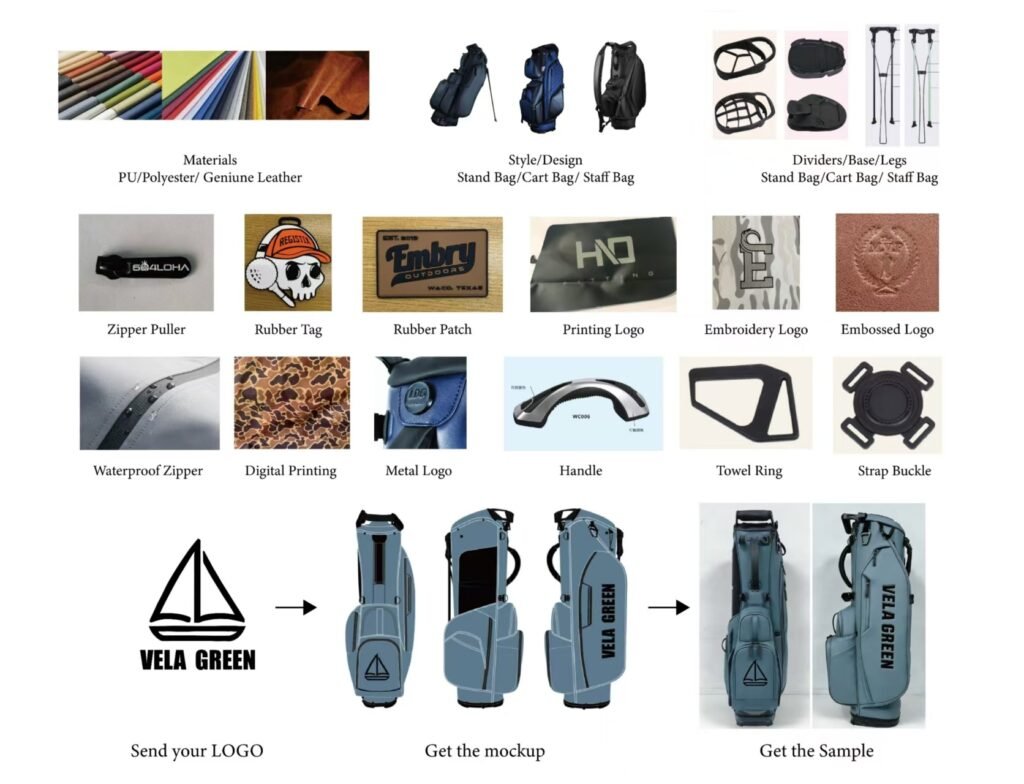
At Vela Green, we provide full-range OEM & ODM services for golf bags, golf headcovers, gloves, towels and other golf accessories. We support custom design, material selection, logo branding, color matching and mass production, strictly complying with CPSC, REACH and other international standards. With mature production experience, reliable quality control and professional export support, we help brands and importers develop market-oriented products with efficient lead times and flexible order quantities.