For B2B golf bag manufacturers, exceptional product quality means little without effective golf bag distribution. A well-designed bag that never reaches the right retail shelves or online storefronts cannot generate revenue. Yet many suppliers focus entirely on production and neglect the downstream golf bag distribution channels that connect their products with end customers. In 2026, the fastest-growing golf bag brands are those that master both manufacturing and golf bag distribution—building robust wholesale networks that drive repeat orders.
This guide outlines five proven golf bag distribution channels that B2B suppliers can leverage to expand market reach, secure retail placement, and grow wholesale volume.
Why Golf Bag Distribution Strategy Matters in 2026
The global golf bags market is expanding at a CAGR of 7.3%, projected to reach US$2 billion by 2030. But growth is uneven across regions and channels. Brands that actively manage their golf bag distribution capture disproportionate share compared to those that rely on passive inbound inquiries. Effective golf bag distribution achieves three critical outcomes: it places products where target customers actually shop, it reduces the time between production and final sale, and it builds relationships that generate repeat wholesale orders.
A distribution strategy should align with your manufacturing strengths. For a factory with 20 years of experience serving 15 countries, the logical next step is to transform production capability into distribution advantage. The five channels below represent the most effective golf bag distribution pathways for B2B suppliers in 2026.
Channel #1: Direct Wholesale to Pro Shops and Golf Courses
Pro shops and on-course retail locations remain the most prestigious golf bag distribution channel. Golfers who play regularly trust the recommendations of course professionals. A bag displayed in a pro shop carries implicit quality endorsement that online listings cannot replicate. Pro shops also typically carry fewer brands, giving your products higher visibility.
How to Build Golf Bag Distribution Through Pro Shops:
- Target high-traffic courses. Public courses with 40,000+ annual rounds move more inventory than private clubs with limited member bases.
- Offer demo bags. Provide the pro shop with one bag to display and test. Golfers need to handle the bag, feel the materials, and test the stand mechanism before purchase.
- Include point-of-sale materials. Branded display stands, product information cards, and care guides help pro shop staff sell your bags confidently.
- Provide favorable terms. Net 60 or consignment terms reduce inventory risk for pro shops, encouraging them to stock your line.
For golf bag distribution, pro shop wholesale pricing typically runs 40–50% off MSRP. Margins are thinner than direct-to-consumer, but volume can be significant for well-positioned products.
Channel #2: Partnership with Off-Course Golf Retailers
Off-course retailers—chains like PGA TOUR Superstore, Dick‘s Sporting Goods, and regional golf specialty shops—represent the largest volume channel in golf bag distribution. These stores carry multiple brands across every price point and attract serious golfers who come prepared to purchase.
Securing Placement with Off-Course Retailers:
- Understand their vendor requirements. Most large retailers have formal vendor onboarding processes, including insurance, compliance documentation, and EDI (Electronic Data Interchange) capability.
- Differentiate your line. Retail buyers see dozens of bag lines annually. Your golf bag distribution pitch must highlight unique features: sustainable materials, smart pockets, lightweight construction, or price-to-value ratio.
- Prepare a sell-in package. Include sample bags, margin analysis, marketing support plans, and sell-through guarantees (e.g., markdown money or return rights).
- Start with regional players. National chains are difficult to enter directly. Build a track record with respected regional retailers first, then approach larger accounts with proof of performance.
Golf bag distribution through off-course retailers typically yields 50–100 unit orders per location, with reorders driven by sell-through velocity. Provide the buyer with sell-through data from other accounts to demonstrate demand.
Channel #3: B2B E‑commerce and Wholesale Marketplaces
Digital golf bag distribution has matured significantly. While pro shops and retail stores remain essential, B2B buyers increasingly research and place orders online. A strong digital presence ensures you capture buyers who never attend trade shows or respond to cold calls.
Building Digital Golf Bag Distribution Channels:
- List on wholesale marketplaces. Platforms like Faire, Abound, and industry-specific B2B sites connect suppliers with independent retailers. Complete your profile with high-quality images, detailed specifications, and transparent pricing.
- Optimize your own B2B website. Create a password-protected wholesale portal where approved buyers can view real-time inventory, download spec sheets, and place reorders. This reduces friction for repeat customers.
- Use SEO to attract buyers. Publish content targeting wholesale searches—like this blog post—to demonstrate expertise and capture inbound inquiries.
- Leverage email marketing. Build a list of wholesale prospects from trade shows and inquiries. Send regular updates about new designs, seasonal promotions, and inventory availability.
Digital golf bag distribution works best for smaller retail accounts (single-location pro shops, online stores) that prefer self-service ordering. Lower your minimum order quantity for these channels to attract trial orders.
Channel #4: Tournament and Corporate Sales
Tournament and corporate sales represent a high-margin, lower-volume golf bag distribution channel with exceptional brand exposure. Corporate outings, charity tournaments, and member-guest events often order custom-branded golf bags as player gifts or prizes. These orders are typically 50–200 units per event, with premium pricing due to the customization.
How to Access Tournament and Corporate Golf Bag Distribution:
- Partner with event organizers. Reach out to tournament directors, country club event coordinators, and corporate incentive houses. Offer competitive pricing on custom bags with short lead times.
- Create a tournament package. Bundle the bag with matching headcovers, towel, and divot tool. This increases average order value while simplifying the organizer‘s purchasing process.
- Showcase past tournament work. Build a portfolio of custom bags produced for recognizable events. Photos of branded bags on the course serve as powerful social proof.
- Offer design support. Many tournament organizers lack in-house design capabilities. Provide template-based customization with quick proof approval.
For golf bag distribution through this channel, lead time is often the deciding factor. Tournament dates are fixed; bags must arrive 2–3 weeks before the event. Build a reputation for on-time delivery, and repeat business will follow.
Channel #5: International Distribution Partnerships
For manufacturers already serving 15+ countries, international golf bag distribution is a natural growth lever. Rather than managing direct export to every market, partner with established in-country distributors who already have sales teams, warehouse facilities, and retailer relationships.
Building International Golf Bag Distribution:
- Identify potential distributors. Research distributors who currently carry complementary but non-competing golf products (e.g., apparel, shoes, training aids). Attend international trade shows (PGA Show, ISPO) to meet candidates face-to-face.
- Prepare an exclusive territory proposal. Distributors invest significantly in marketing and inventory. Offer exclusive distribution rights for a defined territory in exchange for minimum annual purchase commitments.
- Provide marketing and training support. Equip your distribution partners with product catalogs, display materials, and sales training. The more effectively they can sell your bags, the faster your golf bag distribution grows.
- Set clear performance metrics. Define annual volume targets, payment terms, and reporting requirements. Review performance quarterly and adjust territory rights accordingly.
International golf bag distribution typically operates at lower margins than direct wholesale, but the volume can be substantially larger. A good distribution partner opens dozens of retail doors that would take years to access independently.
Integrating Multiple Golf Bag Distribution Channels
Most successful B2B golf bag suppliers do not rely on a single channel. Instead, they build an integrated golf bag distribution portfolio that balances volume, margin, and risk. A typical channel mix might look like this:
| Channel | Share of Volume | Average Margin | Primary Function |
|---|---|---|---|
| Off-course retail | 40–50% | Medium | Volume, brand visibility |
| Pro shops | 15–25% | Medium-High | Prestige, local credibility |
| B2B e‑commerce | 10–15% | High | Low-friction reorders |
| Tournament/corporate | 10–15% | High | Custom premium orders |
| International distributors | 10–20% | Medium | Geographic expansion |
The optimal golf bag distribution mix depends on your manufacturing capacity, pricing strategy, and target markets. Start with two channels, prove success, then expand.
Key Metrics to Track in Golf Bag Distribution
Effective golf bag distribution requires continuous measurement. Track these metrics for each channel:
- Inventory turnover. How many times per year does inventory sell through? Higher turnover reduces carrying costs and frees working capital.
- Sell-through rate. Percentage of units shipped to a retailer that actually sell to end customers. Low sell-through indicates poor channel fit or insufficient marketing support.
- Average order value. Larger orders reduce per-unit logistics costs. Encourage bundling and volume discounts.
- Customer acquisition cost. Total marketing and sales spend divided by new wholesale accounts gained. Improve this by refining your channel targeting.
- Repeat order rate. Percentage of wholesale customers who place a second order. High repeat rates signal satisfied distribution partners and product-market fit.
Review these metrics monthly. Adjust golf bag distribution channel investment toward the channels delivering the strongest results.
Common Golf Bag Distribution Mistakes to Avoid
| Mistake | Consequence | Solution |
|---|---|---|
| Ignoring channel differentiation | Retailers undercut each other on price, eroding margins | Set channel-specific pricing and MAP (Minimum Advertised Price) policies |
| Stocking too many SKUs | Slow inventory turns, high carrying costs | Launch 2–3 core models per channel before expanding |
| No sell-through support | Inventory sits on shelves, no reorders | Provide marketing collateral, demo bags, and staff training |
| Single channel dependency | Vulnerability to channel disruption | Build balanced golf bag distribution across 3+ channels |
| Poor logistics coordination | Late deliveries, damaged products, retailer dissatisfaction | Partner with reliable freight forwarders and set clear shipping SLAs |
Conclusion: Build Your Golf Bag Distribution Network Systematically
Effective golf bag distribution transforms manufacturing capability into market success. The five channels—pro shops, off-course retailers, B2B e‑commerce, tournament sales, and international distributors—each offer distinct advantages. The most successful B2B suppliers build an integrated channel portfolio, track performance metrics relentlessly, and adjust investment toward the channels delivering the strongest returns.
Start by auditing your current golf bag distribution reach. Which channels are underperforming? Which are missing entirely? Then systematically build capability in the channels best suited to your products and target markets. With 20 years of manufacturing experience and clients across 15 countries, you already have the production foundation. Now build the distribution engine that turns quality bags into repeat wholesale orders.
Our factory supports your golf bag distribution efforts with flexible MOQs, branded packaging, and reliable 30‑day bulk production. Contact us to discuss wholesale pricing and sample programs tailored to your target channels.
OEM & ODM Service
Whether you’re planning to build your own brand, develop new products, or find a stable manufacturing partner for the US and European markets, working with a professional OEM & ODM factory can significantly improve your product quality and market competitiveness.
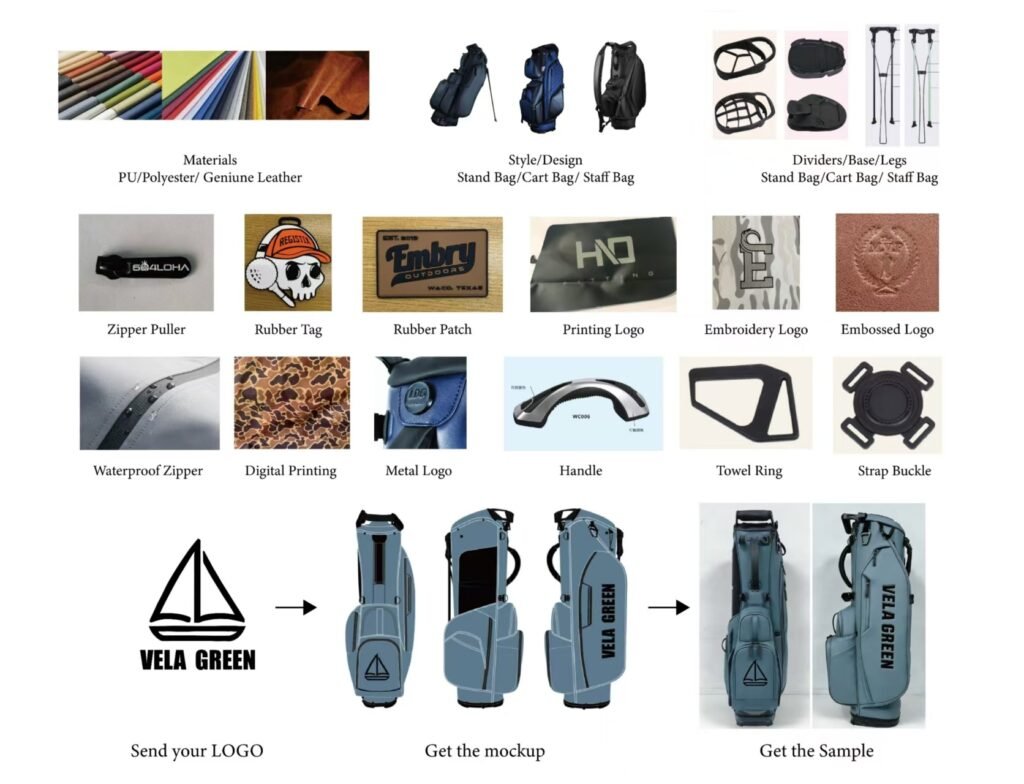
At Vela Green, we provide full-range OEM & ODM services for golf bags, golf headcovers, gloves, towels and other golf accessories. We support custom design, material selection, logo branding, color matching and mass production, strictly complying with CPSC, REACH and other international standards. With mature production experience, reliable quality control and professional export support, we help brands and importers develop market-oriented products with efficient lead times and flexible order quantities.