Golf bag brand licensing has become one of the most powerful growth strategies in the golf equipment industry. The global golf equipment market is projected to grow from USD 8.80 billion to USD 13.17 billion by 2032, and golf bag brand licensing is at the heart of this expansion. From major sports leagues partnering with bag manufacturers to lifestyle brands entering the golf space through licensing agreements, the landscape has never been more dynamic.
This guide explores three proven paths for golf bag brand licensing—OEM licensing partnerships, sports league and event licensing, and brand franchising—and how B2B buyers can leverage each to grow their business.
Why Golf Bag Brand Licensing Matters in 2026
Golf bag brand licensing has evolved significantly. In 2025, Topgolf Callaway Brands extended its licensing agreement with Perry Ellis International for Callaway-branded golf and lifestyle apparel through December 31, 2032, with plans for a premium Callaway Apparel line launching by 2028. This seven-year extension signals continued confidence in brand licensing as a strategic growth driver.
Meanwhile, PowerBilt Holdings entered a global licensing agreement with HEAD Sport GmbH to launch a new line of HEAD golf equipment, blending HEAD‘s reputation for high-performance sports gear with PowerBilt’s 109-year legacy. The collaboration includes a comprehensive lineup including premium golf bags, woods, irons, wedges, and putters.
For B2B buyers, golf bag brand licensing offers multiple benefits:
- Instant brand credibility: Licensed brands carry built-in trust with consumers
- Access to established distribution channels: Licensees benefit from existing retail relationships
- Premium pricing power: Licensed products command higher margins
- Reduced marketing costs: The brand does the heavy lifting in consumer awareness
Path #1: OEM Licensing Partnerships for Golf Bag Manufacturing
The first path in golf bag brand licensing is the OEM licensing partnership model. In this arrangement, a brand owner (licensor) grants a manufacturer (licensee) the right to produce and distribute branded golf bags in exchange for royalties.
How OEM Licensing Partnerships Work
The licensor provides brand rights, design guidelines, and quality standards. The licensee handles manufacturing, quality control, and often distribution. Revenue is shared through royalty payments—typically a percentage of wholesale revenue.
Real-World Examples
- Callaway / Perry Ellis International: Topgolf Callaway Brands has licensed Callaway-branded golf and lifestyle apparel to Perry Ellis International for design, manufacturing, and distribution through 2032. This long-standing partnership, originally signed in 2009, demonstrates the staying power of successful golf bag brand licensing.
- HEAD / PowerBilt: PowerBilt serves as the exclusive global licensee for HEAD golf equipment, blending HEAD’s premium sports reputation with PowerBilt’s manufacturing legacy. The product line includes a Players Series of premium golf bags.
- DKNY / PGB Sports: PGB Sports signed a deal to license DKNY Sport and DKNY Golf men‘s apparel and accessories in Europe, representing an expansion of the DKNY brand into sportswear.
What This Means for B2B Buyers
For manufacturers, securing a golf bag brand licensing agreement with a recognized brand provides instant market credibility and access to established customer bases. For brands, licensing out production allows expansion into categories without building manufacturing capacity. Many factories now serve as authorized OEM producers for world‑known brands such as adidas, TaylorMade, and Mizuno in China.
Path #2: Sports League and Event Licensing
The second path in golf bag brand licensing involves securing rights to produce merchandise for professional sports leagues, tours, and major tournaments. This is one of the fastest-growing segments of the licensed golf merchandise market.
The Scale of Sports Licensing
Mojo Licensing, for example, sells NFL, MLB, NBA, NHL, NCAA, Team USA Olympics, and PGA Tour branded backpacks and luggage. The company recently signed a deal with the PGA Tour that includes golf bags. Its products are distributed through Fanatics, Amazon, Target, and team stores.
Tournament Licensing
Major golf tournaments represent significant golf bag brand licensing opportunities:
- Golf Canada launched an expanded merchandise and licensing program in 2026, welcoming 13 new brands including Peter Millar, G/FORE, Nike, TravisMathew, and Good Good Golf. The program features tournament-exclusive apparel, limited-edition headwear, premium accessories, and commemorative items.
- Stewart Golf signed a licensing partnership with The Open, golf‘s original Championship, covering 2026, 2027, and 2028.
- Abacus Sportswear was appointed as an Official Licensee for the 2026 Solheim Cup-.
- Glenmuir was renewed as an Official Licensee of The Open in a new five-year agreement running from 2026-.
What This Means for B2B Buyers
For golf bag manufacturers, securing a golf bag brand licensing agreement with a major tour or tournament opens doors to premium retail channels and event sales. The barriers to entry are high—licenses are difficult and expensive to obtain—but the payoff is substantial.
Path #3: Brand Franchising and Private Label Licensing
The third path in golf bag brand licensing is the franchise or private label model—where an established brand concept is licensed to operators who run their own locations or product lines under the brand umbrella.
Franchise Models in Golf
The golf franchise sector is expanding rapidly:
- Golf Envy, a California-based indoor golf brand, launched a UK franchise programme in 2026 targeting premium simulator venues-.
- GolfTRK currently has five locations open, 21 franchise units sold, and eight additional locations scheduled to open in 2026, actively seeking franchisees in Denver, Minneapolis, Phoenix, Chicago, and Detroit-.
- RUFF Golf signed a new ten-year Master Franchise agreement for the Midlands in the UK-.
Private Label Licensing for Pro Shops
The private label model is particularly strong in the Middle East, where pro shops are launching private label golf accessories to capture 40–60% higher margins versus reselling third-party brands. A complete OEM order from a factory—from artwork approval to delivery at a Dubai or Riyadh pro shop—takes approximately 45 calendar days.
Custom-branded golf ball markers that cost $1.20 landed can retail at $8.99 in a UAE pro shop—a 7.5x markup, compared to a 2.2x markup on branded accessories. Private label transforms commodity products into brand assets, carrying the club’s identity rather than someone else‘s.
What This Means for B2B Buyers
For manufacturers, the private label and franchise model offers golf bag brand licensing opportunities with lower barriers to entry. Pro shops, resorts, and franchise operators need reliable OEM partners who can deliver branded products with low MOQs and fast turnaround. The Middle East market alone now hosts over 20 championship-caliber golf courses in the UAE, with Dubai’s golf tourism sector generating an estimated $380+ million annually.
Golf Bag Brand Licensing: Choosing the Right Path
| Path | Best For | Key Requirement | Revenue Model |
|---|---|---|---|
| OEM Licensing Partnership | Manufacturers with production capacity | Proven quality systems, certifications | Royalty payments |
| Sports League/Event Licensing | Brands seeking premium positioning | Licensing fees, quality standards | Wholesale + retail sales |
| Brand Franchising/Private Label | Pro shops, resorts, franchise operators | Low MOQ capability, fast turnaround | Direct sales with higher margins |
Common Golf Bag Brand Licensing Mistakes to Avoid
| Mistake | Consequence | Solution |
|---|---|---|
| Ignoring quality standards | Brand reputation damage | Maintain rigorous QC regardless of license type |
| Underestimating royalty costs | Margin erosion | Calculate total cost of licensing before committing |
| No exclusivity protection | Channel conflict | Negotiate territorial or channel exclusivity |
| Skipping legal review | Intellectual property disputes | Have licensing agreements reviewed by counsel |
Conclusion: Leverage Golf Bag Brand Licensing for 2026 Growth
Golf bag brand licensing offers three powerful paths for B2B growth in 2026. OEM licensing partnerships connect manufacturers with established brands seeking production capacity. Sports league and event licensing opens premium retail channels with built-in consumer trust. Brand franchising and private label licensing enables pro shops and resorts to capture higher margins through branded merchandise.
The golf equipment market is growing—from USD 8.80 billion to USD 13.17 billion by 2032. The brands that master golf bag brand licensing today will be the ones capturing market share tomorrow. Whether you are a manufacturer seeking licensed production agreements, a brand looking to expand into golf bags, or a retailer building a private label program, the opportunities in golf bag brand licensing have never been greater.
With 20 years of golf bag manufacturing experience and a proven track record as an OEM partner for brands across 15 countries, we support B2B clients in executing brand licensing strategies. Contact us to discuss how our manufacturing capabilities can support your licensing program.
OEM & ODM Service
Whether you’re planning to build your own brand, develop new products, or find a stable manufacturing partner for the US and European markets, working with a professional OEM & ODM factory can significantly improve your product quality and market competitiveness.
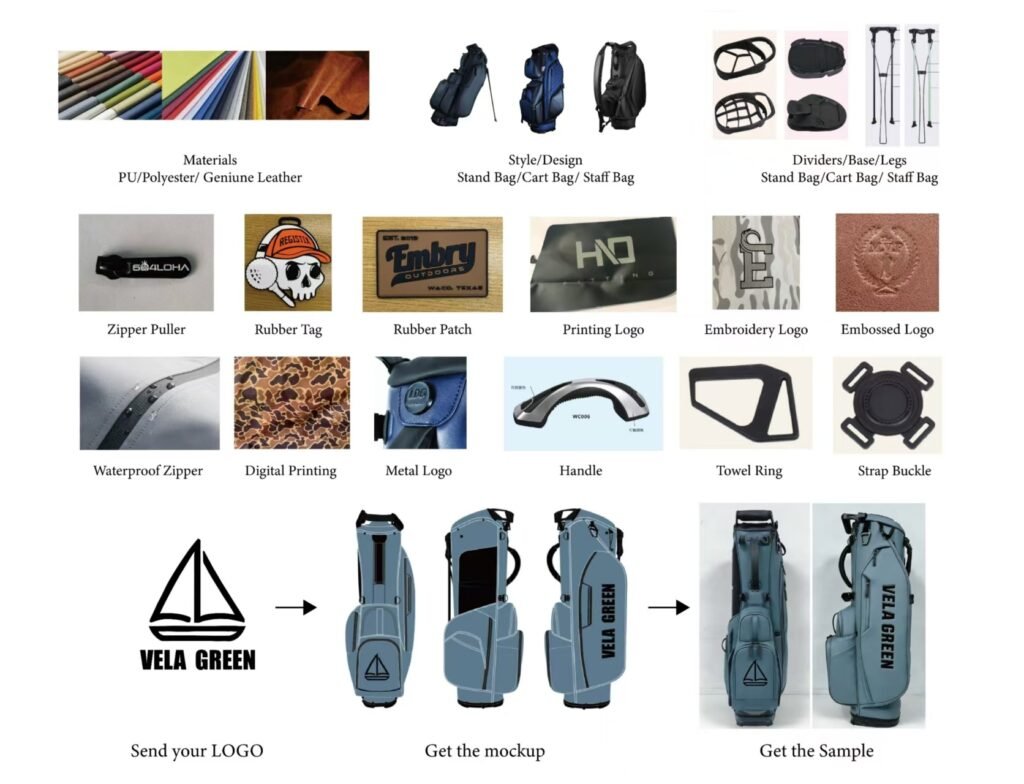
At Vela Green, we provide full-range OEM & ODM services for golf bags, golf headcovers, gloves, towels and other golf accessories. We support custom design, material selection, logo branding, color matching and mass production, strictly complying with CPSC, REACH and other international standards. With mature production experience, reliable quality control and professional export support, we help brands and importers develop market-oriented products with efficient lead times and flexible order quantities.