The global golf bag market trends for 2026 reveal an industry at an inflection point. Rising participation, technological disruption, and shifting consumer preferences are creating both challenges and opportunities for B2B buyers. Understanding these golf bag market trends is no longer optional—it is essential for brands that want to source products that resonate with today‘s golfers and capture growth in an expanding market.
The global golf bags market was valued at approximately USD 1.43 billion in 2025 and is projected to reach USD 1.75 billion by 2031, registering a compound annual growth rate (CAGR) of 3.34%.- Other industry analyses project even stronger growth, with the market forecast to expand from USD 1.5 billion in 2025 to USD 2.2 billion by 2031 at a CAGR of 4.70%.- Within this growing market, six key golf bag market trends are reshaping demand, supply, and the competitive landscape.
Trend #1: The Golf Equipment Boom Is Lifting All Boats
The broader golf equipment market is experiencing remarkable expansion, creating a rising tide that lifts the entire golf bag market trends landscape. The global golf equipment market grew to an estimated USD 20.9 billion in 2026 and is predicted to reach USD 26.7 billion by 2031.- This growth is driven by surging participation—more than 160 million people worldwide played some form of golf in 2025, marking an almost 50% rise from 2023. The US alone is projected to pass 50 million participants across 2026.
For B2B buyers monitoring golf bag market trends, this participation surge translates directly into increased demand for bags across all categories. As more golfers enter the sport, demand rises for entry-level carry bags. As players become more dedicated, they upgrade to premium stand bags and cart bags. And as travel resumes post-pandemic, demand for travel bags continues to grow. The equipment boom creates a favorable environment for brands that can offer the right products at the right price points.
Trend #2: Customization and Personalization Are No Longer Optional
Among the most significant golf bag market trends is the accelerating shift toward customization. Consumers increasingly seek bags that reflect their personal style and identity.- For many middle-class golfers, a golf bag has become a way to showcase personal style and identity.- Premium golf bags are expected to grow at an annual rate of 6.47% through 2030, outpacing the broader market.-
This trend toward premium products is evident across the equipment sector. Customization and personalization have become significant trends in the golf equipment industry, driven by the desire for equipment that matches individual playing styles and preferences.- For B2B buyers, this means sourcing golf bag market trends that include flexible customization options: color choices, embroidery placements, pocket configurations, and material selections. Brands that offer personalization capabilities will capture a growing share of the premium segment.
Trend #3: Smart Technology Integration Is Reshaping Product Expectations
The integration of smart technology into golf equipment is one of the fastest-growing golf bag market trends. AI-driven technology has become a primary driver of equipment demand, with the global golf equipment market‘s growth increasingly attributed to AI adoption.- Major trends in the forecast period include increasing adoption of smart golf equipment, rising demand for eco-friendly gear, and enhanced focus on performance-optimized materials.-
For golf bag market trends, this translates into demand for bags that complement the tech-enabled golfer. Features such as integrated USB charging ports, dedicated padded compartments for GPS devices and rangefinders, cable management systems, and magnetic closures for easy access are becoming standard expectations rather than luxury add-ons. B2B buyers should evaluate suppliers based on their ability to incorporate these smart features into bag designs without compromising durability or weight.
Trend #4: Sustainability Is Driving Material Innovation
Sustainability has moved from a marketing differentiator to a market requirement in golf bag market trends. Growing use of eco-friendly golf gear is identified as a major trend shaping the equipment industry.- Consumers increasingly reward brands that demonstrate genuine environmental commitment, and this is reflected in sourcing decisions.
For B2B buyers tracking golf bag market trends, this means prioritizing suppliers that offer recycled materials (GRS-certified fabrics), bio-based foams, water-based adhesives, and reduced plastic packaging. Sustainable golf bags are no longer a niche category—they are becoming the baseline expectation for premium products. Buyers who incorporate sustainability criteria into their supplier evaluation will be better positioned to meet retailer and end-consumer demands.
Trend #5: Emerging Markets Are Creating New Demand Centers
Geographic shifts represent another critical dimension of golf bag market trends. Rising middle classes, new golf course developments, and expanding e-commerce are driving demand for lightweight, premium, and travel golf bags across Asia and Africa through 2031.-
China, the world‘s second largest economy, is forecast to reach a projected market size of USD 481.0 million for golf bags by 2032, trailing a CAGR of 13.2% over the analysis period 2025-2032.- This growth far outpaces the global average, signaling significant opportunities for B2B suppliers who can establish distribution relationships in the region. Similarly, markets in Southeast Asia and the Middle East are showing increasing demand for premium golf equipment as new courses open and participation grows. B2B buyers should consider these golf bag market trends when planning geographic expansion strategies.
Trend #6: The Rise of Female and Junior Golfers Is Reshaping Product Design
Demographic shifts are fundamentally altering product requirements in golf bag market trends. Female golfers in the United States reached nearly 7.9 million in 2024, increasing from 20% of participants in 2012 to 28% in 2024. Globally, women now account for 43% of off-course participants. This surge in female and junior golfer demographics is creating heightened demand for bags that are lighter, ergonomically tailored for smaller statures, and aesthetically diverse.
For B2B buyers analyzing golf bag market trends, this means sourcing product lines specifically designed for female and junior golfers: lighter materials, adjusted strap ergonomics, shorter bag heights, and fresh color palettes. Pro shops and golf academies serving growing female and junior memberships are actively seeking specialized products. Brands that can offer differentiated designs for these segments will capture market share that generalist competitors miss.
What These Golf Bag Market Trends Mean for B2B Buyers
The six golf bag market trends outlined above point to a clear conclusion: the golf bag industry is becoming more specialized, more technology-driven, and more consumer-focused. B2B buyers who treat these golf bag market trends as strategic signals—rather than passing fads—will build durable competitive advantages.
Actionable Takeaways for B2B Buyers:
- Prioritize suppliers with customization capabilities. Flexible MOQs, in-house embroidery, and material variety are essential for meeting the personalization trend.
- Evaluate smart feature integration. Ask potential partners about their experience with USB ports, magnetic closures, and device-friendly pocket designs.
- Incorporate sustainability criteria. GRS certification, recycled materials, and reduced packaging should be part of your supplier scorecard.
- Plan for emerging market growth. Consider distribution partnerships in Asia and the Middle East to capture expanding demand.
- Develop female and junior product lines. Differentiated designs for these growing segments will differentiate your brand from competitors.
Conclusion: Act on Golf Bag Market Trends Now
The golf bag market trends of 2026 are not gradual shifts—they are accelerating forces that will separate winning brands from laggards over the next 3–5 years. The golf equipment market‘s expansion, the rise of customization, smart technology integration, sustainability demands, emerging market growth, and demographic diversification all point to a more complex but more opportunity-rich environment.
B2B buyers who act on these golf bag market trends now—by sourcing from suppliers with the right capabilities, developing product lines for growing segments, and expanding into new geographic markets—will capture disproportionate share as the market grows. Those who wait will find themselves playing catch-up in a market that is moving faster than ever.
With 20 years of golf bag manufacturing experience and a proven track record serving clients across 15 countries, we stay ahead of every golf bag market trend—from sustainable materials to smart features to flexible customization. Contact us to discuss how our capabilities align with your 2026 sourcing strategy.
OEM & ODM Service
Whether you’re planning to build your own brand, develop new products, or find a stable manufacturing partner for the US and European markets, working with a professional OEM & ODM factory can significantly improve your product quality and market competitiveness.
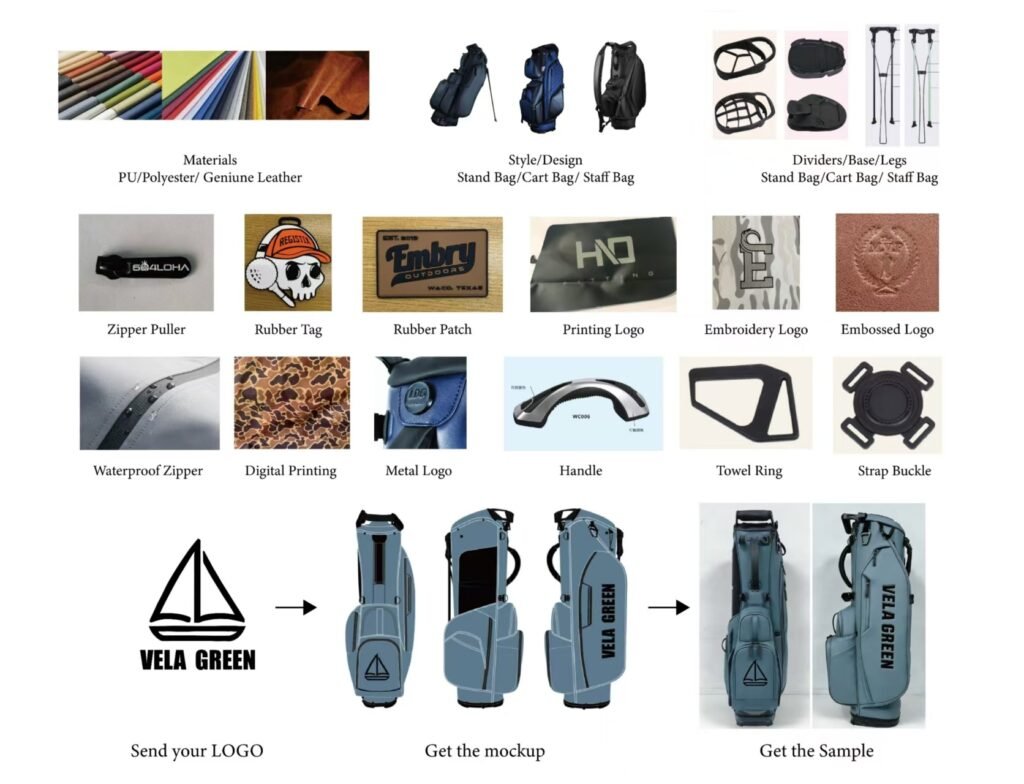
At Vela Green, we provide full-range OEM & ODM services for golf bags, golf headcovers, gloves, towels and other golf accessories. We support custom design, material selection, logo branding, color matching and mass production, strictly complying with CPSC, REACH and other international standards. With mature production experience, reliable quality control and professional export support, we help brands and importers develop market-oriented products with efficient lead times and flexible order quantities.