Effective golf bag brand building has never been more critical for B2B suppliers. The global golf bags market is projected to expand from USD 1.43 billion in 2025 to USD 1.75 billion by 2031, registering a CAGR of 3.34%-. Yet growth alone does not guarantee success. Brands that master golf bag brand building capture disproportionate share, while those that treat their product as a commodity compete solely on price.
This guide presents five essential golf bag brand building strategies for B2B buyers and suppliers in 2026—from defining your brand identity to building wholesale partnerships that drive repeat orders.
Why Golf Bag Brand Building Matters in 2026
The golf industry is undergoing a fundamental transformation. More than 160 million people worldwide played some form of golf in 2025, marking an almost 50% rise from 2023-. The US alone is projected to surpass 50 million participants in 2026-. Female golfers in the United States reached nearly 7.9 million in 2024, increasing from 20% of participants in 2012 to 28%. Younger demographics are joining in record numbers.
This participation surge creates unprecedented opportunity for golf bag brand building. More golfers mean more demand for bags across every category—entry-level carry bags, premium stand bags, travel bags, and custom designs. But it also means more competition. The brands that succeed in 2026 are those that treat golf bag brand building as a strategic priority, not an afterthought.
A golf bag has always been one of the most visible pieces of equipment in the sport. Historically treated as purely practical, the bag is now becoming a canvas for self-expression. Brands that understand this shift—and build their identity around it—will win the loyalty of today‘s diverse, style-conscious golfers.
Strategy #1: Define Your Golf Bag Brand Identity
The foundation of any successful golf bag brand building effort is a clear brand identity. Without a defined position in the market, your brand becomes indistinguishable from competitors.
Key Questions for Golf Bag Brand Building:
- What is your brand‘s core promise? Sunday Golf, for example, built its identity around making golf “more approachable and inclusive without compromising on quality”. Its products are lightweight, functional, and approachable for a broad range of golfers.
- Who is your target customer? Are you serving premium country club members, young urban golfers, corporate gift buyers, or tournament organizers? Each segment has different needs and price expectations.
- What is your brand‘s visual identity? Color palette, logo design, and product aesthetics should be consistent across all touchpoints. Brands like OGIO have built recognition through bold, conversation-starting designs that inject personality into the fairways.
A well-defined brand identity guides every decision in golf bag brand building—from product design to packaging to wholesale sales materials.
Strategy #2: Differentiate Your Products Through Design and Materials
Product differentiation is the most visible element of golf bag brand building. In a crowded market, your bags must stand out on retail shelves and on the course.
Differentiation Strategies for Golf Bag Brand Building:
- Bold design and colorways. Cleeks GC collaborated with artists to create bags that looked more like art pieces than traditional golf gear. OGIO launched its “Ham and Eggs” colorway across seven leading models, continuing its tradition of brave, conversation-starting designs. Limited-edition seasonal styles give retailers a fresh story each season.
- Material innovation. BIG MAX introduced materials that are both scratch and abrasion resistant, offering water repellence and weather resistance-. Brands using sustainable materials—such as recycled polyester and bio-based foams—appeal to eco-conscious golfers and retailers-.
- Functional superiority. Sunday Golf‘s 2026 lineup is built to help partners win with golf bags that are lightweight and have unique design. OGIO launched its lightest-ever carry bag, the Featherlite, a minimalist stand bag designed for durability without the weight-.
For B2B suppliers, golf bag brand building through differentiation means offering wholesale partners a product story they can sell—not just a price point they can discount.
Strategy #3: Expand Beyond the Bag—Build a Lifestyle Brand
The most sophisticated golf bag brand building strategy in 2026 is expansion beyond the bag itself. Leading brands are transforming from product manufacturers into lifestyle platforms.
ORKAI (formerly ORCA Golf) represents this shift perfectly. The brand evolved from a premium golf bags manufacturer into “a modern golf lifestyle platform designed for today‘s discerning golfer”. It now offers custom and retail premium golf bags alongside expanded lifestyle categories, including travel accessories and off-course essentials. The brand’s philosophy is that a golf bag should be “a statement, not a mere utility”-, reflecting the golfer‘s personal style and values-.
Swag Golf transformed from a boutique putter manufacturer into “a premier force in golf gear, accessories, and apparel”, transitioning from sold-out DTC drops to a sophisticated omnichannel powerhouse. Its revenue is now balanced between its digital community and a rapidly expanding wholesale footprint.
For B2B suppliers, this trend in golf bag brand building creates opportunities to offer expanded product lines—matching headcovers, towels, gloves, travel accessories, and lifestyle items—that increase average order value and wholesale account loyalty.
Strategy #4: Build Strong Wholesale Partnerships
Wholesale channel strategy is a critical component of golf bag brand building. In 2026, successful brands treat wholesale relationships as partnerships, not transactions.
Wholesale Golf Bag Brand Building Tactics:
- Differentiate wholesale offers. The smart move in 2026 is to segment your channels clearly, differentiate your wholesale offers (assortment, pricing, collateral) and maintain control of brand experience-. Reserve certain fabrics or colorways for wholesale partners, or create exclusive bundles.
- Use data to drive assortment. Analyze which SKUs move fastest in pro-shop channels vs. resort shops vs. online club orders. Build channel-specific cores and wholesale special bundles.
- Improve the buying experience. In 2026, strong brands stand out by making wholesale ordering seamless—digital portals, live inventory views, flexible replenishment, and options for personalization or club-logo programs.
- Enable sell-through. Support wholesale partners with content (how-to guides, demo kits), events (club demo days, tournament activations), and retailer training.
A strong wholesale strategy in golf bag brand building transforms retail partners into brand advocates who actively promote your products to their customers.
Strategy #5: Leverage Trade Shows and Industry Events
Trade shows remain a vital channel for golf bag brand building in the B2B golf industry. The 2026 PGA Show hosted more than 1,000 exhibiting companies and brands, including the game‘s most recognizable names and emerging innovators across equipment, technology, apparel, and accessories-.
Trade Show Strategies for Golf Bag Brand Building:
- Create a memorable booth experience. Sunday Golf, a PGA Show mainstay for years, hosts a world-famous happy hour gathering on the first day of the show. This builds relationships and keeps the brand top-of-mind for buyers.
- Showcase new products. The PGA Show serves as a key meeting point for brands and retailers as the industry evolves and expand. Launching new lines or limited-edition colorways at trade shows generates buzz and media coverage.
- Targeted B2B events. The Golf Business Expo, set for October 2026, offers a more targeted B2B environment for suppliers and buyers of golf equipment-.
For golf bag brand building, trade shows provide face-to-face interaction that digital channels cannot replicate. Buyers need to touch fabrics, test zippers, and feel strap padding before committing.
Golf Bag Brand Building Metrics to Track
Effective golf bag brand building requires measurement. Track these key performance indicators:
| Metric | What It Measures | Target |
|---|---|---|
| Wholesale account growth | New retail partners acquired | 10–20% annual increase |
| Reorder rate | Wholesale partner loyalty | 40%+ |
| Average order value | Per-account revenue | 15%+ annual growth |
| Brand recall | Recognition among target buyers | Measured via surveys |
| Sell-through rate | Retailer inventory movement | 70%+ within season |
Review these metrics quarterly. Adjust your golf bag brand building strategy based on what the data reveals.
Common Golf Bag Brand Building Mistakes to Avoid
| Mistake | Consequence | Solution |
|---|---|---|
| Competing solely on price | Margin erosion, commodity positioning | Differentiate through design, materials, service |
| Ignoring wholesale channel | Missed retail opportunities | Build dedicated wholesale program |
| Inconsistent branding | Confused market positioning | Maintain consistent visual identity |
| No sell-through support | Slow retailer inventory turns | Provide marketing collateral and training |
| Treating all channels equally | Channel conflict, diluted brand | Differentiate offers by channel |
Conclusion: Start Your Golf Bag Brand Building Journey Today
Golf bag brand building in 2026 requires a comprehensive approach that goes far beyond product quality. Define your brand identity clearly. Differentiate through bold design and innovative materials. Expand beyond the bag into lifestyle categories. Build wholesale partnerships based on mutual growth. Leverage trade shows to build relationships.
The global golf bags market is growing. Participation is surging. New demographics—female golfers, younger players, international markets—are creating unprecedented demand. The brands that master golf bag brand building today will capture the market‘s growth tomorrow. Those that treat their product as a commodity will compete on price alone.
With 20 years of golf bag manufacturing experience and a proven track record serving clients across 15 countries, we support your golf bag brand building efforts with flexible MOQs, custom design capabilities, and consistent quality. Contact us to discuss how we can help bring your brand vision to life.
OEM & ODM Service
Whether you’re planning to build your own brand, develop new products, or find a stable manufacturing partner for the US and European markets, working with a professional OEM & ODM factory can significantly improve your product quality and market competitiveness.
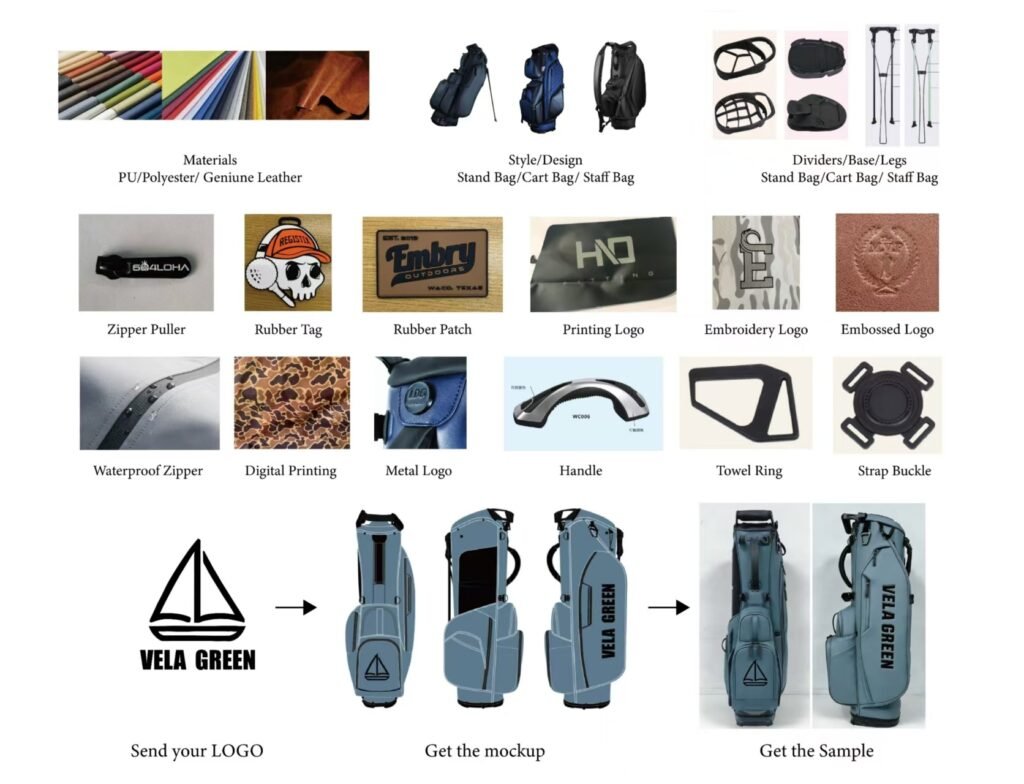
At Vela Green, we provide full-range OEM & ODM services for golf bags, golf headcovers, gloves, towels and other golf accessories. We support custom design, material selection, logo branding, color matching and mass production, strictly complying with CPSC, REACH and other international standards. With mature production experience, reliable quality control and professional export support, we help brands and importers develop market-oriented products with efficient lead times and flexible order quantities.