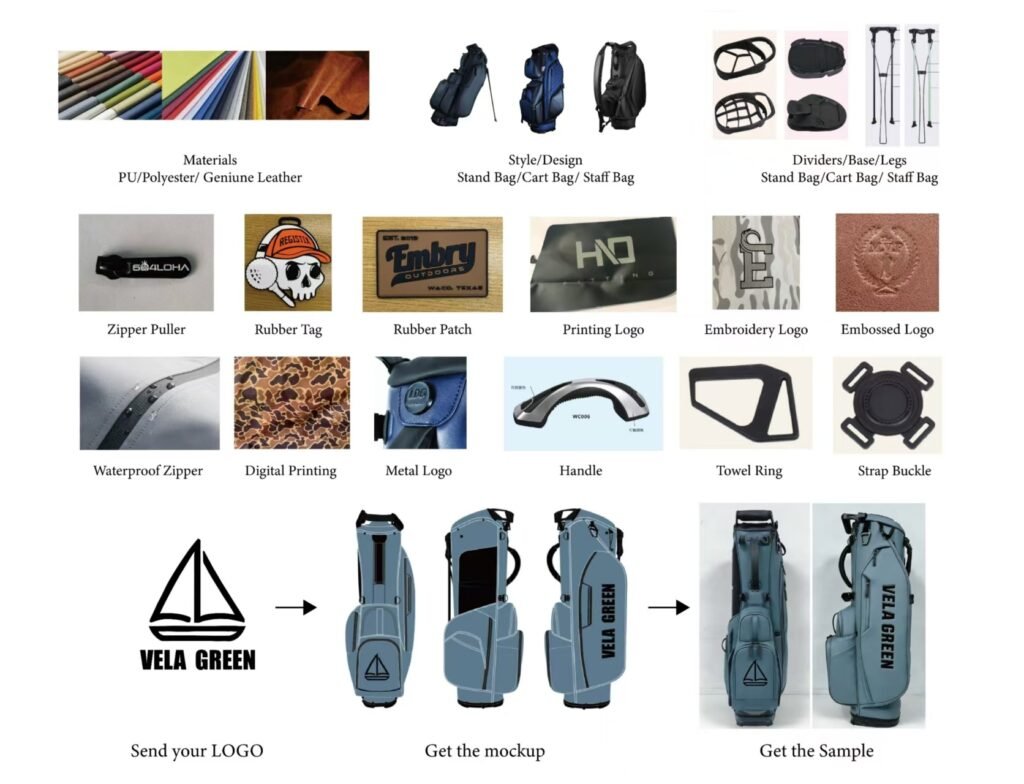
The global golf bag OEM manufacturing landscape has transformed dramatically in 2026. Rising participation—with over 160 million golfers worldwide and the US alone projected to surpass 50 million players—has created unprecedented demand for custom golf bags. The global golf bags market, valued at USD 1.43 billion in 2025, is projected to reach USD 1.75 billion by 2031-. For B2B buyers, understanding golf bag OEM manufacturing is no longer optional—it is essential for sourcing products that meet quality standards, cost targets, and delivery timelines.
This guide provides a comprehensive overview of golf bag OEM manufacturing, from production processes and quality control to material innovation and supplier selection.
What Is Golf Bag OEM Manufacturing?
Golf bag OEM manufacturing refers to the production of golf bags by a factory that operates under another brand‘s name. The brand provides design specifications, material requirements, and branding elements, while the OEM golf bag production factory handles the entire manufacturing process—from sourcing materials to assembly, quality control, and packaging-.
In 2026, top-tier golf bag OEM manufacturing partners offer more than just assembly. They provide full-service capabilities including in-house design support, rapid prototyping, material sourcing, and logistics coordination. The best custom golf bag factories maintain ISO 9001 certification, BSCI compliance, and REACH chemical safety standards.
Why European Brands Are Accelerating China OEM in 2026
A significant trend in golf bag OEM manufacturing is the accelerating shift of European golf brands toward China-based production. Chinese factories deliver 15–30% total cost savings versus European domestic production, driven by lower labor, energy, and raw material costs. Top factories operate at annual capacities exceeding 50 million dozen, with automated production lines achieving consistency metrics that match or exceed many Western facilities.
European market access requires more than cost competitiveness—factories must hold CE marking capability and comply with REACH chemical safety regulations. The factories that have invested in both CE and USGA certifications can now serve dual markets from the same production line.
The Golf Bag OEM Manufacturing Process: 5 Key Stages
Professional golf bag OEM manufacturing follows a structured five-stage process that ensures quality and consistency-.
Stage 1: Design and Planning
The golf bag OEM manufacturing process begins with client discussions to determine bag type (stand, cart, tour, travel), dimensions, divider configuration (4-way, 6-way, or 14-way), pocket layouts, material preferences, and branding requirements-. CAD and 3D tools help visualize the design before production begins-. Leading manufacturers now compress this phase by offering in-house design teams that can translate client concepts into production-ready technical drawings within days.
Stage 2: Material Sourcing and Sampling
Once the design is finalized, the factory sources all materials—fabric, zippers, foam padding, hardware, webbing, and thread. For standard materials, samples generally take 7–10 days to produce. However, custom-dyed fabrics or specialized hardware like branded zippers can stretch this timeline to 20–25 days.
Top golf bag OEM manufacturing partners have compressed sampling to 7–10 days through independent R&D workshops and flexible production lines. This speed allows brands to test designs and iterate quickly before committing to bulk production.
Stage 3: Bulk Production
After sample approval, the OEM golf bag production process moves to full manufacturing. Standard production runs of 50–100 units require 30–45 days. For larger orders, industry benchmarks show that leading manufacturers can deliver 2,000 units or less in 30 days.
Stage 4: Quality Inspection
Quality control in golf bag OEM manufacturing happens at multiple stages—incoming material inspection, in-line production checks, and final pre-shipment inspection. Factories with AQL 2.5 inspection protocols typically deliver higher consistency across large batches-.
Stage 5: Packaging and Logistics
The final stage involves individual polybagging, carton assembly, barcode labeling, and master carton packing for international shipping. Proper golf bag OEM manufacturing partners coordinate sea freight, customs documentation, and delivery to your warehouse-.
Key Certifications in Golf Bag OEM Manufacturing
When evaluating golf bag OEM manufacturing partners, certifications provide objective proof of capability and compliance-:
| Certification | What It Validates |
|---|---|
| ISO 9001 | Documented quality management system |
| BSCI | Ethical labor practices and social compliance |
| REACH | Chemical safety for European market |
| OEKO-TEX | Textile safety testing for harmful substances |
| CE Marking | EU market access for equipment |
| USGA/R&A | Conformance with golf governing body standards |
Factories with ISO 9001 certification typically maintain on-time delivery rates above 95% and batch inspection pass rates exceeding 99.5%. The highest-performing custom golf bag factories achieve client reorder rates of 70%, demonstrating consistent quality and reliability.
Material Innovation in Golf Bag OEM Manufacturing
Material selection is a critical decision in golf bag OEM manufacturing, accounting for 40–50% of unit costs. In 2026, several material trends are reshaping the industry:
- Jacquard Nylon: A textured synthetic material trending for 2026 that offers a premium look without adding extra weight. Standard nylon bags weigh about 5.5 lbs.
- Hydrolysis-Resistant PU Leather: Lower-quality PU leather can scratch or peel over time in humid conditions. Sourcing hydrolysis-resistant PU leather ensures 3–5 years of durability.
- Matte Black Waterproof PU Leather: A trendy choice for minimalist stand bags in 2026.
- Recycled Materials (RPET): Recycled polyester (rPET) is gaining popularity, particularly in European markets. MNML Golf introduced bags made from 100% recycled materials at a $349 price point, significantly undercutting traditional PU leather bags.
Switching to sustainable materials can slash the carbon footprint of a golf bag by up to 85%, while improved manufacturing techniques can save as much as 200 liters of water per bag-.
Quality Control Standards in Golf Bag OEM Manufacturing
Professional golf bag OEM manufacturing implements multi-stage quality control:
IQC (Incoming Quality Control): All materials—fabric rolls, zippers, hardware, foam—are inspected before production begins. Fabric is tested for tensile strength, water resistance, and UV stability.
IPQC (In-Process Quality Control): Random checks during assembly examine stitch length ( ±0.5mm tolerance), seam alignment, logo placement, and hardware attachment. The first article off the line must match the golden sample exactly-.
PSI (Pre-Shipment Inspection): Final 100% visual inspection catches surface defects before packing. AQL (Acceptable Quality Level) Level II, 2.5/4.0 is the industry standard-. Factories that meet REACH and CPSIA standards are better equipped to handle environmental and safety requirements-.
How to Choose the Right Golf Bag OEM Manufacturing Partner
Selecting the right golf bag OEM manufacturing partner requires evaluating multiple factors:
1. Production Capacity and Lead Times
Verify monthly output and standard lead times. Leading manufacturers deliver 2000-piece orders in 30 days. Ask for documented on-time delivery rates—top suppliers maintain 95%+.
2. Customization Capabilities
True custom golf bag factory partners offer full design control—material selection, color matching, size grading, internal compartment layout, and packaging-. Evaluate whether the supplier can handle OEM (full creative control) or ODM (faster, more affordable production) models.
3. Sample Speed and Quality
The best golf bag OEM manufacturing partners deliver samples in 7–10 days. If a factory takes 20+ days for an initial sample, they lack agile capacity.
4. Certifications and Compliance
Verify current ISO 9001, BSCI, REACH, and any market-specific certifications. Non-compliance can trigger customs holds, fines, or product destruction.
5. Client References and Reorder Rates
Ask for client references and reorder rates. A 70%+ reorder rate signals consistent quality and satisfaction.
6. Communication and Responsiveness
Test responsiveness before committing. A golf bag OEM manufacturing partner that takes days to reply will not improve during production.
2026 Tariff Considerations in Golf Bag OEM Manufacturing
The 2026 tariff landscape significantly impacts golf bag OEM manufacturing sourcing decisions. Since April 2026, golf bags imported into the US face a layered tariff system-. Golf bags made from man-made fibers under HTS 4202.92.31 are subject to a total effective duty of 52.6%—combining a 17.6% base rate, 25% Section 301 duty, and a 10% surcharge. Vietnam and Taiwan offer lower rates at approximately 10%, making them attractive sourcing options.
The EU now requires 10-digit TARIC codes for customs clearance, with a flat €3 duty per tariff sub-heading applying from July 1, 2026. Errors in classification can lead to severe financial penalties, ranging from 20% of dutiable value to as much as four times the lawful duties.
Emerging Markets for Golf Bag OEM Manufacturing
China leads Asia‘s golf bag market, with projections estimating it will reach USD 134.1 million by 2031-. The country’s rapid urbanization and heavy investments in sports infrastructure are fueling new golf facilities in major cities-. China‘s strong network of OEM clusters allows manufacturers to quickly adapt to evolving design trends and maintain shorter production timelines-.
Vietnam and Taiwan are gaining ground as cost-effective production hubs. The Middle East is also emerging as a growth market, with pro shops launching private label golf accessories through Chinese OEM factories-.
The Future of Golf Bag OEM Manufacturing
Several trends will shape golf bag OEM manufacturing over the next 3–5 years:
- Smart Equipment Integration: The smart golf equipment market is expected to grow by 15% annually through 2027, with over 35% of golfers expressing interest in GPS tracking and mobile connectivity features-.
- Lightweight Technology: Competition has shifted to lightweight technology, with leading products achieving weights under 1.8kg while maintaining IPX7 waterproofing and 12.7kg tear strength-.
- Sustainable Materials: Recycled fabrics, biodegradable components, and carbon-neutral manufacturing are reshaping golf bags for durability and reduced environmental impact-.
- AI and Automation: AI and automation are revolutionizing golf bag OEM manufacturing, enhancing customization, efficiency, and quality-.
Conclusion: Master Golf Bag OEM Manufacturing for 2026 Success
Golf bag OEM manufacturing in 2026 offers unprecedented opportunities for B2B buyers—but only for those who understand the landscape. From the 15–30% cost advantages of China-based production to the 7–10 day sampling capabilities of agile manufacturers, from AQL quality control standards- to material innovations like Jacquard Nylon and recycled RPET, the factors that separate winning brands from laggards are clear.
Choose golf bag OEM manufacturing partners with proven certifications, documented quality systems, flexible production capabilities, and transparent communication. Verify their reorder rates, test their samples, and build long-term relationships. The brands that master golf bag OEM manufacturing today will capture the growing market tomorrow.
With 20 years of dedicated golf bag manufacturing experience, ISO 9001 and BSCI certifications, 7–10 day sampling capability, and a client reorder rate exceeding 70%, we deliver consistent quality across stand bags, cart bags, travel bags, and custom accessories for clients in 15+ countries. Contact us to discuss your OEM golf bag production project.
OEM & ODM Service
Whether you’re planning to build your own brand, develop new products, or find a stable manufacturing partner for the US and European markets, working with a professional OEM & ODM factory can significantly improve your product quality and market competitiveness.
At Vela Green, we provide full-range OEM & ODM services for golf bags, golf headcovers, gloves, towels and other golf accessories. We support custom design, material selection, logo branding, color matching and mass production, strictly complying with CPSC, REACH and other international standards. With mature production experience, reliable quality control and professional export support, we help brands and importers develop market-oriented products with efficient lead times and flexible order quantities.