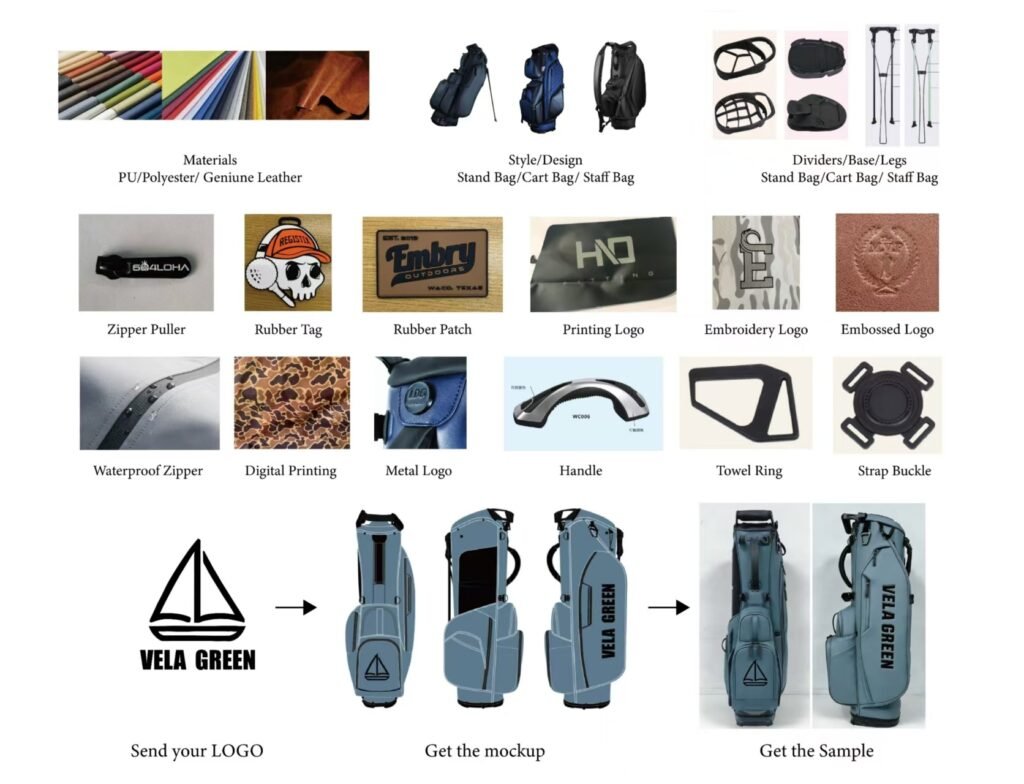
The golf bag OEM process is the engine that transforms your brand‘s vision into a physical product that golfers trust. OEM (Original Equipment Manufacturer) means you retain full control over every detail—design, materials, features, and branding—while the factory handles production. Understanding the golf bag OEM process is essential for B2B buyers seeking reliable supply chain partners.
Whether you are launching a new line of stand bags for walking golfers or developing premium cart bags for tournament play, the golf bag OEM process follows five predictable stages. This guide walks you through each stage, from initial concept to final delivery, to help you plan effectively and avoid costly delays.
Why Understanding the Golf Bag OEM Process Matters
In 2026, the global golf bags market was valued at US$1.3 billion and is projected to reach US$2 billion by 2030, growing at a CAGR of 7.3%-. Smart golf equipment will continue to gain traction, with the segment expected to grow by 15% annually through 2027-. In this dynamic environment, partners who master the golf bag OEM process gain a significant competitive advantage over those who treat sourcing as a series of disconnected transactions.
For B2B buyers, the golf bag OEM process encompasses five key stages: design and development, sampling and prototyping, bulk production, quality control, and logistics and delivery. Each stage has specific timelines, cost structures, and quality benchmarks.
Stage 1: Design and Development in the Golf Bag OEM Process
The first stage of the golf bag OEM process turns your brand vision into tangible plans. It begins with gathering specifications: bag type (stand, cart, tour, travel), number of dividers (4-way, 6-way, or 14-way with full-length coverage), pocket configurations (insulated cooler, lined valuables pocket), and branding requirements (logo placement, embroidery details).
During this phase, factories create CAD drawings and tech packs outlining dimensions, component layouts, material specifications, and stitch patterns. These design documents become the roadmap for the rest of the golf bag OEM process. Even the smallest design errors caught at this stage save weeks of rework downstream.
Key Design Decisions in the Golf Bag OEM Process
Material selection is critical. Common fabrics include nylon, polyester, and PU leather—each offering different trade-offs between weight, durability, and cost. For bag structure, aluminum and lightweight metals provide internal support, while hardware choices (zippers, buckles, clasps) must balance aesthetic appeal with long-term corrosion resistance.
Functional features require careful planning: ergonomic contour-fit straps reduce shoulder strain; pivoting base systems improve walking balance; quick-release buckles simplify adjustments on the course. Many brands now also incorporate sustainable materials, such as recycled polyester and organic cotton, into their designs to appeal to eco-conscious golfers.
Before moving to sampling, request physical fabric swatches and a color card from your manufacturer. This simple step confirms material quality and color accuracy before the golf bag OEM process proceeds further.
Stage 2: Sampling and Prototyping in the Golf Bag OEM Process
The sampling stage is the most critical in the entire golf bag OEM process. It transforms technical drawings into a physical product—your first opportunity to hold, test, and refine your design before committing to full production.
Factories create initial samples using your specifications. Standard sample lead times average 7–14 days, depending on customization level-. More agile manufacturers offer expedited sampling in 7–14 days by starting with 3D digital prototypes before moving to physical samples-. For crowdfunding campaigns or tight deadlines, this speed is invaluable—with physical samples in hand, campaigns that reach 30% funding in the first week achieve 75% success rates.
Testing Your Sample: What to Evaluate
When your sample arrives, test everything. Open and close every zipper at least 20 cycles to confirm smooth operation. Load the bag with a full set of clubs (including driver, fairway woods, hybrids, and putter) and assess weight distribution. If it is a stand bag, deploy the leg mechanism 10–15 times—legs should extend smoothly, lock securely, and retract fully when lifted. Walk with the loaded bag for at least 10 minutes to evaluate strap comfort and balance.
Expect 1–3 sample rounds before final approval. Each revision adds 5–10 days to the overall golf bag OEM process timeline, so provide clear, written feedback the first time to minimize delays. Expedited sampling costs typically range from $300 to $800 per prototype—about 20% to 30% higher than standard services.
Stage 3: Bulk Golf Bag OEM Process Production
After sample approval, the golf bag OEM process moves to full production. Factories source all materials in your order quantity: fabric, foam padding, zippers, hardware, webbing, and thread. Material procurement for standard items typically takes 5–10 days. Custom-dyed fabrics or custom-molded hardware may require extended sourcing windows.
Once materials arrive, the factory schedules your order on the production line. The actual OEM golf bag production timeline depends on three factors:
- Order volume: Standard production after sample approval takes 30–45 days. Smaller batches under 500 units can ship in as little as 15 days-. Complex builds with molded components or multi-material assemblies may extend to 60 days-.
- Design complexity: Bags with full-length 14-way dividers require significantly more assembly time than simple 4-way layouts.
- Factory capacity: During peak season (May–October for holiday inventory), production queues extend by 30–50%. Plan your golf bag OEM process calendar accordingly.
Modern manufacturing combines traditional craftsmanship with advanced automation. Precision cutting systems maintain tolerances within ±0.5mm. Automated sewing machines handle straight seams, while skilled workers hand-finish complex details like bartack reinforcement at stress points and custom embroidery.
Technology Innovations in the Golf Bag OEM Process
Today‘s golf bag OEM process increasingly incorporates advanced technologies. Laser cutting systems deliver precision edges with ±0.1mm tolerance for complex shapes. Ultrasonic cutting simultaneously seals edges of synthetic materials, preventing fraying without thread.
Smart features are also becoming standard options: RFID-enabled club tracking systems help golfers prevent lost clubs; mobile app integration provides personalized statistics; built-in rangefinders assist with yardage determination. Security features like biometric locking systems and GPS tracking devices are appearing on premium tour bags.
Stage 4: Quality Control Standards in the Golf Bag OEM Process
Quality control (QC) is the gatekeeper of the golf bag OEM process. Professional manufacturers implement multi-stage inspections to ensure consistent output before products leave the factory.
Three-Stage Quality Control in the Golf Bag OEM Process
IQC (Incoming Quality Control): Inspects fabric rolls, zippers, hardware, and foam before production begins. Fabric is tested for tensile strength (≥200 N per ASTM D5034), water resistance (AATCC 22 Grade 4+), and UV stability (500+ hours per ASTM G155).
IPQC (In-Process Quality Control): Random checks during assembly examine stitch length (±0.5mm tolerance), seam alignment, logo placement, and hardware attachment. The first article off the line must match the golden sample exactly before full production proceeds.
PSI (Pre-Shipment Inspection): Final 100% visual inspection catches any surface defects before packing. AQL (Acceptable Quality Level) Level II, 2.5/4.0 is the industry standard. Advanced factories integrate automated quality monitoring sensors alongside digital inspection systems.
For major brand orders, defect rates can be driven below 0.5% through fully automated precision cutting and stitching systems-. Confirm that your manufacturer provides documented QC reports for each stage of the golf bag OEM process before shipment.
Stage 5: Logistics and Delivery in the Golf Bag OEM Process
The final stage of the golf bag OEM process moves finished products from factory to warehouse. Proper packaging includes an individual polybag for each bag, cardboard inserts to maintain shape during transit, and master cartons with edge crush resistance suitable for container stacking.
Logistics adds 15–40 days to your total timeline depending on destination:
- Sea freight: Asia to US West Coast: 15–20 days; US East Coast: 25–30 days; Europe: 30–40 days. Smaller batches can ship via air freight in 5–7 days at significantly higher cost-.
- Duty considerations: US tariffs on Chinese golf bags can reach 27.6–52.6% depending on classification under HS code 4202.92. Some buyers now source from Vietnam or Taiwan to access lower tariff exposure.
- Packaging optimization: Right-sized cartons reduce volumetric weight charges. Manufacturers offering FSC-certified boxes with 40% post-consumer recycled content appeal to eco-conscious customers.
Discuss shipping terms upfront. FOB (Free on Board) means the factory covers all costs to load the container at the origin port; CIF adds freight and insurance to destination port; DDP (Delivered Duty Paid) delivers the goods to your door. Each option affects your total landed cost differently.
After-Sales Support and Warranty in the Golf Bag OEM Process
A complete golf bag OEM process does not end at delivery. After-sales support protects your investment and reduces long-term liability. Professional manufacturers offer warranties covering manufacturing defects, material failures, zipper malfunctions, stand mechanism failures, strap attachment issues, hardware defects, and stitching failures.
Warranty duration varies by product tier: budget bags ($50–$150) offer 6–12 months coverage; mid-range bags ($150–$350) provide 1–2 years; premium bags ($350+) include 2–5 years of comprehensive coverage. Some manufacturers offer lifetime warranties on manufacturing defects for their premium lines-.
Before committing to a golf bag OEM process partner, clarify their defect handling process, acceptable AQL limits, and remedy protocols for units that fail pre-shipment inspection.
Timeline Summary of the Golf Bag OEM Process
| Stage | Typical Duration | Key Activities |
|---|---|---|
| Design and development | 1–2 weeks | CAD drawings, tech packs, material selection |
| Sampling | 7–14 days | Physical prototype, fit testing, up to 3 revision rounds |
| Bulk production | 30–45 days (15–60 days depending on complexity and volume) | Material sourcing, assembly, in-line QC |
| Sea freight | 15–40 days | Port to warehouse depending on destination |
| Total (approximate) | 60–105 days | From order to door; add 2–3 weeks contingency |
Expedited timelines are possible: small batches under 500 units may ship in as little as 15 days after sample approval, and air freight can shorten delivery by 15–25 days at a premium of 15–30% on total logistics cost-.
Common Mistakes in the Golf Bag OEM Process
Avoid these errors that derail the golf bag OEM process:
- Skipping physical samples: Approving based on digital renderings leads to color mismatches, incorrect material textures, and poor fit. Always test a physical pre-production sample.
- Ignoring strap and zipper quality: Cheap straps fray quickly; weak zippers fail under tension. Specify YKK zippers (or equivalent) and padded breathable straps in your contract.
- Forgetting about packaging costs: Individual polybags, master cartons, and printed inserts add $1–$3 per unit to landed cost. Discuss packaging before final pricing.
- No contingency buffer: Add 2–3 weeks to your expected timeline. Chinese New Year (February) shuts down production for 2–4 weeks; peak season extends lead times by 30–50%.
Conclusion: Master the Golf Bag OEM Process for Brand Success
The golf bag OEM process is not mysterious—it follows a predictable five-stage flow that professional manufacturers execute daily. By understanding design requirements, sampling timelines, bulk production schedules, quality control standards, and logistics dependencies, you can plan realistic delivery windows and manage customer expectations effectively.
The best golf bag OEM process outcomes result from clear communication, thorough sample testing, documented quality agreements, and trusted manufacturing partnerships. Each stage offers opportunities to optimize quality and protect margins. Brands that invest time upfront in understanding the golf bag OEM process consistently outperform those that chase the lowest per-unit price without evaluating total cost and risk.
With 20 years of experience in the golf bag OEM process serving clients across 15 countries, we maintain ISO 9001 and BSCI certifications, offer rapid 7–14 day sampling, and deliver transparent quality control reports at every stage. Contact us to discuss your OEM project and request a free capability consultation.
OEM & ODM Service
Whether you’re planning to build your own brand, develop new products, or find a stable manufacturing partner for the US and European markets, working with a professional OEM & ODM factory can significantly improve your product quality and market competitiveness.
At Vela Green, we provide full-range OEM & ODM services for golf bags, golf headcovers, gloves, towels and other golf accessories. We support custom design, material selection, logo branding, color matching and mass production, strictly complying with CPSC, REACH and other international standards. With mature production experience, reliable quality control and professional export support, we help brands and importers develop market-oriented products with efficient lead times and flexible order quantities.