Smart golf bag packaging is about more than just getting products from the factory to your warehouse. In 2026, effective golf bag packaging strategies reduce shipping costs, protect products from damage, enhance brand perception, and demonstrate environmental responsibility. Yet many B2B buyers treat golf bag packaging as an afterthought, leading to damaged goods, inflated freight bills, and missed branding opportunities.
This guide presents five essential golf bag packaging strategies that every B2B buyer should implement, from material selection to brand activation.
Strategy #1: Prioritize Product Protection in Golf Bag Packaging
The most important function of golf bag packaging is protecting your product during international transit. A single damaged shipment can wipe out profits, trigger customer returns, and damage brand reputation.
Critical Protection Elements for Golf Bag Packaging:
- Structural reinforcement: Golf bags have irregular shapes, with protruding handles, zippers, stand mechanisms, and straps that are vulnerable to compression and snagging. Choose corrugated boxes with burst strength of at least 200 lbs per square inch for international shipping. Custom die-cut inserts hold the bag in position and prevent shifting during transit.
- Void fill: Empty space inside the box allows the golf bag to move, causing abrasion and denting. Use air pillows, recycled paper padding, or molded pulp to fill voids completely. For golf bag shipping, the National Golf Foundation recommends a minimum of 2 inches of protective padding on all sides.
- Moisture protection: Golf bags are often shipped via ocean freight, where humidity and condensation pose real risks. Specify a polybag liner for each individual bag, and request desiccant packs inside master cartons for high‑humidity routes.
Strategy #2: Reduce Costs Through Optimized Golf Bag Packaging Dimensions
Shipping costs are increasingly driven by dimensional weight (DIM weight) rather than actual weight. A poorly sized golf bag packaging box can double or triple your freight bill. Industry data shows that right‑sizing packaging can reduce package volume by up to 40%, translating directly into lower shipping costs.-
How to Optimize Golf Bag Packaging Dimensions:
- Bag nesting: When packing multiple golf bags in a master carton, alternate them head‑to‑toe to reduce total height. A 38‑inch stand bag can often be nested with another bag in a 40‑inch box instead of requiring a 50‑inch box for a single layer.
- Compression: For soft‑shell stand and cart bags, discuss compression packing with your factory. Using vacuum‑sealing or compression straps during packaging can reduce packed volume by 15–25% without damaging the bag.
- Flat‑pack accessories: Ship headcovers, towels, gloves, and other soft goods outside the main bag compartment to allow tighter nesting of the golf bags themselves.
Pro tip: Ask your supplier to provide packed carton dimensions and weights for a sample order before committing to full production. A 10% reduction in carton dimensions can reduce sea freight costs by 8–12% for full container loads.
Strategy #3: Embrace Sustainable Golf Bag Packaging
Sustainability is no longer optional in golf bag packaging. Eco‑conscious golf is a fast‑growing market segment. Leading golf bag manufacturers now incorporate fabric made from 25–30 recycled plastic bottles per bag.- Recycled polyester rPET is a standout material in sustainable design, crafted from plastic bottles and textile waste; it reduces carbon emissions by 60% compared to virgin nylon while maintaining durability and water resistance.-
Sustainable Golf Bag Packaging Options:
- Corrugated boxes: Require FSC‑certified cardboard with minimum 40% post‑consumer recycled content. White coated and uncoated paper with 40% post-consumer waste PCW fiber is readily available from wholesale packaging suppliers.-
- Molded fiber pulp: Perfect as custom‑shaped inserts that cradle the golf bag within the master carton. This type of packaging is manufactured from recycled paper fibers, providing an eco‑friendly alternative to traditional materials like plastic and styrofoam.-
- Biodegradable void fill: Replace plastic bubble wrap with paper‑based alternatives or cornstarch peanuts. Paper bubble wrap offers the same protective cushioning as its plastic counterpart without the guilt of petroleum‑based materials.-
- Plastic elimination: For polybag liners, ask about plant‑based biodegradable polybags or reusable fabric dust covers that can double as a product add‑on.
The shift toward eco‑friendly golf bags and sustainable golf bag packaging is also about making the most of what is already out there.- Global brands now prioritize GRS Global Recycled Standard certification to prove recycled content claims.
Strategy #4: Use Branded Golf Bag Packaging to Enhance Customer Experience
Golf bag packaging is the first physical touchpoint your customer experiences. Unboxing a golf bag should feel premium, not industrial. Branded golf bag packaging can differentiate your products in retail environments and drive social media sharing.
Branding Opportunities for Golf Bag Packaging:
- Custom‑printed master cartons: Include your brand logo, product imagery, and social media handles on the shipping box itself. This reinforces brand recognition before the box is even opened.
- Internal branded elements: A printed tissue paper wrap, branded polybag, or custom sticker inside the packaging creates a premium unboxing moment at minimal cost.
- Included inserts: Add a thank‑you card, care instructions, or a promotional offer for future purchases. These inserts drive repeat business and demonstrate attention to detail.
- Retail‑ready packaging: If your bags are sold in brick‑and‑mortar stores, design the packaging to function as a retail display. A shelf‑ready box with a branded front panel eliminates the need for separate merchandising materials.
Packaging styles ranging from straight tuck end STE boxes to reverse tuck end RTE boxes can make your product shine with minimal complexity.-
Strategy #5: Optimize Golf Bag Packaging for Supply Chain Efficiency
The final golf bag packaging strategy focuses on your internal supply chain. How you receive, store, and pick your golf bag inventory affects labor costs, warehouse space, and fulfillment speed.
Supply Chain Optimization Tips for Golf Bag Packaging:
- Pallet standardization: Ensure master cartons are sized to fit standard pallet dimensions (typically 40″ x 48″). Non‑standard boxes reduce pallet density, increasing freight cost per unit.
- Labeling: Barcode labels on each master carton enable efficient receiving and inventory tracking. Include the SKU, color, quantity, and country of origin on outward‑facing labels.
- Stacking strength: Confirm that master cartons are rated for stacking. A 40‑foot container may stack boxes 8–10 high. Cartons lacking sufficient edge crush resistance ECT will collapse under the weight.
- Retail pick‑pack: If you fulfill direct‑to‑consumer orders, consider having your factory pack individual golf bags in retail‑ready boxes at origin. This eliminates repackaging labor at your warehouse, albeit with higher per‑unit packaging costs.
By optimizing golf bag packaging for your own supply chain, you reduce labor costs and improve order accuracy. The initial investment in better packaging design pays dividends in operational efficiency.
Selecting a Golf Bag Packaging Partner
Not all suppliers treat golf bag packaging with equal importance. When evaluating manufacturing partners, ask these questions:
- Do you offer in‑house packaging design? The best suppliers provide structural design for custom boxes and inserts.
- What sustainable packaging options do you offer? Look for FSC‑certified cardboard, molded fiber inserts, and recycled polybags.
- Can you provide packed carton dimensions and weights for sampling? This allows you to calculate accurate landed costs before ordering.
- Do you have experience with branded packaging? Request samples of custom‑printed boxes from previous clients.
Common Golf Bag Packaging Mistakes to Avoid
| Mistake | Consequence | Solution |
|---|---|---|
| Oversized boxes | Higher freight costs, more void fill needed | Right‑size packaging; test nested configurations |
| No moisture protection | Water damage from ocean humidity | Polybag liners + desiccant packs for sea freight |
| Unbranded cartons | Missed marketing opportunity | Custom‑print master cartons with logo |
| Insufficient stacking strength | Collapsed cartons, damaged product | Verify edge crush test ratings for full container loads |
| Single‑use plastic only | Negative brand perception, regulatory risk | Transition to recycled or biodegradable alternatives |
Golf Bag Packaging Regulatory Considerations
Depending on your target markets, golf bag packaging must comply with various regulations:
- EU Packaging Directive: Packaging materials must be recyclable. France and Germany have specific labeling requirements for recyclability.
- US state regulations: Several states have passed extended producer responsibility EPR laws for packaging, shifting costs to brand owners.
- Chemical restrictions: Inks, adhesives, and coatings on golf bag packaging must comply with REACH Europe and Prop 65 California. For example, eighteen US states now restrict PFAS in consumer products, with seven new bans taking effect in 2026 covering apparel, textiles, and related goods.
- China GB standards: Packaging exported from China must meet domestic environmental standards, including restrictions on certain heavy metals in printing inks.
Work with your golf bag packaging supplier to ensure compliance for all target markets. The cost of non‑compliance—shipment holds, fines, reputational damage—far exceeds the cost of proper materials.
The Financial Impact of Smart Golf Bag Packaging
Investing in optimized golf bag packaging generates measurable returns:
| Investment Area | Typical ROI |
|---|---|
| Right‑sized boxes (20–40% volume reduction) | 8–15% lower freight costs |
| Sustainable materials (FSC, recycled content) | Premium positioning, higher retail prices |
| Branded packaging (custom printing) | Increased social sharing, brand recall |
| Moisture protection (polybags, desiccants) | Reduced damage claims, fewer returns |
Contract packaging services can save businesses 30–40% on packaging costs while accelerating time to market or other transport timelines.- For brands importing multiple container shipments annually, these savings quickly compound.
Conclusion: Transform Golf Bag Packaging from Cost to Asset
Golf bag packaging is not just a shipping necessity—it is a strategic tool that reduces costs, protects products, enhances brands, and demonstrates environmental responsibility. The five strategies in this guide—product protection, dimension optimization, sustainable materials, branded presentation, and supply chain efficiency—provide a complete framework for B2B buyers in 2026.
Start by auditing your current golf bag packaging against these strategies. Identify the biggest gaps, then work with your supplier to implement improvements one at a time. Even small changes—right‑sizing a box or adding a branded polybag—deliver meaningful returns.
With 20 years of experience in golf bag manufacturing, we offer end‑to‑end packaging solutions: custom corrugated boxes, sustainable void fill, branded printing, and compliance documentation. Contact us to discuss your golf bag packaging requirements and request a sample package design.
OEM & ODM Service
Whether you’re planning to build your own brand, develop new products, or find a stable manufacturing partner for the US and European markets, working with a professional OEM & ODM factory can significantly improve your product quality and market competitiveness.
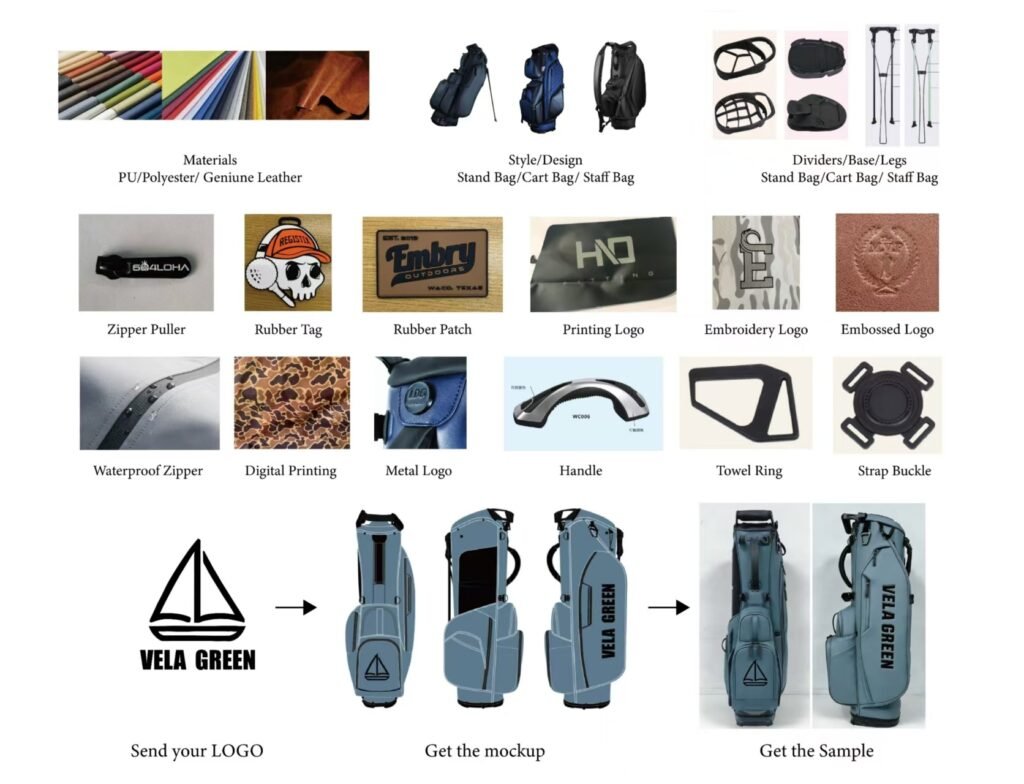
At Vela Green, we provide full-range OEM & ODM services for golf bags, golf headcovers, gloves, towels and other golf accessories. We support custom design, material selection, logo branding, color matching and mass production, strictly complying with CPSC, REACH and other international standards. With mature production experience, reliable quality control and professional export support, we help brands and importers develop market-oriented products with efficient lead times and flexible order quantities.