In 2026, effective procurement teams are shifting from a siloed focus on purchase price to a holistic total cost of ownership analysis. A study by McKinsey found that companies excelling in managing B2B customer relationships tend to have 20% higher revenue growth than their peers-. The same principle applies to golf bag total cost of ownership—buyers who evaluate all cost factors consistently outperform those who chase the lowest factory price.
The CPG (consumer packaged goods) margin model that most brands run was built for a world that no longer exists-. Effective procurement strategies today redefine supplier relationship management beyond cost and compliance-. Supply chain transparency has also shifted from a niche compliance exercise into a core strategic imperative for businesses-. In this environment, mastering golf bag total cost of ownership is no longer optional—it is a competitive necessity.
Factor #1: Landed Cost Beyond the Ex-Works Price in Golf Bag Total Cost of Ownership
The most overlooked element of golf bag total cost of ownership is the gap between the factory‘s ex‑works price and your actual landed cost. When comparing supplier quotes, many buyers calculate:
Unit cost × Order quantity + Sea freight + Insurance
But this misses destination costs. A much more comprehensive approach evaluates the total cost of ownership (TCO)—including not just the initial price but also shipping costs, potential quality issues, communication challenges, and the time required to manage the relationship-.
TCO includes logistics, import duties, customs brokerage fees, and inland delivery. A supplier’s ex‑works price of $25 per bag can become $38 landed after all factors are added. Conversely, a supplier quoting $30 may have lower TCO due to superior logistics location.
Essential Components of Landed Cost in Golf Bag Total Cost of Ownership:
- Ocean freight: $2–$6 per bag. Rates vary wildly by route—Asia to US West Coast (15–20 days, $0.35–$0.50/kg) versus Asia to Europe (30–40 days, $0.50–$0.70/kg).
- Import duties: US tariffs on Chinese golf bags can reach 52.6%, depending on HS code (4202.92 or 9506.39). This single factor can double your TCO.
- Port and customs fees: Terminal handling charges (THC) at destination ports add $200–$500 per container, often unbudgeted.
- Inland delivery: Port to warehouse can add $1–$3 per bag, depending on distance.
- Sample and tooling amortization: A one‑time $500 sample fee spread over 500 bags adds $1.00 per unit to TCO. Custom mold tooling for branded hardware can add $1,000–$5,000—spread over your order volume.
Factor #2: Quality Failures and Returns in Golf Bag Total Cost of Ownership
A bag that looks perfect at final inspection can still generate massive after‑sales costs. Returns, replacements, and warranty claims are hidden explosives within golf bag total cost of ownership. A defect rate of just 3% in a 1,000‑unit order means 30 defective bags. Each defect requires customer communication, return shipping, replacement unit, and warehouse handling. For mid‑priced golf bags, returns often cost 200–300% of the original unit cost once these hidden costs are included.
How Quality Failures Drive Golf Bag Total Cost of Ownership:
- Return shipping: B2B buyers often pay return freight for defective goods, which can be $15–$30 per bag for cross‑border returns.
- Warehouse labor: Receiving, inspecting, and processing each return consumes 15–30 minutes of paid labor.
- Replacement production: The factory may replace defective units at no cost, but the freight to ship replacements to your customer is rarely covered.
- Brand reputation: The hardest cost to quantify—each defective bag creates negative word‑of‑mouth that damages future sales.
Factor #3: Supply Chain Inefficiency in Golf Bag Total Cost of Ownership
When a supplier fails to deliver on time, the resulting costs cascade through your entire operation. Late shipments translate directly into higher golf bag total cost of ownership through:
- Expedited air freight: When sea freight delays threaten a retail launch, you may pay $10–$20 per bag for air freight instead of $2–$4 for ocean. This often erases any unit price savings from a cheaper supplier.
- Lost sales: A late arrival that misses the spring golf season can result in unsold inventory that requires deep discounting (50% or more) to move.
- Warehouse overtime: Unpredictable arrival dates force warehouse teams into overtime or weekend shifts.
- Order cancellations: Retail customers may cancel orders if their delivery windows are missed entirely.
On‑time delivery is a core KPI in golf bag total cost of ownership. The industry benchmark for strong supplier reliability is an on‑time delivery rate of 90% or higher-.
Factor #4: Compliance, Certifications, and Audits in Golf Bag Total Cost of Ownership
Failure to verify supplier certifications before ordering introduces compliance costs that can balloon golf bag total cost of ownership. Non‑compliance can lead to shipment holds, fines, or even destruction of an entire container.
Regulatory Compliance Impact on Golf Bag Total Cost of Ownership:
- EU GPSR (General Product Safety Regulation): Effective December 13, 2024, non‑EU manufacturers must appoint an EU‑based Responsible Person. Non‑compliance means denied entry.
- US CPSC e‑filing: Mandatory for all regulated consumer products starting July 8, 2026. Importers must submit product certificate data electronically.
- PFAS bans: Eighteen US states now restrict PFAS in consumer products, with seven new bans taking effect in 2026.
- Certification lapses: ISO 9001 expires after three years; BSCI audits are valid for two years. An expired certification means the factory‘s quality systems are no longer independently verified, introducing hidden risk.
Verifying certifications like ISO 9001 (quality management) and BSCI (ethical labor) may cost a few hours of staff time, but failure to verify can cost tens of thousands in compliance failures-.
Factor #5: Sampling Iterations in Golf Bag Total Cost of Ownership
Every additional sample round adds expense and time. The more rounds required to reach approval, the higher your golf bag total cost of ownership climbs. Aggressive buyers often push suppliers to deliver a final sample in 7–10 days, but rushing the design process often backfires. Proper quality control in golf bag production requires rigorous sampling-.
Sampling Costs in Golf Bag Total Cost of Ownership:
- Direct fees: $50–$200 per sample round, plus shipping from factory to buyer.
- Delayed revenue: Each revision round adds 7–10 days to your timeline. A three‑round sample process could cost you a full month of retail sales.
- Management overhead: Your team‘s time reviewing samples, providing feedback, and chasing revisions is a real cost.
Digital sampling solutions—like 3D prototypes—can cut these costs dramatically. Companies now offer 7–14 day sample production integrating 3D prototypes and rigorous quality checks to ensure high standards-. Investing in digital sampling upfront reduces physical revision rounds and lowers TCO.
Factor #6: Packaging and Warehousing in Golf Bag Total Cost of Ownership
Packaging and storage are often the most under‑budgeted components of golf bag total cost of ownership. Right‑sizing your packaging can reduce package volume by up to 40%, directly lowering freight costs. FSC‑certified cardboard with 40% post‑consumer recycled content and molded fiber inserts can simultaneously reduce environmental impact and lower unit costs-.
Key Packaging & Warehousing Factors Affecting Golf Bag Total Cost of Ownership:
- Right‑sized cartons: A 10% reduction in carton dimensions can reduce sea freight costs by 8–12% for full container loads.
- Stacking strength: Cartons lacking sufficient edge crush resistance (ECT) collapse under the weight of 8–10 stacked boxes in a container.
- Pallet optimization: Non‑standard box sizes reduce pallet density, increasing freight cost per unit.
- Bonded warehousing: Storing goods in a bonded warehouse defers duty payments until goods are withdrawn for sale, improving cash flow. For high‑volume importers, this can reduce working capital tied up in duty payments by 50–70%.
Factor #7: After-Sales Support and Supplier Relationship Management in Golf Bag Total of Ownership
The final factor in golf bag total cost of ownership is the cost of managing the supplier relationship itself. A supplier that requires constant communication, missed deadlines, and excessive oversight imposes a high management burden that rarely appears on invoices.
Supplier Management Costs in Golf Bag Total Cost of Ownership:
- Time inefficiency: Every hour your team spends chasing a disorganized supplier is an hour not spent on product development or customer acquisition.
- Re‑work and re‑testing: A supplier that fails to learn from previous mistakes forces repeated quality checks and audits.
- Lack of transparency: Suppliers who withhold production updates or inventory data force you to carry safety stock, tying up working capital. Supply chain transparency transforms from a niche exercise into a core strategic imperative-.
- Relationship friction: Studies show B2B buyers who build trust‑based supplier relationships reduce transaction costs by 15–25% through faster response times and proactive problem‑solving.
TCO Calculation Worksheet for Golf Bag Buyers
Use this worksheet to evaluate each supplier’s true golf bag total cost of ownership:
| Cost Factor | Supplier A (Cheapest Quote) | Supplier B (Mid‑Range Quote) |
|---|---|---|
| Ex‑works price | $18.00 | $22.50 |
| Ocean freight + insurance | $5.00 | $4.00 (better port access) |
| Import duties (25–52.6%) | $4.50–$9.50 | $5.60–$11.80 |
| Sample amortization (over order) | $0.50 | $0 (sample fee waived) |
| Estimated defect rate | 5% ($0.90 per unit across order) | 2% ($0.45 per unit) |
| Compliance risk premium | 10% ($1.80) | 0% (fully certified) |
| Management overhead | $0.60 (high) | $0.30 (low) |
| Total Cost of Ownership per bag | $31.30–$36.30 | $32.85–$39.05 |
The “cheap” factory may have lower TCO for a perfect, compliant order—but adds significant risk. The “expensive” factory has higher baseline costs but lower risk. Your decision depends on your brand‘s risk tolerance and quality requirements.
How to Reduce Golf Bag Total Cost of Ownership
Implement these strategies to lower your golf bag total cost of ownership:
- Negotiate landed cost, not ex‑works: Request FOB port pricing to include all factory‑side costs up to loading the container.
- Build AQL into contracts: Acceptable Quality Limit (AQL) Level II, 2.5/4.0 gives you clear recourse when defect rates exceed acceptable levels.
- Right‑size packaging: Ask your supplier for packed carton dimensions and weights before full production. A 20% volume reduction on 10,000 units yields real savings.
- Invest in digital sampling: 3D prototypes reduce physical revision rounds, cutting sample fees and timeline simultaneously.
- Plan around peak seasons: Sourcing outside peak periods (May–October) reduces production wait times and can lower TCO by 10–15% through better capacity availability.
- Build supplier scorecards: Track on‑time delivery, defect rates, and responsiveness. Share data quarterly to drive improvement.
Conclusion: Master Golf Bag Total Cost of Ownership for Smarter Sourcing
Your supplier‘s factory price is only the beginning. By incorporating landed cost analysis, quality failures, supply chain delays, compliance risk, sampling iterations, packaging logistics, and supplier relationship management into your golf bag total cost of ownership calculation, you gain a complete financial picture that prevents hidden expenses from destroying your margins.
The seven factors above work for any B2B buyer, from new brands placing their first 200‑unit order to established retailers importing full containers. Start auditing your current golf bag total cost of ownership today—you may discover that your most expensive supplier is actually your least expensive, once all hidden costs are accounted for.
With 20 years of experience in golf bag manufacturing, we provide complete TCO transparency—landed cost estimates, ISO 9001 and BSCI compliance, right‑sized packaging, and responsive after‑sales support. Contact us for a no‑obligation TCO comparison.
OEM & ODM Service
Whether you’re planning to build your own brand, develop new products, or find a stable manufacturing partner for the US and European markets, working with a professional OEM & ODM factory can significantly improve your product quality and market competitiveness.
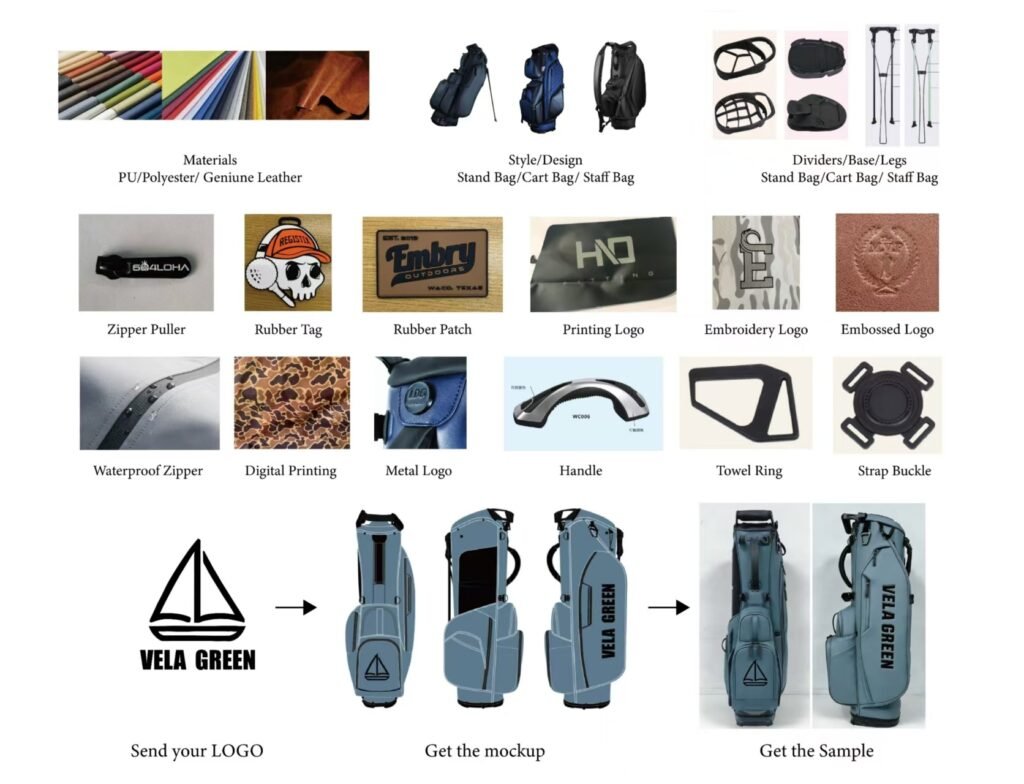
At Vela Green, we provide full-range OEM & ODM services for golf bags, golf headcovers, gloves, towels and other golf accessories. We support custom design, material selection, logo branding, color matching and mass production, strictly complying with CPSC, REACH and other international standards. With mature production experience, reliable quality control and professional export support, we help brands and importers develop market-oriented products with efficient lead times and flexible order quantities.