The landscape of golf bag sourcing challenges has never been more complex for B2B buyers. The global golf bags market is projected to expand from USD 1.43 billion in 2025 to USD 1.75 billion by 2031-. Yet this growth comes with unprecedented obstacles—soaring tariffs, opaque cost structures, inconsistent quality standards, and regulatory minefields. For procurement professionals navigating golf bag sourcing challenges in 2026, the stakes are higher than ever.
This guide identifies five critical golf bag sourcing challenges facing B2B buyers today and provides actionable strategies to overcome each one.
Challenge #1: The Tariff Maze in Golf Bag Sourcing
The most immediate golf bag sourcing challenges come from the 2026 tariff landscape. Since April 2026, golf bags imported into the United States face a layered tariff system that has fundamentally altered sourcing economics-.
Understanding the 2026 Tariff Structure
For golf bags classified under HS Code 4202.92, the duty structure varies dramatically by material and origin:
- Golf bags from China made of man-made fibers (HTS 4202.92.31): Total effective duty of 52.6% — combining a 17.6% base rate, 25% Section 301 duty, and a 10% surcharge
- General sports bags from China (HTS 4202.92.91): Total duty of 27.6%
- Golf bags from Vietnam or Taiwan: Approximately 10% baseline rate
The EU has also tightened requirements, now mandating 10-digit TARIC codes for customs clearance, with a flat €3 duty per tariff sub-heading effective July 1, 2026. Classification errors can lead to severe financial penalties, ranging from 20% of dutiable value to as much as four times the lawful duties.
Strategy: Diversify Sourcing Geography
To navigate these golf bag sourcing challenges, B2B buyers should evaluate suppliers across multiple regions. Vietnam and Taiwan are gaining ground as cost-effective production hubs. Maintaining relationships with suppliers in at least two regions provides flexibility to shift production when tariffs or disruptions affect one area.
Challenge #2: Cost Structure Opacity in Golf Bag Sourcing
A persistent golf bag sourcing challenge is the lack of cost transparency. Buyers frequently receive quotes that appear competitive but conceal significant hidden expenses.
The Regional Cost Trap
China is not a unified manufacturing market. Different industrial zones carry vastly different cost structures. The Pearl River Delta region offers world-class manufacturing infrastructure but higher labor and rent costs drive up factory prices. Inland provinces may offer 10–20% lower unit production costs, but higher inland logistics expenses and longer delivery times often offset those savings.
Strategy: Request Full Cost Breakdown
To overcome this golf bag sourcing challenge, ask every potential supplier for a detailed landed cost breakdown including:
- Ex-works price
- Inland freight to port
- Ocean freight and insurance
- Import duties and customs clearance fees
- Port handling and inland delivery
A $2 difference in ex-works price can become a $3–4 difference in landed cost after duties and logistics are factored in. Buyers who compare landed cost rather than factory price make better sourcing decisions.
Challenge #3: Quality and Process Inconsistency
Among the most frustrating golf bag sourcing challenges is the gap between sample quality and bulk production quality. Buyers approve a perfect sample, only to receive containers with inconsistent stitching, substandard materials, or functional failures.
The Three Quality Gaps
Industry analysis reveals three recurring golf bag sourcing challenges in quality:
- Inconsistent process standards — Different factories apply different quality benchmarks, making it difficult to compare suppliers
- Waterproofing bottlenecks — Traditional stitching creates pinhole leaks; approximately 40% of lightweight bags fail in wet conditions
- Compliance execution gaps — Many factories lack proper lab testing and quality control loops, with rework rates reaching 3–5%
Strategy: Multi-Stage Quality Verification
To address these golf bag sourcing challenges, implement a three-stage quality verification process:
- Pre-production sample approval — Test the physical sample under real-world conditions
- In-process inspection — Conduct random checks during bulk production
- Pre-shipment inspection — Use AQL (Acceptable Quality Level) Level II, 2.5/4.0 standards
Headline manufacturers achieving batch pass rates above 99.5% demonstrate that rigorous quality systems can overcome these golf bag sourcing challenges.
Challenge #4: Delivery Lead Time and Logistics Volatility
Delivery reliability has emerged as a critical golf bag sourcing challenge in 2026. Geopolitical tensions have increased oil prices, further affecting shipping costs and supply chain stability. Port congestion, container shortages, and route disruptions continue to plague international logistics.
The Lead Time Trap
Buyers are generally facing “out-of-control delivery cycles” in golf bag sourcing challenges. A factory that promises 30-day delivery may take 45–60 days when material shortages or production bottlenecks occur. Each week of delay represents lost revenue, missed retail windows, and customer dissatisfaction.
Strategy: Build Buffer and Verify Track Records
To manage these golf bag sourcing challenges:
- Add 2–3 weeks contingency to every timeline
- Request documented on-time delivery rates (95%+ is industry benchmark)
- Ask about peak season capacity and how the factory handles demand surges
- Consider phased delivery—receive partial shipments to maintain inventory flow
Factories with annual production exceeding 50 million units typically demonstrate stronger logistics coordination and delivery reliability.
Challenge #5: Regulatory Compliance and Customs Risk
The final major golf bag sourcing challenge is regulatory compliance. Exporting to Europe requires REACH chemical safety compliance. Selling to California demands Prop 65 certification. Each market has distinct requirements, and failure to comply can result in shipment holds, fines, or product destruction.
The Compliance Cost
Non-compliance creates cascading costs:
- Customs holds that delay delivery by weeks
- Fines that erode already-thin margins
- Product destruction that eliminates entire shipments
- Reputational damage that affects future sales
Strategy: Verify Certifications Before Production
To mitigate these golf bag sourcing challenges:
- Request current ISO 9001 (quality management) and BSCI (social compliance) certificates
- Verify REACH and Prop 65 compliance documentation
- Ask for third-party lab test reports, not just supplier claims
- Confirm that the factory can provide country of origin certificates and accurate HS code classifications
Leading manufacturers now provide complete compliance packages—including REACH, California Prop 65, and customized packaging for Amazon FBA standards—addressing these golf bag sourcing challenges proactively.
Overcoming Golf Bag Sourcing Challenges: A Practical Framework
The five golf bag sourcing challenges outlined above—tariffs, cost opacity, quality inconsistency, delivery volatility, and compliance risk—are interconnected. Each requires systematic attention.
The B2B Sourcing Scorecard
| Challenge | Evaluation Criteria | Pass/Fail |
|---|---|---|
| Tariff exposure | Supplier located in low-tariff region or tariff-sharing arrangement? | |
| Cost transparency | Full landed cost breakdown provided? | |
| Quality consistency | Documented QC process with AQL standards? | |
| Delivery reliability | On-time delivery rate 95%+ over 12 months? | |
| Compliance readiness | Current ISO 9001, BSCI, REACH certifications? |
Use this scorecard when evaluating potential partners. Suppliers who score well across all five criteria are better equipped to help you navigate golf bag sourcing challenges.
Conclusion: Master Golf Bag Sourcing Challenges for 2026 Success
The golf bag sourcing challenges of 2026 are not temporary disruptions—they represent a permanent shift in the global sourcing environment. Tariffs have reached historic highs, cost structures remain opaque, quality inconsistency persists, delivery volatility continues, and regulatory requirements expand.
B2B buyers who master these golf bag sourcing challenges will capture market share from competitors who struggle. The strategies in this guide—geographic diversification, landed cost analysis, multi-stage quality verification, timeline buffering, and certification verification—provide a complete framework for success.
The golf bags market is growing. Participation is surging. But growth without disciplined sourcing is growth that consumes margins rather than generating them. Start your next sourcing project by auditing potential partners against these five challenges. The brands that master golf bag sourcing challenges today will be the ones winning wholesale accounts tomorrow.
With 20 years of golf bag manufacturing experience, transparent cost structures, documented ISO 9001 and BSCI certifications, and a proven track record of on-time delivery, we help B2B clients navigate every golf bag sourcing challenge. Contact us to discuss your sourcing requirements and request a compliance package.
OEM & ODM Service
Whether you’re planning to build your own brand, develop new products, or find a stable manufacturing partner for the US and European markets, working with a professional OEM & ODM factory can significantly improve your product quality and market competitiveness.
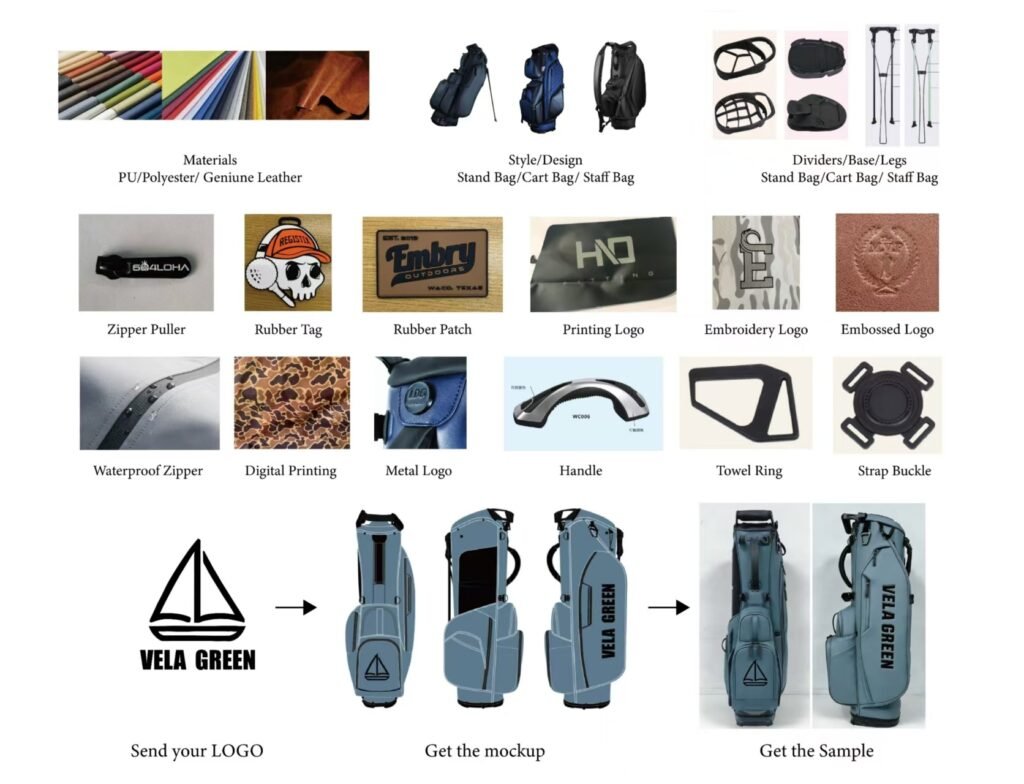
At Vela Green, we provide full-range OEM & ODM services for golf bags, golf headcovers, gloves, towels and other golf accessories. We support custom design, material selection, logo branding, color matching and mass production, strictly complying with CPSC, REACH and other international standards. With mature production experience, reliable quality control and professional export support, we help brands and importers develop market-oriented products with efficient lead times and flexible order quantities.