Successful golf bag price negotiation is the single most impactful skill for B2B buyers seeking to protect margins. The global golf bags market is projected to reach USD 1.75 billion by 2031, yet many procurement professionals leave thousands of dollars on the table by accepting the factory‘s first quote. Effective golf bag price negotiation is not about squeezing suppliers—it is about understanding cost structures, leveraging volume, and building partnerships that deliver long-term value.
This guide presents seven proven golf bag price negotiation tactics that B2B buyers can use to reduce landed cost, secure better payment terms, and build supplier relationships that generate savings order after order.
Tactic #1: Understand the Factory‘s Cost Structure Before Golf Bag Price Negotiation
The foundation of successful golf bag price negotiation is understanding what drives the factory‘s costs. Without this knowledge, you are negotiating blind.
Typical Golf Bag Cost Breakdown
- Raw materials: 40–50% of total cost (fabric, zippers, hardware, foam)
- Labor: 20–25% (skilled sewing operators, embroidery, assembly)
- Quality control: 5–10% (incoming, in-process, and pre-shipment inspection)
- Overhead and profit: 10–15% (facilities, equipment, management, margin)
Questions to Ask Before Price Negotiation
- “What is the material cost breakdown for this design?”
- “Are there alternative materials that would reduce cost without affecting quality?”
- “What is the labor component, and is there flexibility in assembly methods?”
Armed with cost knowledge, you can identify which components offer the most negotiation leverage. For example, if raw materials are 50% of cost, switching to a slightly lower-denier fabric might yield significant savings.
Tactic #2: Leverage Volume and Consolidation in Golf Bag Price Negotiation
Volume is your most powerful lever in golf bag price negotiation. Factories spread fixed costs (setup, machine calibration, pattern creation) across order quantity, so larger orders reduce per-unit cost.
Volume Pricing Tiers
| Order Volume | Typical Per-Unit Cost | Savings vs. 100 Units |
|---|---|---|
| 100 units | $35.00 | Baseline |
| 300 units | $28.00 | 20% |
| 500 units | $24.00 | 31% |
| 1,000 units | $22.00 | 37% |
Consolidation Strategies for Golf Bag Price Negotiation
- Combine multiple SKUs — Ordering 200 stand bags and 200 cart bags as one 400-unit order may qualify for the 500-unit price tier.
- Share your forecast — Even if your first order is 300 units, sharing a 12-month forecast of 1,200 units can secure better pricing.
- Ask about annual volume rebates — Some factories offer year-end rebates based on total purchases.
Tactic #3: Negotiate MOQ Flexibility in Golf Bag Price Negotiation
MOQ is often presented as fixed, but it is one of the most negotiable terms in golf bag price negotiation. Factories set MOQs based on setup costs—but many are willing to flex for the right opportunity.
MOQ Negotiation Tactics
- Trial order compromise: “We will start with 200 units at a slightly higher per-unit price, and commit to 500 units on the next order if quality and lead time are met.”
- Color mix flexibility: “We need 100 units of each of three colors—can we count this as one 300-unit order for pricing?”
- Forecast commitment: “We project 2,000 units over the next 12 months. What MOQ and pricing can you offer to support our growth?”
The MOQ-Price Trade-off
A higher MOQ reduces per-unit cost but increases inventory risk. In golf bag price negotiation, the optimal MOQ balances unit cost against cash flow and storage capacity. A $2 per unit saving on 500 units ($1,000 total) may not justify tying up $10,000 in extra inventory.
Tactic #4: Optimize Payment Terms in Golf Bag Price Negotiation
Payment terms are among the most overlooked elements of golf bag price negotiation. Standard terms for new international relationships are 30% deposit and 70% before shipment. Stronger buyers negotiate better.
Payment Term Negotiation Options
- Reduce deposit percentage: Negotiate 20% deposit instead of 30%
- Extended dating: Request Net 60 or Net 90 terms—sell the product before paying for it
- Early payment discounts: Ask for 2/10 Net 30 (2% discount for paying within 10 days)
- Inspection-based release: Structure the final 70% payment to be released after pre-shipment inspection passes
The Cash Flow Impact
On a $20,000 order, reducing the deposit from 30% ($6,000) to 20% ($4,000) frees $2,000 in working capital. Extended dating to Net 90 gives you three months to sell inventory before payment is due.
Tactic #5: Address Landed Cost, Not Just Ex-Works Price in Golf Bag Price Negotiation
The most common mistake in golf bag price negotiation is focusing exclusively on ex-works price while ignoring logistics, duties, and handling fees. A factory that quotes $1 lower per bag might cost $3 more in landed cost due to higher freight or duties.
Complete Landed Cost Components
| Component | Typical Range |
|---|---|
| Ex-works price | Factory quote |
| Inland freight to port | $0.50–$1.00 per bag |
| Ocean freight | $2–$6 per bag |
| Insurance (110% of cargo value) | 0.3–0.5% |
| Import duties (US) | 10–52.6% |
| Customs clearance fees | $150–$300 per shipment |
| Inland delivery (port to warehouse) | $1–$3 per bag |
Landed Cost Negotiation Tactics
- Ask for FOB pricing (including factory-side costs to load the container)
- Request supplier assistance with freight consolidation to reduce logistics cost
- Negotiate tariff-sharing arrangements—some suppliers will absorb a portion of tariff increases for repeat customers
- Compare landed cost, not factory price, when evaluating competing quotes
Tactic #6: Leverage Long-Term Partnership in Golf Bag Price Negotiation
The most powerful golf bag price negotiation tactic is signaling long-term commitment. Suppliers are far more flexible with buyers they expect to work with for years, not months.
Building Partnership Capital
- Share your growth plans: “We expect to grow from 500 to 5,000 units annually over the next three years. How can we structure pricing to support that growth?”
- Pay on time (or early): Suppliers prioritize buyers who pay reliably. Consistent early payment can be leveraged for better terms.
- Provide feedback: Share sell-through data and product improvement suggestions. Suppliers value insights that help them improve.
Partnership-Based Negotiation Leverage
When a supplier views you as a long-term partner, they become more flexible on:
- First-order MOQ
- Sample fees (may be waived or applied to bulk orders)
- Payment terms
- Priority production slots during peak season
- After-sales support for defect claims
Tactic #7: Negotiate Sample Fees and Tooling Costs in Golf Bag Price Negotiation
Sample fees and tooling costs are often accepted without negotiation, yet they represent real costs that can be reduced or eliminated in golf bag price negotiation.
Sample Fee Negotiation
- Request fee waivers: Some suppliers waive sample fees for serious buyers with volume potential
- Apply to bulk orders: Ask that sample fees be credited against the first bulk order
- Share samples: If ordering multiple designs, share sample costs across SKUs
Tooling Cost Negotiation
Custom molds for branded zippers, handles, or hardware typically cost $300–$2,000. For trial orders, ask to use the factory‘s existing open molds, deferring tooling investment until the design proves successful. For proven designs, amortize tooling costs across the full order.
Golf Bag Price Negotiation Checklist
| Tactic | Key Action | Priority |
|---|---|---|
| Understand cost structure | Request material and labor breakdown | High |
| Leverage volume | Combine SKUs; share forecast | High |
| Negotiate MOQ flexibility | Start with trial; commit to growth | Medium |
| Optimize payment terms | Reduce deposit; extend dating | High |
| Address landed cost | Compare delivered price; share tariffs | High |
| Build partnership | Share plans; pay on time | Medium |
| Negotiate sample/tooling | Request credits; use open molds | Low |
Conclusion: Master Golf Bag Price Negotiation for 2026 Success
Effective golf bag price negotiation is not about confrontation—it is about preparation, transparency, and partnership. The seven tactics in this guide—understanding cost structures, leveraging volume, negotiating MOQ flexibility, optimizing payment terms, addressing landed cost, building partnership capital, and reducing sample fees—provide a complete framework for successful negotiation.
B2B buyers who master golf bag price negotiation protect margins, improve cash flow, and build supplier relationships that deliver value beyond the current order. Start your next negotiation by preparing cost data, defining your must-have terms, and communicating long-term commitment. The savings go directly to your bottom line.
With 20 years of golf bag manufacturing experience and transparent pricing structures, we welcome informed golf bag price negotiation. Contact us to discuss your volume requirements and request a detailed cost breakdown.
OEM & ODM Service
Whether you’re planning to build your own brand, develop new products, or find a stable manufacturing partner for the US and European markets, working with a professional OEM & ODM factory can significantly improve your product quality and market competitiveness.
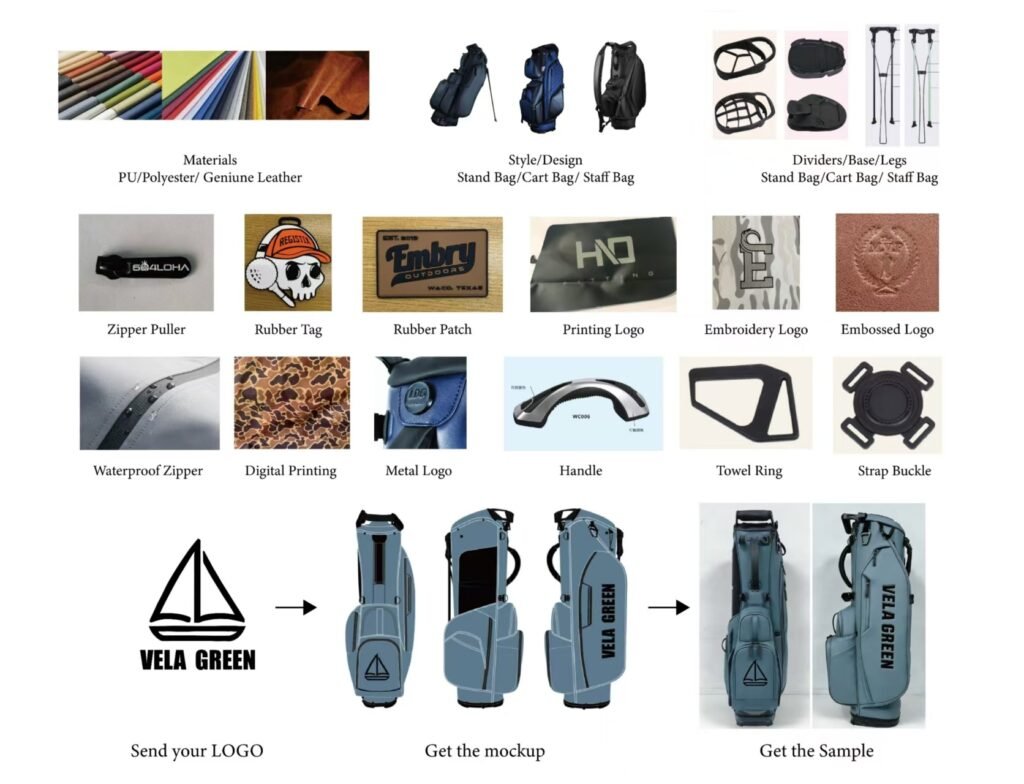
At Vela Green, we provide full-range OEM & ODM services for golf bags, golf headcovers, gloves, towels and other golf accessories. We support custom design, material selection, logo branding, color matching and mass production, strictly complying with CPSC, REACH and other international standards. With mature production experience, reliable quality control and professional export support, we help brands and importers develop market-oriented products with efficient lead times and flexible order quantities.