A golf bag divider system is one of those details buyers don‘t think about until something goes wrong. Clubs get scratched. Graphite shafts develop stress fractures. Irons tangle so badly that pulling one out feels like a wrestling match. By then, the customer has already returned the bag and left a one-star review. I’ve seen it happen more times than I can count over 20 years in this business. The golf bag divider system is not a cosmetic feature—it is the structural backbone of club protection. Get it right, and your bags earn loyal customers. Get it wrong, and you‘ll spend your margin on replacements.
This guide breaks down five golf bag divider system decisions that separate premium bags from problem bags.
Why Golf Bag Divider System Quality Matters More Than You Think
Walk through any pro shop and you‘ll see bags with 4, 6, 14, and even 15-way golf bag divider system configurations. The cheap ones look fine on the shelf. But after a few rounds, the difference shows. Clubs wear against each other. Shafts get nicked. Grips snag on exposed rivets. Customers notice.
For B2B buyers, a weak golf bag divider system means returns, warranty claims, and retailers who won‘t reorder. A well-engineered system means repeat business. The global golf bag market is projected to reach USD 1.66 billion by 2031—but that growth only helps brands that deliver products golfers actually keep.
Decision #1: 14-Way vs. 6-Way vs. 4-Way — What Actually Sells
The number of dividers in a golf bag divider system is the first decision. More dividers mean better club separation but also more weight, complexity, and cost.
4-Way and 6-Way Divider Systems
Budget and lightweight stand bags typically use 4-way or 6-way golf bag divider systems. They are lighter and cheaper to produce. But they allow clubs to bunch together. Graphite shafts can rub against each other, and irons tangle at the bottom.
14-Way Divider Systems
Premium stand bags and most cart bags use 14-way golf bag divider systems. Each club gets its own slot. This reduces shaft abrasion dramatically and makes club selection easier. The trade-off is weight—14-way systems add 0.5 to 1 pound compared to 6-way systems.
What Sells in 2026
For cart bags, 14-way golf bag divider systems are now the expectation in the mid-to-premium segment. For stand bags, 6-way remains popular for walkers who prioritize weight, but 14-way is gaining share among golfers who carry premium graphite shafts. If you‘re sourcing for the US market, stock both. European buyers lean toward 14-way in cart bags and 6-way in lightweight carry bags.
Decision #2: Full-Length Dividers vs. Partial Dividers
This is where many suppliers cut corners. A true golf bag divider system uses full-length dividers that extend from the top rim all the way to the base. Partial dividers stop a few inches down, allowing clubs to mix below the surface.
Why Full-Length Matters
Full-length dividers prevent clubs from sliding sideways and tangling at the bottom. They also protect shafts from rubbing against each other during transport. For golfers with expensive graphite shafts, this is non-negotiable.
How to Verify Full-Length Dividers
Ask your supplier to show the internal construction of the golf bag divider system. Some factories use a top insert that looks like full-length dividers but stops short. Push a club all the way down and feel for resistance. If it goes into a shared space, the dividers are partial.
Decision #3: Padding Thickness and Foam Density
Even the best-configured golf bag divider system fails if the padding is too thin. Clubs bang against each other during a round. Without adequate cushioning, shafts and heads take damage.
Minimum Padding Standards
For a quality golf bag divider system, insist on at least 3–5mm of closed-cell EVA foam on all divider walls. Closed-cell foam does not absorb water and maintains its shape over time. Open-cell foam is cheaper but compresses permanently after a few months.
Foam Density
Density matters as much as thickness. Low-density foam (under 30 kg/m³) flattens quickly. High-density foam (45–60 kg/m³) provides lasting protection. Ask your supplier for the foam spec. If they can‘t provide it, they probably don‘t know—and that’s a red flag.
Decision #4: Base Construction and Club Protection
The base of the bag is part of the golf bag divider system—or at least it should be. When a golfer sets the bag down, club heads can hit the ground if the base isn‘t reinforced.
What to Look For
A reinforced base with a molded rubber or plastic shell protects both clubs and the bag itself. The internal base pad should be at least 5mm thick and bonded to the divider structure. Cheap bags use a thin foam pad that compresses after a few rounds.
The Test
Load a sample bag with a full set of clubs—driver, fairway woods, irons, wedges, putter. Set it down on concrete 20 times. Then inspect the club heads and the base pad. If you see scuffs or compression marks, the golf bag divider system is not up to standard.
Decision #5: Divider Material and Stitching
The material of the golf bag divider system itself—the fabric walls and top rim—affects durability and appearance.
Fabric and Lining
Nylon is standard. 210D or 420D nylon works for budget bags. 600D or 1680D ballistic nylon lasts far longer. Soft linings like brushed polyester or microfiber protect graphite shafts from scratches. Some premium golf bag divider systems use fleece-lined slots.
Stitching and Bar-Tacking
Every divider wall should be stitched with high-tenacity thread and bar-tacked at stress points. Look for even stitch density and no loose threads. A golf bag divider system that unravels at the seams is a warranty claim waiting to happen.
How to Test a Golf Bag Divider System Before Bulk Order
Before you commit to 500 units, order a pre-production sample and run these tests:
- Load test: Fill all slots with clubs. Walk 18 holes or simulate by shaking the bag vigorously.
- Pull test: Remove and insert each club 20 times. Check for snagging or resistance.
- Base test: Set the loaded bag down on concrete 20 times. Inspect club heads and base pad.
- Padding test: Press the divider walls between your fingers. They should feel firm, not spongy or thin.
- Stitch test: Inspect every seam. Look for skipped stitches, loose threads, or uneven bar-tacks.
If the sample passes, you have a golf bag divider system worth scaling. If it fails, you‘ve saved yourself thousands in returns.
Common Mistakes Buyers Make with Golf Bag Divider Systems
| Mistake | What Happens | Fix |
|---|---|---|
| Choosing 4-way to save $0.50 | Customers return bags with scratched shafts | Offer 14-way on premium lines |
| Accepting partial dividers | Clubs tangle, grips snag | Specify full-length dividers in writing |
| Ignoring foam density | Padding flattens after one season | Require 45+ kg/m³ closed-cell EVA |
| No base reinforcement | Club heads hit concrete | Specify reinforced base with 5mm pad |
| Skipping the sample test | Bulk order full of defects | Always test a pre-production sample |
Conclusion: The Golf Bag Divider System Is Not a Place to Cut Corners
Every B2B buyer wants a lower unit price. But the golf bag divider system is the wrong place to save a dollar. A bag that protects clubs earns repeat orders. A bag that scratches shafts generates returns. The five decisions in this guide—divider count, full-length construction, padding, base reinforcement, and stitching—determine which outcome you get.
If you‘re sourcing golf bags for the US or European market, make the golf bag divider system part of your supplier evaluation. Ask for samples. Test them hard. The factories that welcome that scrutiny are the ones worth partnering with.
With 20 years of golf bag manufacturing experience, we build every stand bag and cart bag with full-length, padded divider systems designed for real-world club protection. Contact us to discuss your divider specifications and request a sample.
OEM & ODM Service
Whether you’re planning to build your own brand, develop new products, or find a stable manufacturing partner for the US and European markets, working with a professional OEM & ODM factory can significantly improve your product quality and market competitiveness.
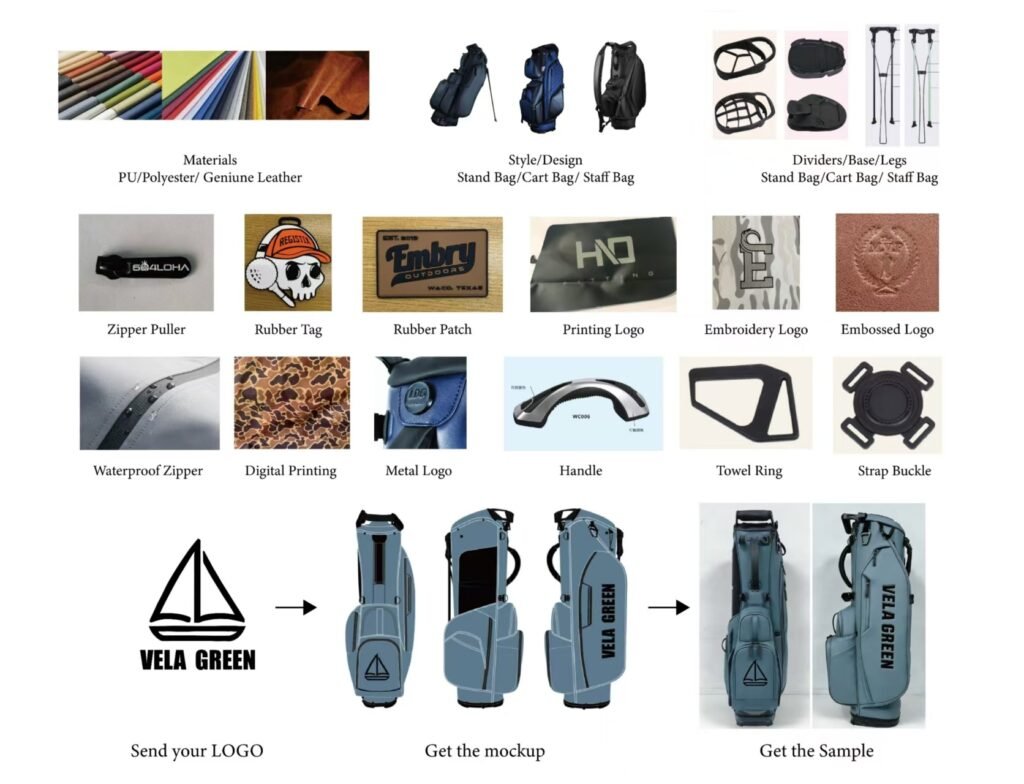
At Vela Green, we provide full-range OEM & ODM services for golf bags, golf headcovers, gloves, towels and other golf accessories. We support custom design, material selection, logo branding, color matching and mass production, strictly complying with CPSC, REACH and other international standards. With mature production experience, reliable quality control and professional export support, we help brands and importers develop market-oriented products with efficient lead times and flexible order quantities.