For B2B buyers in the golf bag market, choosing the right manufacturing partner is the single most important decision you’ll make. The global golf bag market is projected to grow from USD 1.43 billion in 2025 to USD 1.75 billion by 2031, but this growth comes with hidden risks. Rising 2026 tariffs and shipping costs are forcing golf bag makers to rethink sourcing strategies and adopt tighter customs compliance-. A thorough golf bag supplier risk assessment protects your margins, your brand reputation, and your supply chain.
This guide reveals five critical red flags that every buyer should include in their golf bag supplier risk assessment—warning signs that separate reliable partners from costly mistakes.
Why Golf Bag Supplier Risk Assessment Matters in 2026
The stakes for golf bag supplier risk assessment have never been higher. Manufacturers and sourcing activities in Asia-Pacific are most affected by tariff impacts, while North America and Europe face higher retail prices for imported sports bags-. Major brands are already shifting toward Vietnam-based sourcing, marking a structural realignment in supply chain strategy-.
A proper golf bag supplier risk assessment evaluates long-term reliability and factory capabilities-. Buyers who skip this step expose themselves to financial loss, quality failures, and supply chain disruption. Those who invest in thorough golf bag supplier risk assessment build resilient supply chains that weather any storm.
Red Flag #1: Lack of ISO 9001 and BSCI Certifications
The first red flag in any golf bag supplier risk assessment is missing or expired certifications. ISO 9001 confirms the factory has a solid quality management system. BSCI certification validates ethical labor practices and social compliance. Without these, you have no objective proof of quality systems or ethical production.
What to Verify in Your Golf Bag Supplier Risk Assessment
- ISO 9001: Valid for three years—check the expiry date
- BSCI: Valid for two years—verify the audit rating (A or B is acceptable)
- REACH compliance: Essential for EU-bound shipments
- Prop 65 compliance: Required for California, US sales
A proper golf bag supplier risk assessment always includes certification verification before any order is placed.
Red Flag #2: Opaque Financial Health and Payment Demands
The second red flag in golf bag supplier risk assessment is unclear financial health. When a factory faces cash flow problems, quality suffers, deliveries delay, and in worst cases, the factory closes with your deposit.
Warning Signs in Golf Bag Supplier Risk Assessment
- Declining transaction volume: Suppliers showing revenue declines may be at risk
- Delayed invoice settlements: Slow payments to their own vendors indicate distress
- Reluctance to share financials: Healthy suppliers should provide basic financial documentation
- Pressure for 100% upfront payment: Cash-strapped factories may demand full prepayment
A thorough golf bag supplier risk assessment includes requesting bank references or trade credit insurer ratings. Start with smaller orders to test reliability before committing to large volumes.
Red Flag #3: Inconsistent Quality Control Documentation
Quality failures are among the most expensive outcomes of poor golf bag supplier risk assessment. Factories without documented QC processes ship defects. Period.
Quality Control Questions for Golf Bag Supplier Risk Assessment
- “What are your inspection processes at each production stage?”
- “Can you share quality reports from previous similar orders?”
- “What defect tracking systems are in place?”
- “Do you follow AQL (Acceptable Quality Level) Level II, 2.5/4.0 standards?”
Supplier audits evaluate long-term reliability and factory capabilities-. They verify critical details such as business licenses, export permits, and ISO 9001 certifications-. Any golf bag supplier risk assessment should include a physical or virtual factory audit—remote evaluations simply cannot match the visibility of an on-site inspection.
Red Flag #4: Single-Source Dependency and Geographic Concentration
The fourth red flag in golf bag supplier risk assessment is over-reliance on a single factory or country. Topgolf Callaway Brands’ procurement data shows a pronounced shift toward Vietnam-based sourcing since mid-2024, marking a structural realignment-. This signals increasing reliance on agile, single-source partners—heightening supply chain vulnerability if key vendors face capacity or compliance constraints-.
Diversification Questions for Golf Bag Supplier Risk Assessment
- “What percentage of your production capacity is typically utilized?”
- “Do you have backup suppliers for critical materials?”
- “What is your contingency plan for production delays?”
A resilient golf bag supplier risk assessment evaluates whether the factory can scale during peak seasons and whether they have backup plans for equipment breakdowns, labor shortages, or raw material delays. Industry leaders are accelerating onboarding of new suppliers in Mexico and Cambodia, signaling strategic regional diversification-.
Red Flag #5: Poor Communication and Unrealistic Promises
The final red flag in golf bag supplier risk assessment is communication quality. A supplier that is slow to respond or makes unrealistic promises during vetting will not improve during production.
Communication Red Flags
- Slow response times: Emails unanswered for more than 24 hours
- Vague answers: Incomplete responses to technical questions
- Unrealistic timelines: Promising 20-day delivery when industry standard is 45-60 days
- No dedicated point of contact: Unclear who manages your account
Sample Speed as a Leading Indicator
If a factory takes 20+ days for an initial sample, they lack agile capacity—a key warning sign in any golf bag supplier risk assessment. Top manufacturers now compress sampling to 7-10 days through independent R&D workshops and flexible production lines.
Golf Bag Supplier Risk Assessment Checklist
| Red Flag | What to Check | Status |
|---|---|---|
| Missing certifications | ISO 9001, BSCI, REACH, Prop 65—check expiry dates | ☐ |
| Opaque financial health | Request bank references; monitor payment patterns | ☐ |
| No QC documentation | Request inspection reports; verify AQL standards | ☐ |
| Single-source dependency | Evaluate geographic concentration and backup plans | ☐ |
| Poor communication | Test response times; verify sample lead times | ☐ |
Common Golf Bag Supplier Risk Assessment Mistakes to Avoid
| Mistake | Consequence | Solution |
|---|---|---|
| Choosing solely on price | Hidden quality and compliance risks | Evaluate total cost of ownership, not just unit price |
| Skipping factory audits | Unverified claims lead to quality failures | Conduct on-site or virtual audits |
| Ignoring certification expiry | Invalid compliance documentation | Verify expiry dates with issuers |
| No contingency planning | Disruption halts production | Build backup supplier relationships |
Conclusion: Make Golf Bag Supplier Risk Assessment a Priority
Golf bag supplier risk assessment is not a burden—it is a competitive advantage. The five red flags in this guide—missing certifications, opaque financials, weak QC documentation, geographic concentration, and poor communication—provide a complete framework for protecting your supply chain.
In 2026, simply optimizing for cost has been replaced by the principle of resilience. B2B buyers who invest in thorough golf bag supplier risk assessment will capture market share while competitors struggle with supply chain disruptions. Start by auditing your current suppliers against these five red flags. The protection they provide is worth far more than the time invested.
With 20 years of golf bag manufacturing experience, ISO 9001 and BSCI certifications, and a proven track record serving clients across 15 countries, we welcome thorough risk assessment. Contact us to request our supplier due diligence packet and arrange a factory tour.
OEM & ODM Service
Whether you’re planning to build your own brand, develop new products, or find a stable manufacturing partner for the US and European markets, working with a professional OEM & ODM factory can significantly improve your product quality and market competitiveness.
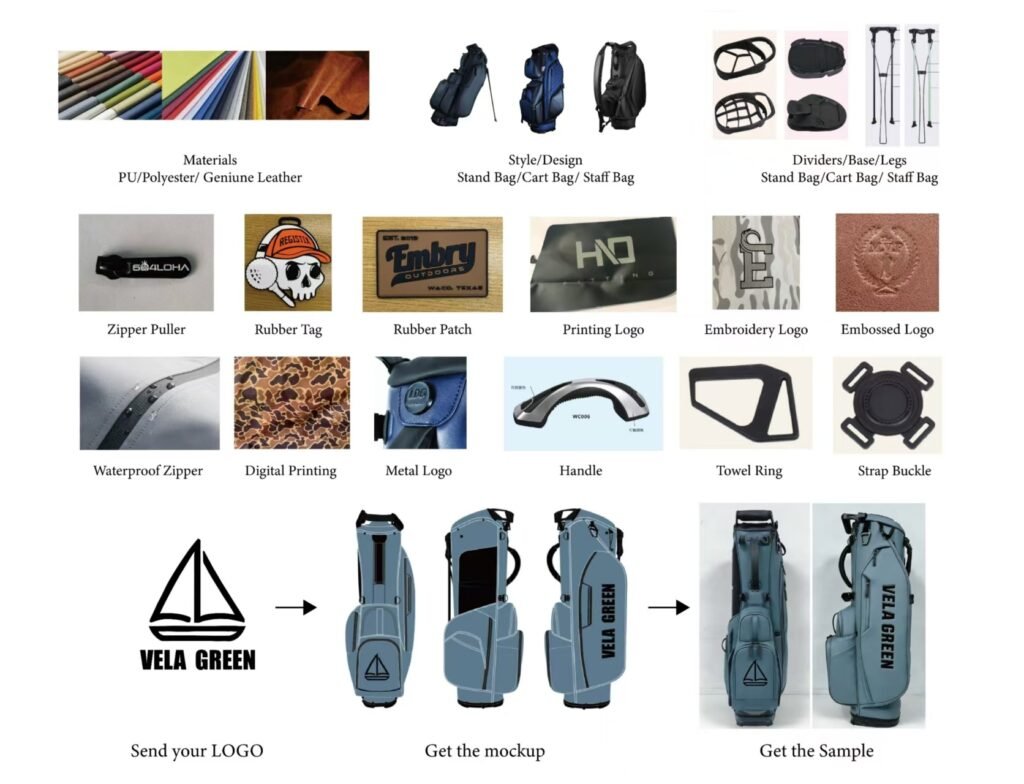
At Vela Green, we provide full-range OEM & ODM services for golf bags, golf headcovers, gloves, towels and other golf accessories. We support custom design, material selection, logo branding, color matching and mass production, strictly complying with CPSC, REACH and other international standards. With mature production experience, reliable quality control and professional export support, we help brands and importers develop market-oriented products with efficient lead times and flexible order quantities.