Golf Bags B2B: Common After-Sales Issues & Quality Control Solutions 2026 is a must-read sourcing guide for global golf bag wholesalers, retailers, and private label brand owners serving US and European markets. In B2B golf equipment wholesale business, after-sales disputes and quality defects are the biggest threats to long-term cooperation, brand reputation, and profit stability. Most bulk order returns, customer complaints, and order cancellations stem from unaddressed production flaws and missing pre-shipment quality control steps. This comprehensive 2026 guide analyzes the most frequent golf bag after-sales problems in cross-border trade, explains their root causes, and provides actionable B2B quality control solutions to help wholesale buyers eliminate quality risks, reduce after-sales rates, and build reliable supply chain cooperation.
For B2B golf bag sellers, low after-sales rate is the core of sustainable wholesale profitability. Many buyers only focus on unit price and MOQ when sourcing, while ignoring standardized quality inspection processes, resulting in batch defective products entering Western retail markets. Mastering professional golf bags B2B after-sales issue handling and quality control solutions enables distributors and brand owners to screen high-quality manufacturers, formulate strict pre-shipment QC standards, resolve common after-sales problems efficiently, and maintain high customer satisfaction in the competitive 2026 global golf wholesale industry.
Why Quality Control & After-Sales Prevention Matters for B2B Golf Bag Wholesale
Unlike retail orders, B2B golf bag bulk shipments involve large order quantities and long-term cooperative relationships. A single batch of quality problems will trigger chain losses: mass returns, high international return shipping costs, negative customer reviews, broken long-term contracts, and damaged brand credibility. US and European golf retailers and pro shops have extremely strict quality and after-sales standards, with zero tolerance for recurring product defects.
Standardized quality control before production, during manufacturing, and before shipment can eliminate over 95% of common after-sales issues. Proactive QC solutions are far more cost-effective than passive after-sales dispute handling. For 2026 B2B golf bag wholesale operations, building a complete quality control system is the key to stabilizing orders, improving profit margins, and expanding Western market share.
Top 8 Common Golf Bag B2B After-Sales Issues in Cross-Border Wholesale
Based on 2025–2026 cross-border wholesale data, we sorted out the most frequent after-sales complaints for exported golf bags targeting US and European markets. These common issues cover fabric, craftsmanship, accessories, waterproof performance, and appearance defects, which are the main causes of B2B order returns.
1. Fabric Fading & UV Aging Failure
Color fading and fabric yellowing are the most common after-sales problems for outdoor golf bags. Low-grade dye materials and missing UV-resistant coating lead to obvious color fading after 1–2 months of outdoor sunlight exposure. European and American end-users often file complaints for inconsistent color and degraded appearance, resulting in bulk returns.
2. Waterproof Layer Peeling & Seam Leakage
Many low-cost wholesale golf bags adopt inferior waterproof coating and untreated stitching seams. After rainy day use or humid storage, the waterproof film peels off, and water seeps through stitch gaps, causing internal club dampness and mildew. This functional defect ranks top 3 in B2B golf bag after-sales disputes.
3. Loose Stitching & Thread Breaking
Stress points including shoulder straps, handles, and bag bottoms suffer from loose stitching and thread breaking due to insufficient dense stitching and missing reinforcement craftsmanship. Long-term carrying and cart friction cause structural damage, which seriously affects product service life and triggers customer dissatisfaction.
4. Hardware Rust & Zipper Jamming
Inferior iron hardware and unpolished zippers easily oxidize and rust in humid European climates and outdoor environments. Zipper teeth deviation, poor lubrication, and rust lead to jamming and failure, affecting daily use and causing after-sales replacement demands.
5. Deformed Bottom & Poor Cart Compatibility
Unqualified bottom support materials and irregular cutting craftsmanship cause golf bag bottom deformation after placement and carrying. Non-standard overall dimensions make the bags unable to fit standard US and European golf cart slots, resulting in incompatibility complaints and retail returns.
6. Logo Peeling, Offset Printing & Embroidery Defects
For private label OEM golf bags, unqualified printing technology and inferior adhesive ink cause logo peeling, cracking, and offset after friction and cleaning. Irregular embroidery threads and loose embroidery edges also affect product appearance, failing Western retail high-standard requirements.
7. Mildew & Odor Problems After Shipment
Undry fabrics, unqualified packaging materials, and sealed container transportation in humid seasons lead to golf bag mildew and peculiar odor after arriving at European and American ports. This batch quality problem often causes large-scale order rejection.
8. Inconsistent Color & Size Deviation
Batch production color difference and random size deviation are typical B2B wholesale defects. Ununiform color matching and non-standard dimensions make products unable to meet retail shelf display standards, forcing buyers to return goods or negotiate price reductions.
Targeted Quality Control Solutions for Each After-Sales Problem
To help B2B wholesale buyers completely solve the above pain points, we match one-to-one professional quality control solutions in thisgolf bags B2B common after-sales issues guide, covering pre-production, in-production, and pre-shipment full-link control:
1. Fading & UV Aging QC Solution
Require factories to adopt high-temperature reactive dyeing and add professional UV-resistant coating treatment for all outdoor golf bags. Conduct sampling light fastness tests and UV aging simulation tests before mass production. Ensure products maintain stable color and fabric performance after long-term outdoor exposure, solving fading after-sales issues fundamentally.
2. Waterproof Failure & Seam Leakage QC Solution
Uniformly adopt double-layer laminated waterproof fabric and full seam hot-press sealing technology for mid-to-high-end golf bags. Arrange special staff to conduct full-bag water spraying and seam leakage sampling tests before shipment. For entry-level products, enforce waterproof adhesive tape pasting for all stitching gaps to avoid water seepage defects.
3. Stitching & Structural Damage QC Solution
Formulate unified stitching standards: all stress points adopt double-layer dense stitching and triangular reinforcement. Conduct tensile testing on shoulder straps and handles during production inspection to ensure strong load-bearing capacity. Eliminate loose threads, missing stitches, and sparse stitching problems in advance.
4. Hardware & Zipper Quality Control
Uniformly adopt anti-rust stainless steel hardware and high-quality smooth zippers. Require factories to do surface anti-oxidation treatment and zipper lubrication testing one by one. Sampling check zipper opening and closing smoothness and hardware firmness to avoid rust and jamming after-sales problems.
5. Size & Cart Compatibility QC Solution
Follow 2026 universal B2B golf bag size standards for production. Inspect the height, top diameter, bottom width and bottom support firmness of each batch of products. Ensure all finished bags are compatible with standard US and European golf cart specifications to eliminate incompatibility disputes.
6. Custom Logo & Appearance QC Solution
Unify OEM printing and embroidery process standards, adopt high-adhesion environmental protection ink and high-density embroidery thread. Check logo position accuracy, printing flatness, and embroidery compactness one by one before shipment. Reject defective products with offset, peeling, and loose threads.
7. Mildew & Odor Prevention QC Solution
Control fabric drying degree during production, adopt mildew-proof packaging materials, and place desiccants in each carton. Strengthen warehouse ventilation management and avoid humid environment storage. Effectively prevent mildew and peculiar odor during long-distance sea transportation.
8. Batch Color & Consistency Control
Adopt unified batch fabric and unified dyeing parameters for mass production. Compare finished products with confirmed color samples one by one to control color difference within industry standards. Strictly calibrate product dimensions to ensure zero batch size deviation.
2026 B2B Full-Link Quality Control Standard Process
To minimize after-sales risks, B2B wholesale buyers must implement three-stage QC management: pre-production confirmation, in-production inspection, and pre-shipment final inspection.
- Pre-Production QC: Confirm fabric samples, color samples, logo crafts, and dimension standards; verify material compliance certificates (REACH, Prop 65) to avoid material non-compliance risks.
- In-Production QC: Conduct random inspections of semi-finished products, check stitching, waterproof treatment, and hardware assembly quality, and correct process deviations in time.
- Pre-Shipment Final QC: Complete full-function testing, appearance inspection, size measurement, and packaging inspection; sample test waterproof, wear-resistant and UV-resistant performance to ensure 100% qualified batch products.
How to Handle B2B Golf Bag After-Sales Disputes Efficiently
Even with strict QC, occasional individual after-sales problems may occur. B2B sellers need standardized processing mechanisms: confirm defect causes through customer videos and pictures, distinguish manufacturing defects and man-made damage, negotiate replacement, compensation or re-delivery solutions with suppliers in a timely manner, and optimize subsequent ordering QC standards to avoid repeated problems.
Final Thoughts
Golf Bags B2B: Common After-Sales Issues & Quality Control Solutions 2026 provides systematic quality control and after-sales prevention solutions for global golf bag wholesale buyers. Most B2B after-sales disputes are avoidable through standardized pre-shipment QC management and standardized production craftsmanship. By mastering these targeted quality control methods, wholesale distributors and brand owners can effectively reduce defect rates and after-sales costs, stabilize long-term B2B cooperative relationships, and achieve high-quality and high-profit sustainable development in the 2026 global golf equipment wholesale market.
OEM & ODM Service
Whether you’re planning to build your own brand, develop new products, or find a stable manufacturing partner for the US and European markets, working with a professional OEM & ODM factory can significantly improve your product quality and market competitiveness.
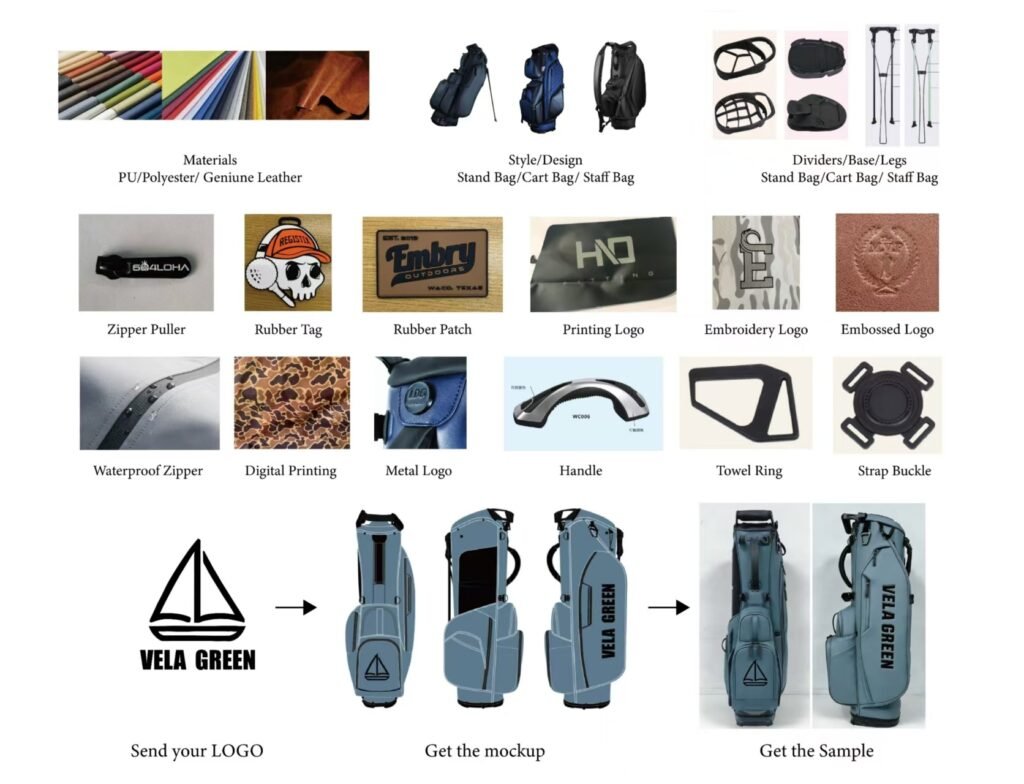
At Vela Green, we provide full-range OEM & ODM services for golf bags, golf headcovers, gloves, towels and other golf accessories. We support custom design, material selection, logo branding, color matching and mass production, strictly complying with CPSC, REACH and other international standards. With mature production experience, reliable quality control and professional export support, we help brands and importers develop market-oriented products with efficient lead times and flexible order quantities.