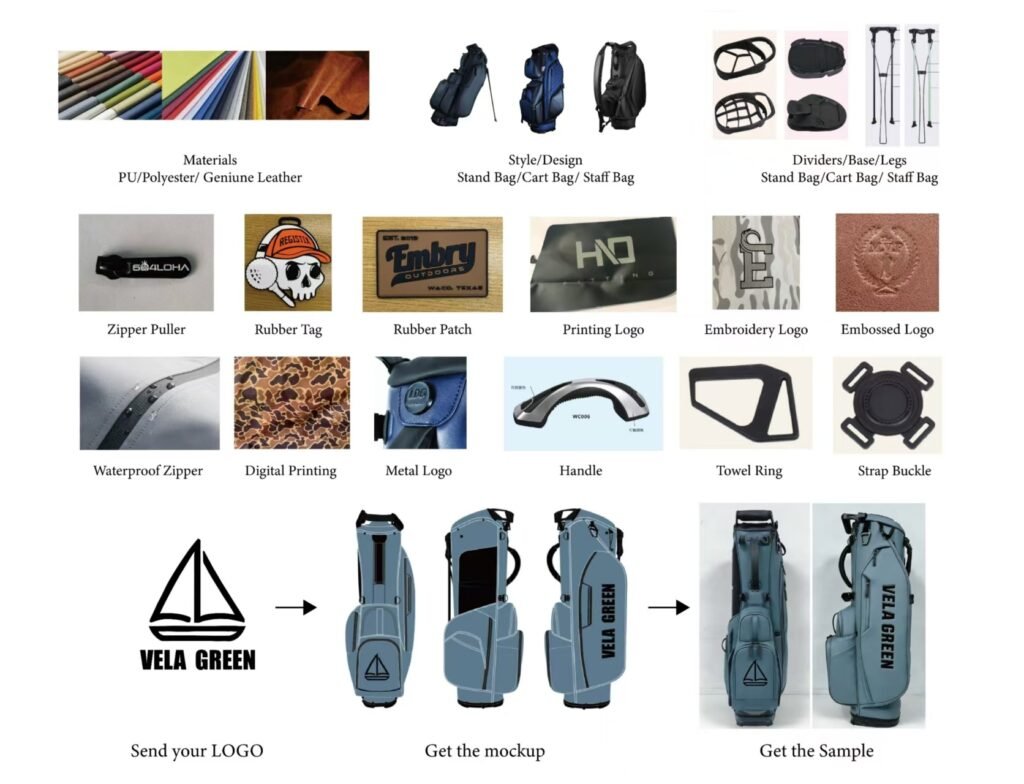
Golf Bags B2B: Fabric Comparison & Material Selection Guide 2026 is one of the most critical core skills for global golf equipment wholesalers, brand owners, and bulk procurement buyers. The fabric and material of a golf bag directly determine its durability, waterproof performance, UV resistance, hand feel, retail pricing, and after-sales return rate. Many B2B sellers face inventory losses and customer complaints due to incorrect material selection, such as faded fabrics, water leakage, fabric cracking, and poor wear resistance. This 2026 professional B2B guide conducts a comprehensive golf bag fabric comparison, analyzes the advantages, disadvantages, and applicable scenarios of mainstream materials, and provides standardized material selection strategies to help buyers select cost-effective golf bag materials for different target markets.
In the highly competitive global golf bag wholesale market, appearance and price are no longer the only competitive factors. End consumers and retail distributors are paying more attention to product durability and material quality. Mastering professional golf bag fabric comparison and material selection standards allows B2B buyers to classify product lines accurately, avoid low-quality homogeneous products, and create high-margin, high-reputation golf bag series for European, American, and global markets.
Why Fabric Material Determines B2B Golf Bag Wholesale Success
Golf bags belong to outdoor sports equipment that requires long-term exposure to sunlight, rain, and complex course terrain. Inferior fabric materials will cause a series of quality problems: thin fabrics are easy to tear, uncoated materials cannot resist rainwater penetration, low-grade dyeing leads to easy fading, and hard fabrics cause poor user experience. These quality defects directly trigger high return rates, negative reviews, and lost long-term cooperative customers.
On the contrary, scientific Golf bags B2B: fabric comparison & material selection can help suppliers match the most suitable materials according to product positioning, market region, and consumer groups. Entry-level materials control costs for mass retail and gift orders, while high-grade functional materials support high-end club and professional product lines, realizing full-price segment market coverage and maximizing overall wholesale profits.
Mainstream Golf Bag Fabrics: Full B2B Comparison 2026
At present, the mainstream golf bag materials in the global B2B wholesale market include 420D polyester, 600D polyester, Oxford cloth, nylon, PU leather, and eco-friendly recycled fabric. Each material has unique performance characteristics, cost advantages, and applicable scenarios. Below is a detailed industry comparison for B2B sourcing reference.
1. 420D Polyester Fabric (Entry-Level Wholesale Standard)
420D polyester is the most cost-effective basic fabric for entry-level golf bags and occupies the largest share of the low-to-medium-end wholesale market. This fabric features lightweight, soft hand feel, low production cost, and flexible dyeing performance, supporting various conventional color matching and simple logo customization. After basic water-repellent coating treatment, it can meet daily outdoor splash-proof needs.
However, 420D polyester has limited wear resistance and UV resistance. Long-term exposure to strong sunlight is prone to fading and fabric aging, and it cannot withstand severe friction and heavy-pressure extrusion. It is very suitable for B2B gift orders, beginner golf bag batches, promotional customized products, and low-budget pro shop retail stocking.
2. 600D High-Density Polyester (Best-Selling Mid-Range Fabric)
600D high-density polyester is the mainstream standard fabric for mid-range golf bags and the most popular material for daily B2B wholesale orders. Compared with 420D fabric, 600D polyester has thicker fiber density, stronger tensile resistance, better wear resistance, and more stable stereoscopic shape, effectively avoiding bag deformation after long-term storage and use.
Most qualified 600D polyester golf bags are equipped with double-layer waterproof coating and anti-UV treatment, adapting to all-weather outdoor golf scenarios. This material balances cost and performance perfectly, suitable for mass retail stand bags, cart bags, and daily golf course supporting equipment. It is the core stocking material for most stable B2B wholesale orders.
3. Premium Oxford Cloth (High Durability & Waterproof Grade)
Oxford cloth is a high-grade functional fabric for premium golf bags, widely used in high-end travel golf bags and professional cart bags. This material features tight weaving structure, super wear resistance, strong tear resistance, and excellent waterproof performance. After professional composite coating treatment, it can resist heavy rain penetration and has outstanding weather resistance, suitable for humid European markets and high-temperature sunny American markets.
Oxford cloth has a firm three-dimensional texture, not easy to wrinkle or deform, with a high-grade matte appearance. Although the procurement cost is slightly higher, its long service life and low failure rate greatly reduce after-sales pressure, making it the preferred material for high-quality wholesale product lines.
4. High-Grade Nylon Fabric (Lightweight Premium Series)
Nylon fabric is lighter, softer, and more skin-friendly than polyester, with better toughness and ductility. It is often used in ultra-lightweight portable golf stand bags and mini Sunday bags. Nylon material has excellent folding resistance, no creases after repeated folding, and is easy to store and carry, perfectly matching the lightweight sports trend of modern casual golf.
The disadvantage is that the material cost is higher than polyester, and the stereoscopic support is slightly weaker. It is suitable for high-end amateur consumer groups and boutique retail markets, helping B2B buyers create differentiated lightweight premium product lines.
5. PU Leather (High-End Display & Staff Bag Material)
PU leather is the classic material for professional staff bags and tournament-level golf bags. It has a delicate leather texture, smooth surface, high gloss, and a strong sense of ceremony, which can greatly improve the overall grade of golf bags. PU leather material is easy to clean and maintain, suitable for golf club display, tournament use, and high-end corporate gift customization.
Due to its relatively heavy weight and poor folding performance, PU leather is not suitable for walking golf bags. It is exclusively positioned in high-end scenario-based products, with high retail premium space and low market competition.
6. GRS Recycled Eco-Friendly Fabric (2026 New Trend Material)
As the global environmental protection trend rises, GRS-certified recycled fabric has become a must-have new material for European market golf bags. Made of recycled polyester raw materials, this fabric meets EU REACH environmental protection standards, with zero harmful residues, low carbon and environmental protection attributes.
The performance of eco-friendly fabric is equivalent to traditional 600D polyester, with stable quality and compliant indicators. B2B buyers who lay out the European market in advance can use this material to form product compliance advantages and quickly enter high-end local retail channels.
B2B Material Selection Guide by Target Market
Combined with the above fabric comparison results, B2B buyers can select targeted materials according to different regional market characteristics to improve product matching:
- US Market: Prioritize 600D polyester and Oxford cloth with anti-UV and fade-proof treatment, focusing on outdoor durability to adapt to long-term high-light outdoor use.
- European Market: Choose GRS eco-friendly fabrics and high-waterproof Oxford cloth to meet environmental compliance and humid climate waterproof needs.
- Premium Club & Tournament Market: Adopt PU leather and high-density Oxford cloth to create high-end texture and professional display effects.
- Promotion & Gift Market: Select cost-effective 420D polyester to control procurement costs and meet large-batch customized order demands.
Key Fabric Testing Standards for B2B Bulk Orders
To avoid material quality risks, B2B buyers must verify the following fabric indicators before mass production: waterproof coating uniformity, UV aging resistance, fabric tensile and tear strength, color fastness, and environmental certification qualification. Professional fabric quality inspection can effectively avoid batch quality problems and ensure long-term stable wholesale business.
Final Thoughts
Accurate Golf bags B2B: fabric comparison & material selection is the foundation for building a differentiated and profitable golf bag product line in 2026. Different fabrics have distinct cost performance, functional attributes and market positioning. B2B wholesale buyers should no longer choose materials blindly based on price, but combine regional market climate characteristics, consumer positioning and product usage scenarios for scientific matching. By optimizing fabric selection, suppliers can effectively reduce after-sales risks, improve product competitiveness, and gain stable profit growth in the global golf equipment wholesale market.
OEM & ODM Service
Whether you’re planning to build your own brand, develop new products, or find a stable manufacturing partner for the US and European markets, working with a professional OEM & ODM factory can significantly improve your product quality and market competitiveness.
At Vela Green, we provide full-range OEM & ODM services for golf bags, golf headcovers, gloves, towels and other golf accessories. We support custom design, material selection, logo branding, color matching and mass production, strictly complying with CPSC, REACH and other international standards. With mature production experience, reliable quality control and professional export support, we help brands and importers develop market-oriented products with efficient lead times and flexible order quantities.