Your search for the right golf bag manufacturer can feel overwhelming. Hundreds of factories claim to be the best, yet countless brands end up with delayed orders, poor stitching, or materials that fall apart after one season. Partnering with a reliable golf bag manufacturer is not just about price—it is about quality, communication, and long-term trust.
This guide walks you through exactly how to evaluate a golf bag manufacturer, what red flags to watch for, and how to build a partnership that helps your brand grow. Whether you need OEM golf bags for a new line or wholesale golf bags for resale, these principles apply.
Why Choosing the Right Golf Bag Manufacturer Matters More Than Ever
In 2026, supply chains remain complex and customer expectations for quality are higher than ever. A single bad batch of OEM golf bags can destroy your brand reputation, cost thousands in returns, and set your launch back months.
A trustworthy golf bag manufacturer does more than sew fabric together. They advise on material selection, suggest cost-saving design tweaks, maintain consistent quality across thousands of units, and deliver on time. Conversely, the wrong partner disappears when problems arise.
6 Critical Criteria to Evaluate a Golf Bag Manufacturer
1. Years of Experience and Specialization
Not all factories understand golf bag production equally. A general luggage factory may lack the specific tooling for golf bag dividers, stand mechanisms, or tour-style pocket layouts. Look for a golf bag manufacturer with at least 5–10 years of focused experience.
What to ask: “How many golf bag models have you produced in the last three years? What is your monthly production capacity for custom golf bag supplier orders?”
2. Quality Control Systems
The best golf bag manufacturer has documented quality control (QC) checkpoints at every stage: incoming material inspection, in-line production checks, and final random sampling before packing.
Red flags: “We check only at the end” or “The workers check their own work.” Without independent QC, defects reach your customers.
What to ask for: Photos of QC stations, third-party inspection reports from previous orders, and their defect rate percentage (industry standard is under 1.5%).
3. Material Sourcing Transparency
A reputable golf bag manufacturer knows exactly where their fabrics, zippers, webbing, and plastics come from. They can provide certificates for material claims such as 1680D denier rating, YKK zipper authenticity, or recycled content percentages.
Why it matters: Material substitution is common. You approve a sample with premium nylon, but production uses cheaper fabric. Transparent sourcing prevents this.
What to ask: “Can you show me invoices or supply chain documentation for the materials used in my sample?”
4. Customization Capabilities
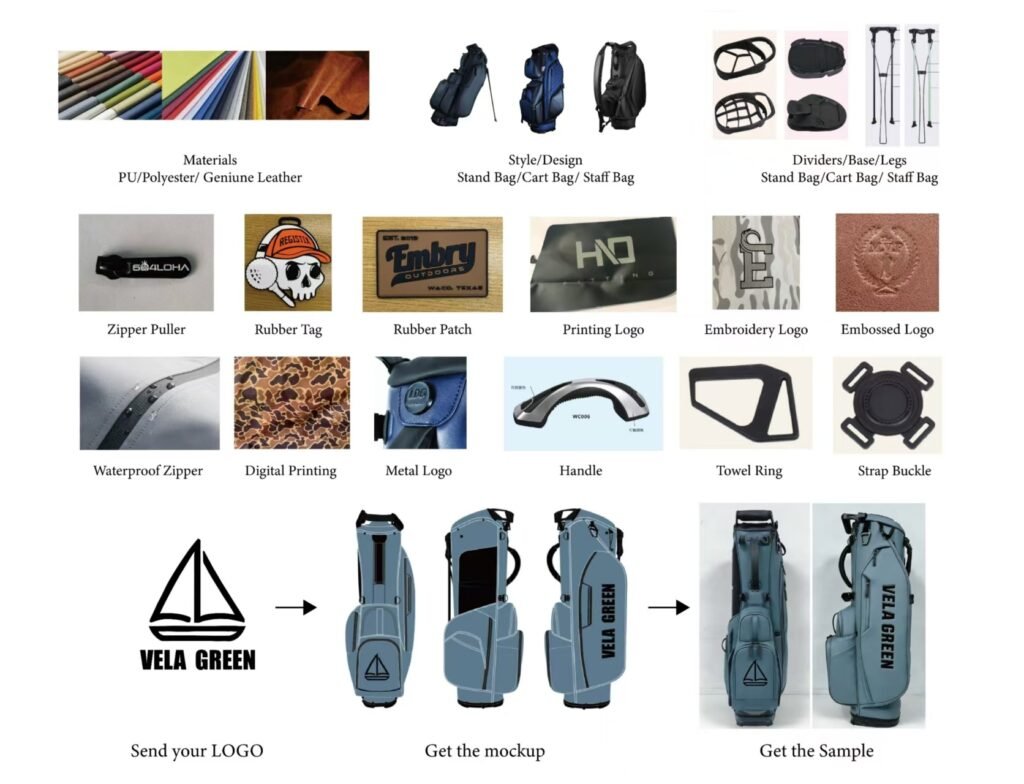
If you need custom golf bag supplier services—logo embroidery, custom colors, unique pocket configurations, or proprietary stand designs—your manufacturer must have in-house design and sampling capabilities.
Beware of factories that outsource embroidery or printing. Every handoff adds delay and quality risk.
What to ask: “Do you have in-house embroidery machines, screen printing, or heat transfer? What is your typical sample lead time for a fully custom design?”
5. Communication and Responsiveness
A technically excellent golf bag manufacturer is useless if they take five days to reply to emails. Time zone differences and language barriers are real, but a professional partner minimizes them.
Test before ordering: Send a detailed inquiry. How long do they take to respond? Do they answer all your questions or give vague replies? Do they proactively suggest solutions?
6. Certifications and Compliance
For selling in Europe, America, or Southeast Asia, your golf bag manufacturer should hold relevant certifications:
| Certification | What It Means |
|---|---|
| BSCI | Ethical labor practices and social compliance |
| ISO 9001 | Quality management system certified |
| REACH | Restricted chemicals compliance (Europe) |
| Prop 65 | California chemical safety |
| GRS | Global Recycled Standard for eco-friendly claims |
What to ask: “Please provide current copies of your BSCI and ISO 9001 certificates.”
Common Mistakes When Vetting a Golf Bag Manufacturer
Even experienced buyers slip up. Here are three frequent errors:
Mistake #1: Choosing a Golf Bag Manufacturer Based Only on MOQ
Low minimum order quantities (MOQs) sound attractive, but very low MOQs often mean the factory is a trading company, not a real golf bag factory. Trading companies add markup and have less control over quality.
Better approach: Look for a genuine golf bag manufacturer with reasonable MOQs (typically 300–500 pieces per design for OEM golf bags) but transparent about costs.
Mistake #2: Not Visiting the Factory or Doing a Virtual Tour
You cannot verify a golf bag manufacturer from a website alone. Photos can be stolen. If a visit is impossible, request a live video walkthrough of the production floor, material storage, and QC area.
Mistake #3: Skipping the Pre-Production Sample Approval
Never approve full production based on a digital drawing or a single photo. Insist on physical pre-production samples. Test them yourself—load clubs, pull zippers, check strap stitching.
How to Start a Partnership with a Golf Bag Manufacturer
Once you have shortlisted potential partners, follow this step-by-step process:
- Request capability presentation. Ask for a catalog of past wholesale golf bags they have produced, especially models similar to your vision.
- Share a detailed design brief. Include dimensions, material specs, pocket count, color codes (Pantone or RGB), and logo placement.
- Negotiate sample terms. Understand sample costs, lead time, and whether the cost is refundable against bulk orders.
- Review a draft manufacturing agreement. Cover confidentiality, exclusivity, defect liability, and payment terms (typically 30% deposit, 70% before shipment).
- Place a trial order. Start with a smaller quantity (e.g., 300 pieces) to test golf bag production quality and on-time delivery before scaling.
The Long-Term Value of a Reliable Golf Bag Manufacturer
A great golf bag manufacturer becomes a strategic partner. They alert you when material prices drop, suggest improvements to reduce your landed cost, and prioritize your orders during peak seasons. Switching manufacturers costs time, sampling fees, and quality uncertainty.
Brands that invest in vetting their custom golf bag supplier thoroughly often enjoy 5+ years of smooth production, consistent quality, and mutual growth.
Conclusion: Your Next Step in Finding the Right Golf Bag Manufacturer
Choosing a trusted golf bag manufacturer requires homework, but the payoff is enormous. You avoid defective products, missed deadlines, and damaged customer relationships. Instead, you deliver OEM golf bags that make your brand look professional and reliable.
Use the six criteria above to evaluate every candidate. Request samples, verify certifications, and trust your instincts—if communication feels difficult before you pay, it will only get worse after.
*With 20 years of dedicated golf bag manufacturing experience, a 3,000㎡ factory, 220 skilled staff, and in-house design and QC teams, we have helped 15+ countries bring their custom golf bag visions to life. Contact us to discuss your project and request a free capability consultation.*
OEM & ODM Service
Whether you’re planning to build your own brand, develop new products, or find a stable manufacturing partner for the US and European markets, working with a professional OEM & ODM factory can significantly improve your product quality and market competitiveness.
At Vela Green, we provide full-range OEM & ODM services for golf bags, golf headcovers, gloves, towels and other golf accessories. We support custom design, material selection, logo branding, color matching and mass production, strictly complying with CPSC, REACH and other international standards. With mature production experience, reliable quality control and professional export support, we help brands and importers develop market-oriented products with efficient lead times and flexible order quantities.