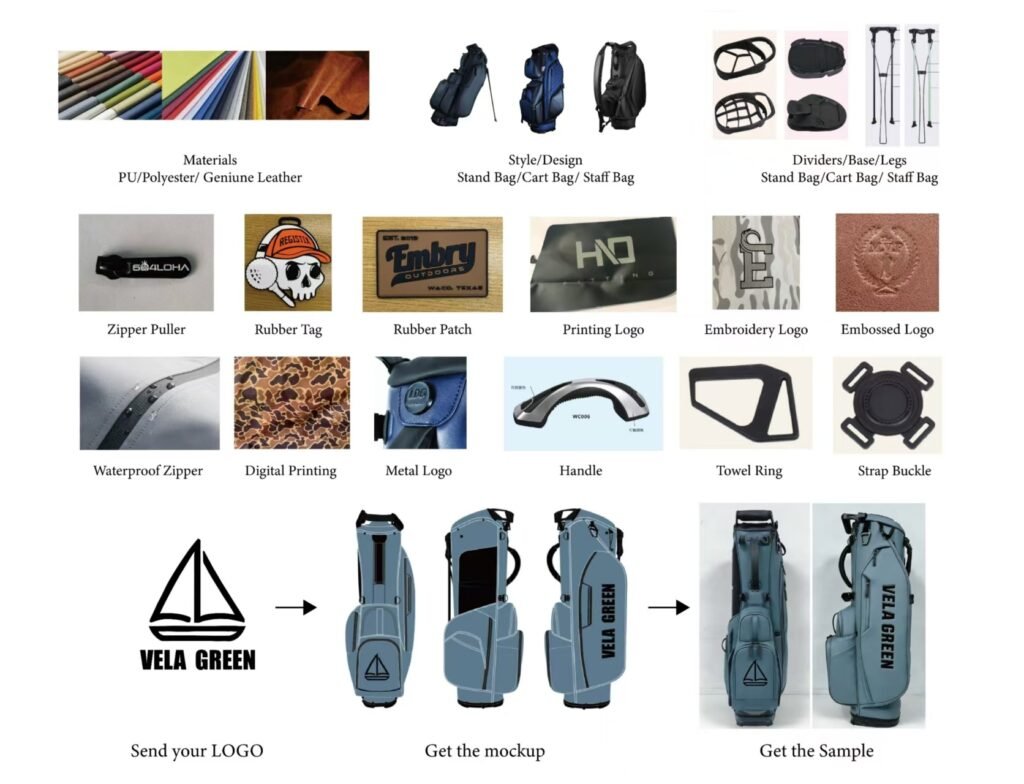
Private Label Golf Bags: Complete B2B Branding Guide for Retailers 2026 is a must-read resource for cross-border retailers, golf shop owners, and B2B distributors looking to build unique product lines and boost profit margins in competitive US and European markets. In 2026, generic wholesale golf bags face severe price homogenization and low profit ceilings, making private label branding the core breakthrough for small and medium golf retail brands. Custom private label golf bags allow retailers to own exclusive brand logos, personalized designs, and differentiated product positioning, completely separating their stores from low-price competitors. This complete B2B guide explains everything you need to know about private label golf bag customization, branding strategies, and wholesale sourcing to help retailers build a high-value, market-competitive golf product system.
Many new golf retailers rely on ready-made ODM golf bag inventory, resulting in identical product displays and powerless price competition. Learning how to launch and operateprivate label golf bags enables retailers to build brand awareness, increase customer loyalty, and gain higher retail premium space. Unlike standardized wholesale goods, private label products carry your exclusive brand identity, laying a solid foundation for long-term store growth and market expansion in the global golf industry.
Why Private Label Golf Bags Dominate 2026 Golf Retail
The global golf retail market has shifted from volume sales to brand value sales. Modern golf consumers in the US and Europe no longer only focus on product practicality; they prioritize brand uniqueness, personalized aesthetics, and exclusive usage experience. Generic golf bags sold by countless retailers can hardly leave a deep impression on customers, resulting in low repurchase rates and fragile market competitiveness.
Private label golf bags solve these pain points perfectly. For retailers, private labeling eliminates price comparison risks, supports customized market-oriented designs, and builds exclusive brand IP. With flexible small-batch OEM/ODM private label solutions widely available in 2026, even startup retail brands can launch their own branded golf bags with low investment and low risk, realizing rapid store upgrading and profit improvement.
Core Benefits of Private Label Golf Bags for B2B Retailers
Investing in private label golf bags brings long-term commercial value that generic wholesale products cannot match, covering profit, brand, and market operation dimensions.
First, higher profit margins. Private label products avoid middleman markup and homogeneous price wars. Retailers can set independent pricing based on brand positioning and product differentiation, obtaining 30%–50% higher profit space than ordinary wholesale golf bags.
Second, exclusive brand differentiation. Private label customization covers brand logo embroidery, exclusive color matching, personalized pocket structures, and customized functional upgrades. These exclusive design elements make your products unique in local golf markets, effectively attracting fixed customer groups and improving store competitiveness.
Third, flexible market adaptation. Based on 2026 Western golf consumption trends, retailers can customize lightweight portable golf bags for casual players, professional waterproof cart bags for frequent course users, and eco-friendly recycled material bags for European green consumption markets, precisely matching segmented consumer demands.
Fourth, sustainable brand accumulation. Every private label golf bag sold acts as mobile brand promotion. Continuous output of exclusive branded products helps retailers form stable brand reputation, accumulate word-of-mouth traffic, and support offline store expansion and online cross-border store scaling.
2026 Step-by-Step Guide to Launch Private Label Golf Bags
Combined with the latest B2B sourcing rules, this standardized process helps retailers launch qualified, marketable private label golf bags efficiently.
1. Confirm brand positioning and target markets. Clarify whether your products target high-end professional players, mid-range amateur golfers, or entry-level casual users. Match product materials, functions, and design styles according to US and European regional preferences to avoid blind customization.
2. Select reliable private label manufacturers. Choose factories with mature golf bag OEM/ODM experience, complete US and EU compliance certifications, and flexible MOQ support. Verify their private label customization cases, quality control systems, and after-sales mechanisms to ensure stable batch quality.
3. Determine personalized customization details. Combine market hot-selling features to confirm core customization content, including brand logo technology (embroidery, silicone printing, heat transfer), exclusive color schemes, functional configurations (insulated pockets, anti-collision dividers, UV resistance), and outer packaging design.
4. Sample confirmation and batch production. Confirm sample quality, color difference, and functional performance before mass production. Lock all standards in formal contracts to avoid batch cutting corners. Arrange pre-shipment inspection to ensure all private label golf bags meet retail sales standards.
Key Branding Tips for 2026 Private Label Golf Bags
To maximize the value ofprivate label golf bags, retailers need to focus on refined branding operations. First, unify brand visual styles, including fixed brand colors, logo positions, and packaging styles, to form consistent brand recognition. Second, highlight exclusive selling points in product listings, such as customized eco-friendly materials, patented functional designs, and Western market exclusive styles, to attract high-value customers.
Third, match localized marketing strategies. For the US market, emphasize durability, UV resistance, and large-capacity practicality; for European markets, highlight lightweight design, environmental protection, and minimalist aesthetics. Targeted branding greatly improves retail conversion rates and customer satisfaction.
Common Private Label Mistakes to Avoid
Many retailers fail in private label branding due to improper operation. Avoid blind high-cost full-customization for new brands; prioritize low-risk ODM-based private label modification to reduce startup costs. Do not ignore market compliance standards; ensure all customized products meet EU REACH and US Prop 65 requirements to avoid sales risks. Additionally, avoid over-customization that deviates from public consumer preferences, balancing uniqueness and market adaptability.
Final Thoughts
Private Label Golf Bags: Complete B2B Branding Guide for Retailers 2026 clarifies the commercial value, customization process, and branding strategies of private label golf bags for B2B retailers. In the increasingly competitive 2026 golf retail market, private label customization is the most effective way to break homogeneous competition, improve profit margins, and build independent brand influence. By choosing reliable manufacturers, matching localized customization, and implementing refined branding operations, retailers can create exclusive high-value golf bag product lines and achieve long-term stable business growth.
OEM & ODM Service
Whether you’re planning to build your own brand, develop new products, or find a stable manufacturing partner for the US and European markets, working with a professional OEM & ODM factory can significantly improve your product quality and market competitiveness.
At Vela Green, we provide full-range OEM & ODM services for golf bags, golf headcovers, gloves, towels and other golf accessories. We support custom design, material selection, logo branding, color matching and mass production, strictly complying with CPSC, REACH and other international standards. With mature production experience, reliable quality control and professional export support, we help brands and importers develop market-oriented products with efficient lead times and flexible order quantities.