OEM vs ODM Golf Bags: Which Option Is Better for B2B Buyers 2026 is one of the most frequently asked questions by global golf bag distributors, private label brand owners, and cross-border retailers. When sourcing wholesale golf bags for US and European markets, B2B buyers often struggle to choose between OEM and ODM cooperation modes. Picking the wrong customization model leads to wasted budgets, slow product iteration, homogeneous inventory, or missed market trends. In 2026, as the golf wholesale market shifts to personalized and niche segmented products, understanding the core differences between OEM and ODM golf bag sourcing helps you select the most cost-effective solution for your brand scale, sales model, and target market.
Many new B2B buyers mistakenly equate OEM and ODM golf bag customization, resulting in unreasonable order planning and profit loss. Simply put, OEM focuses on manufacturing according to buyer designs, while ODM provides ready-made mature styles with minor custom tweaks. To determine which is better between OEM and ODM golf bags for your 2026 B2B business, you need to evaluate your brand positioning, order volume, customization demands, and market update frequency. This guide breaks down the pros, cons, and applicable scenarios of both models to help you make data-driven sourcing decisions.
Basic Definition: OEM vs ODM Golf Bag Customization
Clear definition differentiation is the premise of accurate B2B sourcing. OEM (Original Equipment Manufacturer) golf bag cooperation means buyers provide complete design drawings, structural requirements, material standards, and functional specifications. The factory only undertakes production and processing without changing the buyer’s exclusive design. All customized styles belong exclusively to the buyer’s brand, with no public sales by the manufacturer.
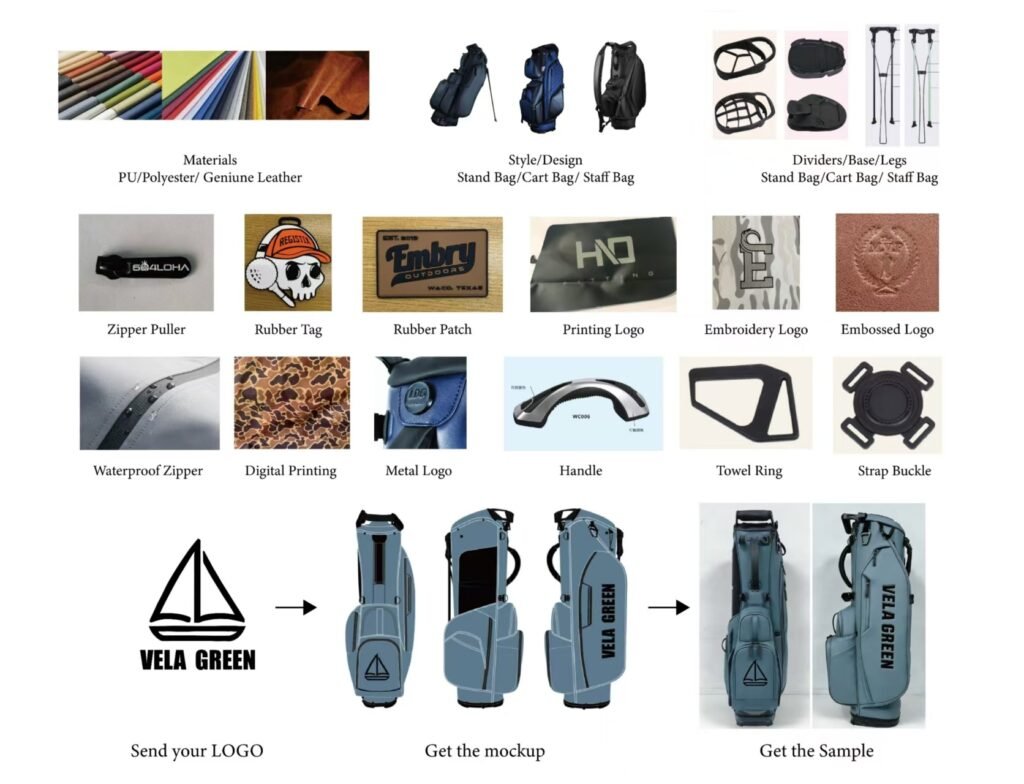
ODM (Original Design Manufacturer) golf bag cooperation refers to factories owning independent mature designs, existing molds, and verified hot-selling styles. B2B buyers select ready-made golf bag models and make minor customizations, including logo printing, color matching, and fabric replacement. The factory retains design ownership and can sell the same styles to other buyers without exclusive authorization.
Core Pros & Cons of OEM Golf Bags for B2B Buyers
OEM golf bag customization is tailored for brands pursuing absolute differentiation and exclusive product barriers. Its biggest advantage is full design independence. B2B buyers can independently define bag structure, pocket layout, functional upgrades, material grades, and ergonomic details, completely avoiding market homogenization. For mid-to-high-end golf brands focusing on US and European premium markets, OEM helps build unique brand product systems and form long-term competitive barriers.
However, OEM cooperation has obvious limitations. It requires high order MOQ, higher production costs, and longer lead times. The whole process involves design confirmation, sample development, mold opening, and mass production, which takes 30–45 days longer than ODM orders. Meanwhile, buyers need to bear mold costs and design risks, making it unsuitable for new brands with small budgets or market trial demands.
Core Pros & Cons of ODM Golf Bags for B2B Buyers
ODM golf bag sourcing is the most cost-effective choice for most 2026 small and medium-sized B2B wholesale buyers. Factories provide mature styles verified by Western market sales, with zero mold costs and low trial order MOQ. Buyers only need to modify logos, colors, and partial materials to quickly launch private label products, greatly shortening product iteration cycles and reducing early R&D risks.
The main disadvantage of ODM is low exclusivity. Without exclusive authorization, the same styles will be sold to multiple wholesalers, leading to market homogenization and price competition. In addition, ODM cannot support structural redesign and major functional upgrades, limiting product differentiation and premium space. It is more suitable for mass-market retail and budget wholesale orders.
2026 Scenario Analysis: Which Is Better for Your B2B Business?
To solve the confusion of OEM vs ODM golf bags selection, B2B buyers can make choices based on their actual business scenarios in 2026.
Choose OEM if you are a mature premium brand or customized bulk distributor. If you target high-end US and European golf club markets, have stable large order volumes, and need exclusive functional designs and brand barriers, OEM is the best option. It supports exclusive structural optimization, patented functional upgrades, and high-standard compliance customization, helping you occupy the high-margin premium market and avoid low-end price competition.
Choose ODM if you are a new brand, cross-border e-commerce seller, or seasonal wholesaler. For buyers needing small-batch trial sales, fast seasonal stock updates, and low-budget private label layout, ODM minimizes risks and costs. Mature factory styles fit 2026 popular trends such as lightweight design, UV resistance, and eco-friendly materials, ensuring fast listing and quick market feedback.
2026 B2B Sourcing Strategy: Hybrid OEM + ODM Matching Mode
The optimal 2026 solution for most golf B2B businesses is a hybrid model. Use ODM customized styles for daily best-selling inventory to ensure stable supply, low cost, and fast turnover. Adopt OEM exclusive customization for core flagship products to build brand differentiation and high-margin profit sources. This combination balances market adaptability and brand competitiveness, avoiding the single risk of full ODM homogeneity or full OEM high cost.
Final Thoughts
OEM vs ODM Golf Bags: Which Option Is Better for B2B Buyers 2026 provides targeted sourcing reference for global golf wholesale buyers. There is no absolute good or bad between OEM and ODM golf bag customization. New sellers with flexible budgets and trial demands prioritize ODM for low-risk layout, while mature premium brands choose OEM for exclusive product barriers. The hybrid OEM & ODM strategy will become the mainstream B2B sourcing trend in 2026, helping buyers maximize profits while avoiding market risks.
OEM & ODM Service
Whether you’re planning to build your own brand, develop new products, or find a stable manufacturing partner for the US and European markets, working with a professional OEM & ODM factory can significantly improve your product quality and market competitiveness.
At Vela Green, we provide full-range OEM & ODM services for golf bags, golf headcovers, gloves, towels and other golf accessories. We support custom design, material selection, logo branding, color matching and mass production, strictly complying with CPSC, REACH and other international standards. With mature production experience, reliable quality control and professional export support, we help brands and importers develop market-oriented products with efficient lead times and flexible order quantities.