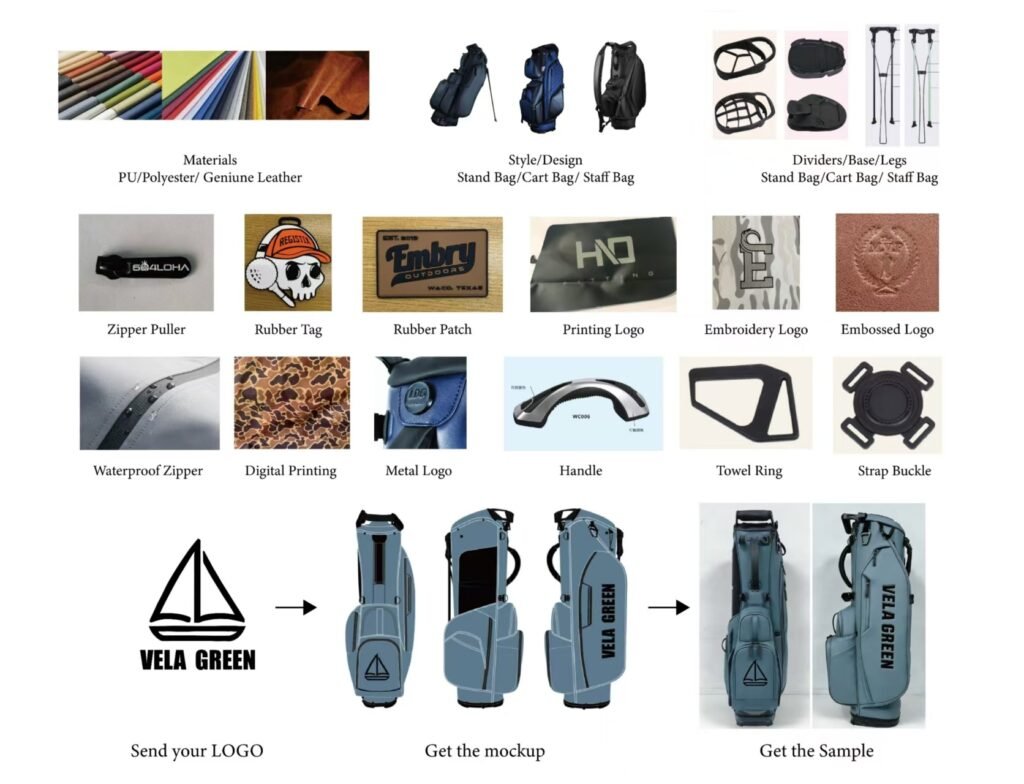
Understanding golf bag production cost is essential for any B2B buyer negotiating with manufacturers. The factory‘s quoted price is not arbitrary—it reflects a complex interplay of materials, labor, hardware, quality control, and overhead. Yet many buyers treat golf bag production cost as a single number to be minimized, missing the opportunity to optimize value across each component.
The global golf bags market is projected to reach USD 1.75 billion by 2031. Within this growing market, golf bag production cost varies widely—from $25–35 per unit for entry-level bags to $70–120 for premium models-. This guide breaks down golf bag production cost into five core components, helping B2B buyers understand where their money goes and how to optimize spending without sacrificing quality.
Component #1: Raw Materials — The Largest Share of Golf Bag Production Cost
Raw materials typically account for 40–50% of total golf bag production cost. This is the single largest cost driver and the area where material choices have the most significant impact on both quality and price.
Fabric Choices and Their Cost Impact
- Nylon and polyester are the most common materials for lightweight and durable golf bags. Standard nylon bags weigh about 5.5 lbs. Jacquard nylon, a textured synthetic trending for 2026, offers a premium look without adding extra weight.
- PU leather offers a high-end, tour-style appearance. It is waterproof and easy to clean, but lower-quality PU leather can scratch or peel in humid conditions. Hydrolysis-resistant PU leather lasts 3–5 years.
- Recycled materials (RPET) are gaining popularity, particularly in European markets. While sometimes cost-competitive, sustainable materials can also command premium positioning.
- Denier rating directly affects cost. Higher denier (e.g., 1680D ballistic nylon) offers greater durability but increases golf bag production cost-.
Frame and Structural Materials
- Carbon fiber frames weigh only 300 grams and are ideal for lightweight designs but cost $50–120 per meter.
- Aluminum frames are cheaper at $15–30 per meter, weigh about 800 grams, and perform well for mid-range bags-.
Cost-Saving Opportunities
Automated laser cutting machines can reduce fabric waste by approximately 15% compared to manual cutting. Working with manufacturers that invest in such technology can lower your golf bag production cost without compromising material quality.
Component #2: Hardware and Custom Components
Hardware accounts for a significant portion of golf bag production cost, especially when custom elements are involved.
Hardware Cost Drivers
- Custom molds for branded zipper pulls, specialized handle grips, or proprietary bottom bases typically cost $300–$2,000 per mold.
- YKK zippers are the industry standard for durability. Weather-sealed and self-healing zippers add cost but reduce warranty claims-.
- Heavy-duty metal hardware ensures enhanced durability but adds to production costs.
Hardware Cost Strategy
For brands testing new designs, using standard hardware from the factory‘s existing open molds eliminates tooling costs entirely. Once a design proves successful, investing in custom molds can differentiate your brand while the cost is amortized across larger order volumes.
Component #3: Labor and Craftsmanship
Labor is the second-largest component of golf bag production cost, typically accounting for 20–25% of total unit cost.
Labor Cost Factors
- Skilled sewing operators are essential for consistent stitch quality. Reinforced stitching at stress points (strap attachments, pocket seams) requires experienced workers.
- Embroidery adds significant labor cost. Standard font embroidery may be included at no charge, but custom logos start at around €100 including VAT. Complex designs require additional programming time.
- Assembly complexity drives labor hours. Bags with 14-way full-length dividers require substantially more assembly time than simple 4-way designs.
- Quality control personnel add to labor costs but reduce returns and warranty claims.
Geographic Labor Cost Variation
- China offers labor costs typically 30–50% lower than Western countries-.
- Vietnam benefits from even lower labor costs and adaptability-.
- Inland Chinese provinces offer labor costs 25–30% lower than coastal Guangdong-.
Labor cost arbitrage explains why most golf bag production cost optimization strategies begin with geographic sourcing decisions. However, lower labor costs must be weighed against supply chain integration and quality consistency.
Component #4: Quality Control and Testing
Quality control is an often-overlooked component of golf bag production cost that directly affects long-term profitability.
QC Cost Components
- Incoming material inspection (IQC) verifies fabric tensile strength, water resistance, and UV stability before production begins.
- In-process quality control (IPQC) checks stitch length (±0.5mm tolerance), seam alignment, and hardware attachment during assembly.
- Pre-shipment inspection (PSI) provides 100% visual inspection with AQL (Acceptable Quality Level) Level II, 2.5/4.0 standards.
- Third-party inspection adds cost but provides independent verification.
The ROI of Quality Control
Rigorous quality control reduces returns and warranty claims. A $1 increase in QC cost per unit can save $5–10 in returns and replacements downstream. For B2B buyers, understanding this trade-off in golf bag production cost is essential for long-term margin protection.
Component #5: Overhead, Profit, and Economies of Scale
The final components of golf bag production cost include factory overhead and profit margin.
Overhead Components
- Factory overhead includes equipment maintenance, utilities, facility costs, and management salaries.
- Design and R&D investment typically accounts for 15–20% of cost structure in premium bags.
- Packaging (polybags, cartons, inserts) adds $1–3 per unit.
Economies of Scale
Golf bag production cost decreases significantly with volume:
| Order Volume | Typical Per-Unit Cost Range |
|---|---|
| 50–100 units | Highest (setup costs spread thin) |
| 100–500 units | Moderate (standard MOQ range) |
| 500–1,000+ units | Lowest (setup costs fully amortized) |
Smaller production runs of 50–100 units require 30–45 day. Larger volumes reduce per-unit labor and overhead costs-.
Manufacturer Profit Margins
OEM manufacturing typically offers 30–50% higher long-term margins than off-the-shelf products-. Some golf bag products can achieve retail margins of 59%-. Understanding the manufacturer‘s margin expectations helps in negotiating fair golf bag production cost while maintaining a sustainable partnership.
Complete Golf Bag Production Cost Breakdown Summary
| Cost Component | Typical Percentage of Total | Key Variables |
|---|---|---|
| Raw materials | 40–50% | Fabric type, denier, frame material, recycled content |
| Hardware | 10–15% | Custom molds, zipper brand, metal vs. plastic |
| Labor | 20–25% | Skill level, geographic location, embroidery complexity |
| Quality control | 5–10% | Inspection frequency, third-party involvement |
| Overhead & profit | 10–15% | Factory efficiency, order volume, brand positioning |
Total golf bag production cost typically ranges from $25–35 for entry-level** to **$40–60 for mid-range and $70–120 for premium units-.
How to Optimize Golf Bag Production Cost Without Sacrificing Quality
B2B buyers can reduce golf bag production cost through several strategies:
- Choose standard materials where possible. Custom-dyed fabrics add 10–15 days to lead time and increase cost.
- Use existing hardware molds for trial orders. Reserve custom molds for proven designs.
- Consolidate orders to achieve volume pricing tiers. Combining multiple SKUs into one shipment reduces per-unit logistics cost.
- Select the right manufacturing region. China offers supply chain integration; Vietnam offers lower labor costs-.
- Invest in up-front design. Catching errors in CAD saves expensive rework during production.
Conclusion: Master Golf Bag Production Cost for Better Sourcing Decisions
Understanding golf bag production cost is not about squeezing every dollar from your supplier—it is about making informed decisions that balance quality, price, and long-term partnership value. Materials drive 40–50% of cost, labor adds 20–25%, and hardware, quality control, and overhead make up the remainder.
B2B buyers who understand these golf bag production cost components can negotiate more effectively, identify cost-saving opportunities, and build supplier relationships based on mutual understanding rather than price pressure alone. The next time you receive a factory quote, you will know exactly where your money is going—and how to optimize it.
With 20 years of golf bag manufacturing experience and transparent cost structures, we help B2B clients understand every component of their production cost. Contact us to request a detailed cost breakdown for your custom golf bag project.
OEM & ODM Service
Whether you’re planning to build your own brand, develop new products, or find a stable manufacturing partner for the US and European markets, working with a professional OEM & ODM factory can significantly improve your product quality and market competitiveness.
At Vela Green, we provide full-range OEM & ODM services for golf bags, golf headcovers, gloves, towels and other golf accessories. We support custom design, material selection, logo branding, color matching and mass production, strictly complying with CPSC, REACH and other international standards. With mature production experience, reliable quality control and professional export support, we help brands and importers develop market-oriented products with efficient lead times and flexible order quantities.