The landscape of golf bag OEM trends is undergoing its most significant transformation in decades. The global golf bags market is projected to expand from USD 1.43 billion in 2025 to USD 1.75 billion by 2031-, while the broader golf equipment market reached USD 9.64 billion in 2026-. For B2B buyers navigating golf bag OEM trends, understanding these shifts is essential for sourcing products that meet evolving consumer expectations and regulatory requirements. This guide explores five key golf bag OEM trends reshaping the industry in 2026.
Trend #1: The Rise of Agile Manufacturing in Golf Bag OEM
One of the most significant golf bag OEM trends in 2026 is the shift toward agile manufacturing. Traditional large-scale factories that only accept orders above 10,000 units are losing ground to manufacturers offering small orders, fast turnaround capabilities.
Industry leaders have compressed sampling to 7–10 days and achieved 30-day delivery for orders under 2,000 pieces. This agility allows brands to test new designs without massive inventory risk. Top agile manufacturers maintain batch pass rates above 99.5% and achieve client reorder rates of 70%. For B2B buyers, this golf bag OEM trend means access to flexible production that supports market testing and rapid iteration.
Trend #2: The Dual-Track Manufacturing Model
Another emerging golf bag OEM trend is the “dual-track manufacturing” model—factories offering both finished bags and semi-finished components like cut pieces and assemblies. This approach helps buyers reduce local assembly costs while maintaining brand quality standards.
Factories providing semi-finished components must maintain strict quality control, as component defects can compromise the final product. Leading manufacturers in this golf bag OEM trend operate with independent pattern rooms and automated cutting beds that can convert designs into high-precision components within 7–10 days. For B2B buyers, this model enables cost-effective local assembly while leveraging China‘s manufacturing expertise.
Trend #3: The Shared OEM Ecosystem in Premium Golf Bags
A reality of the premium golf bag market that represents a key golf bag OEM trend is the shared OEM manufacturing ecosystem. Many luxury brands operate within shared manufacturing networks in Asia. Multiple brands may use similar base molds, divider structures, and silhouette geometries, with differentiation achieved through branding, colorway, panel layout, and hardware finish.
For B2B buyers, this golf bag OEM trend raises an important question: Is a brand‘s platform proprietary, or is it derived from a broader template system? Understanding the OEM ecosystem helps buyers evaluate whether a supplier offers true exclusivity or is producing for multiple labels under different specifications.
Trend #4: Smart Technology Integration
Smart technology integration is one of the fastest-growing golf bag OEM trends in 2026. Solar charging ports have emerged as a key differentiator, driven by the rise of AI-powered smart golf trolleys with high energy demands. Leading manufacturers now integrate flexible solar panels with IPX7 waterproofing while reducing bag weight by approximately 20%.
Other tech features reshaping golf bag OEM trends include built-in GPS mounts, Bluetooth speakers, and swing analysis tools with embedded IMU sensors. Tech-enabled golf bags achieve crowdfunding success rates of 75%, compared to 45% for general projects. For B2B buyers, this golf bag OEM trend means sourcing suppliers capable of integrating electronics without compromising durability or aesthetics.
Trend #5: Sustainability as a Competitive Requirement
Sustainability has moved from a nice-to-have to a competitive requirement in golf bag OEM trends. Eco-friendly golf bag sales surged 145% from 2023 to 2025, with 78% of golfers factoring sustainability into purchasing decisions. A single eco-friendly bag typically uses 25–30 recycled plastic bottles-. Recycled polyester (rPET) reduces carbon emissions by 60% compared to virgin nylon while maintaining durability-.
For B2B buyers, this golf bag OEM trend means prioritizing suppliers with access to certified sustainable materials—GRS-certified rPET, bio-based foams, and OEKO-TEX certified textiles. Sixty-five percent of golfers are willing to pay a 15–20% premium for eco-friendly gear, making sustainability a margin opportunity.
What These Golf Bag OEM Trends Mean for B2B Buyers
The five golf bag OEM trends outlined above point to a clear conclusion: the OEM golf bag industry is becoming more agile, more specialized, more technology-driven, and more sustainability-focused.
Actionable Takeaways
- Prioritize suppliers with agile manufacturing capabilities. 7–10 day sampling and 30-day delivery enable rapid market testing
- Consider dual-track suppliers. Access to semi-finished components can reduce assembly costs
- Understand the OEM ecosystem. Know whether your supplier offers proprietary platforms or shared templates
- Evaluate smart feature capabilities. Solar charging and device integration are becoming baseline expectations
- Incorporate sustainability criteria. GRS certification, recycled materials, and reduced packaging should be part of supplier scorecards
Common Golf Bag OEM Sourcing Mistakes to Avoid
| Mistake | Consequence | Solution |
|---|---|---|
| Choosing solely on price | Sacrificing quality and agility | Balance cost with capabilities and certifications |
| Ignoring agile manufacturing | Long lead times, missed market windows | Prioritize 7-10 day sampling and 30-day delivery |
| No sustainability requirements | Regulatory risks, missed premium opportunities | Include GRS and OEKO-TEX in supplier evaluation |
| Not understanding OEM ecosystem | Paying premium for non-exclusive designs | Ask about platform ownership and exclusivity |
Conclusion: Act on Golf Bag OEM Trends Now
The golf bag OEM trends of 2026 are not temporary—they represent permanent shifts in how golf bags are manufactured, sourced, and sold. Agile manufacturing enables faster product launches. The dual-track model offers cost flexibility. The shared OEM ecosystem demands careful supplier evaluation. Smart technology creates differentiation. Sustainability drives consumer preference and premium pricing.
B2B buyers who act on these golf bag OEM trends now—by sourcing from suppliers with agile capabilities, smart feature expertise, and sustainability certifications—will capture market share as the golf bags market grows toward USD 1.75 billion by 2031. Those who wait will find themselves competing on price alone in a market that increasingly rewards innovation and responsibility.
With 20 years of golf bag OEM manufacturing experience and capabilities including 7-10 day sampling, 30-day delivery for small orders, ISO 9001 and BSCI certifications, and sustainable material sourcing, we help B2B clients stay ahead of every golf bag OEM trend. Contact us to discuss how our capabilities align with your 2026 sourcing strategy.
OEM & ODM Service
Whether you’re planning to build your own brand, develop new products, or find a stable manufacturing partner for the US and European markets, working with a professional OEM & ODM factory can significantly improve your product quality and market competitiveness.
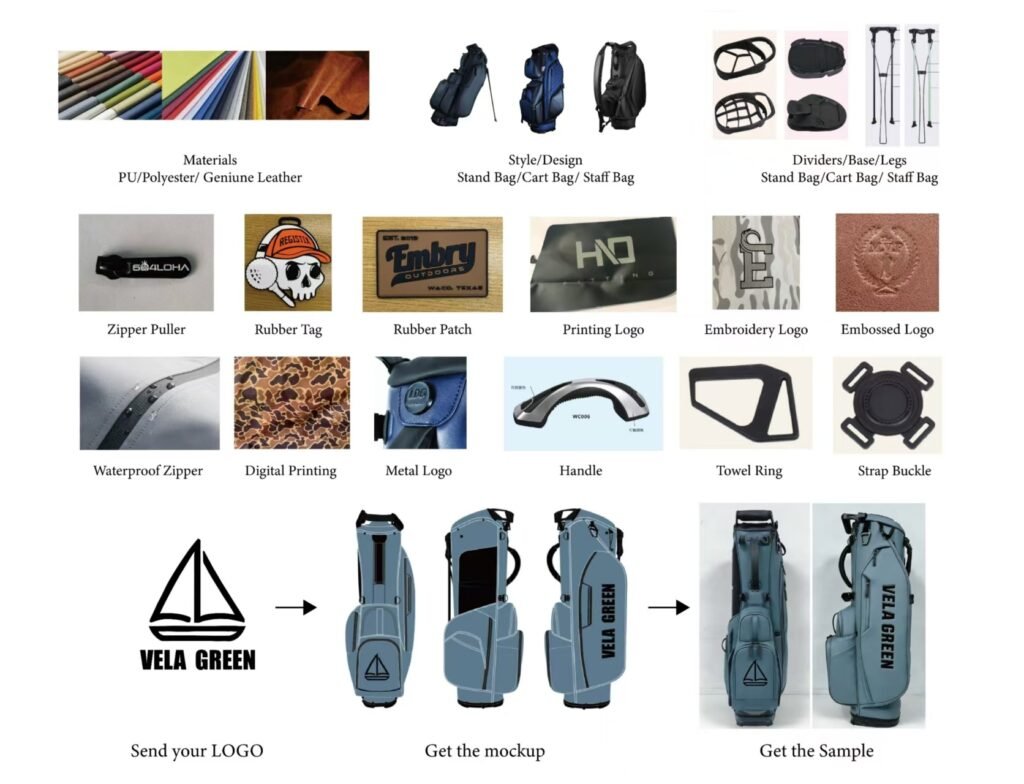
At Vela Green, we provide full-range OEM & ODM services for golf bags, golf headcovers, gloves, towels and other golf accessories. We support custom design, material selection, logo branding, color matching and mass production, strictly complying with CPSC, REACH and other international standards. With mature production experience, reliable quality control and professional export support, we help brands and importers develop market-oriented products with efficient lead times and flexible order quantities.