The global golf bag supply chain is under unprecedented pressure in 2026. Tariffs have escalated dramatically, shipping routes remain unpredictable, and major manufacturers are restructuring their global networks-. For B2B buyers, navigating these challenges requires more than just finding a reliable factory—it demands a strategic approach to golf bag supply chain management that anticipates disruption before it happens.
The global golf bags market is projected to expand from USD 1.43 billion in 2025 to USD 1.75 billion by 2031. Participation continues to rise, with over 160 million golfers worldwide. Yet raw material price volatility and inflationary pressures threaten to destabilize production costs. This guide presents five strategies for building golf bag supply chain resilience that protects your margins and ensures on-time delivery.
Strategy #1: Diversify Your Golf Bag Supply Chain Across Multiple Regions
The most critical lesson from recent disruptions is that concentration creates vulnerability. A golf bag supply chain that relies on a single country or factory is a golf bag supply chain that can break. In early 2026, major industry players accelerated the onboarding of new suppliers in Mexico and Cambodia, signaling a strategic shift away from traditional Asian hubs.
Building Regional Diversity into Your Golf Bag Supply Chain
- China remains the dominant manufacturing hub, particularly in Guangdong and Fujian provinces, with integrated supply chains that reduce component lead times by up to 40%. However, high tariffs make China less cost-effective for US-bound shipments.
- Vietnam has emerged as a compelling alternative, with golf bag exports benefiting from lower tariff exposure- and a well-developed supply chain infrastructure-. Major brands now source heavily from Vietnamese suppliers.
- Mexico offers nearshoring advantages for US buyers, reducing transit times and tariff exposure. Callaway, for example, onboarded Mexican suppliers in early 2026.
- Taiwan provides lower tariff rates than China for US imports, making it an attractive secondary sourcing option.
A resilient golf bag supply chain maintains relationships with at least two qualified suppliers in different regions. This allows you to shift production if one region faces disruption—whether from tariffs, labor strikes, or natural disasters.
Strategy #2: Navigate the 2026 Tariff Landscape in Your Golf Bag Supply Chain
Tariffs have become one of the largest cost drivers in the golf bag supply chain in 2026. Understanding the current tariff structure is essential for accurate landed cost calculation.
Current US Tariff Structure for Golf Bags
For golf bags imported into the United States, classification typically falls under HS Code 4202.92. The duty structure varies significantly by material and origin:
- Golf bags from China made of man-made fibers (HTS 4202.92.31): Total effective duty of 52.6%—combining a 17.6% base rate, 25% Section 301 duty, and 10% surcharge
- General sports bags from China (HTS 4202.92.91): Total duty of 27.6%—combining 17.6% base rate with 10% surcharge
- Golf bags from Vietnam or Taiwan: Approximately 10% baseline rate
Tariff Management Strategies for Your Golf Bag Supply Chain
- Verify HS code classification with a customs broker. Classification errors can lead to penalties from 20% of dutiable value up to four times the lawful duties
- Consider duty drawback programs. U.S. importers can claim refunds on tariffs paid under invalidated duties, with a five-year window for retroactive claims
- Shift sourcing to lower-tariff regions for price-sensitive product lines-
- Monitor EU requirements. The EU now requires 10-digit TARIC codes for customs clearance, with a flat €3 duty per tariff sub-heading effective July 1, 2026
Strategy #3: Optimize Inventory Management Across Your Golf Bag Supply Chain
Inventory management is the hidden lever in golf bag supply chain performance. Poor inventory decisions tie up cash, increase storage costs, and leave you vulnerable to demand shifts-.
Inventory Optimization for Golf Bag Supply Chain Resilience
- Balance preseason buys with in-season reorders. The traditional model of placing one large preseason order is increasingly risky. Successful brands now reserve 20–30% of their open-to-buy budget for in-season chase opportunities based on real-time sell-through data-.
- Leverage real-time inventory visibility. Platforms that provide real-time visibility allow retailers to place in-season reorders quickly, reducing the need for large safety stock-.
- Consider revenue-based funding for inventory. Some golf brands have successfully used revenue-based financing to secure large inventory orders without depleting working capital-.
- Track turnover rates across materials. Managing inventory in the golf bag supply chain is complex due to the variety of materials, hardware, and accessory options involved-. Track turnover rates across all material types to maintain optimal stock levels.
The cost of carrying excess inventory in the golf bag supply chain can be significant. One brand took two years to sell the golf bags they had ordered, highlighting the danger of over-commitment-.
Strategy #4: Prioritize Supplier Compliance and Quality in Your Golf Bag Supply Chain
A golf bag supply chain is only as strong as its weakest supplier. In 2026, compliance failures can trigger customs holds, fines, or even product destruction.
Supplier Qualification Criteria for Your Golf Bag Supply Chain
- Industry experience. Prioritize suppliers with proven experience in the golf industry, particularly those offering OEM/ODM services
- Certifications. Look for ISO 9001 (quality management), REACH (chemical safety), and OEKO-TEX (eco-friendly materials)
- Production capacity. Verify monthly output and standard lead times. Verified factories typically maintain monthly output exceeding 50,000 units, with lead times ranging from 25 to 40 days-
- On-time delivery performance. A high on-time delivery rate minimizes stockouts and supports just-in-time inventory models. Top-tier suppliers maintain delivery rates above 98%
- Quality assurance protocols. Demand transparency in quality control processes, including third-party lab tests for tear strength, colorfastness, and wear resistance
A supplier’s reorder rate provides insight into post-sale satisfaction. High reorder rates suggest repeat business due to product quality and service consistency.
Strategy #5: Master Logistics and Shipping in Your Golf Bag Supply Chain
Logistics is where the golf bag supply chain most often breaks down. Shipping delays, port congestion, and route changes can add days or weeks to delivery timelines-.
Logistics Optimization for Your Golf Bag Supply Chain
- Plan for longer lead times. Equipment and components traveling from Asia can be delayed by congestion at ports and canals-. Disruptions along key routes force some shipments onto longer paths, adding days or weeks in transit.
- Build contingency buffers. Add 2–3 weeks to your expected timeline. You cannot fix the global supply chain, but you can stack the deck in your favor by ordering early.
- Choose suppliers with port access. Fujian-based suppliers in cities like Xiamen and Quanzhou have direct access to major shipping ports, reducing transit time to Europe and North America by 5–7 days compared to inland regions.
- Consider bonded warehousing. Bonded warehouse solutions can optimize customs procedures, improve inventory management efficiency, and increase inventory capacity-.
- Monitor shipping costs. Geopolitical tensions have increased oil prices, further affecting shipping costs and the overall golf bag supply chain.
Building Long-Term Golf Bag Supply Chain Partnerships
The most resilient golf bag supply chain is built on long-term partnerships, not transactional relationships. Suppliers who know your brand and have your patterns on file can offer faster reorder lead times—sometimes as low as 15–20 days for existing designs.
Partnership Benefits for Your Golf Bag Supply Chain
- Priority production slots during peak seasons
- Better pricing through volume loyalty and reduced sampling fees
- Faster sampling as the factory learns your preferences
- Exclusive access to new materials or features
- Priority support for defect and warranty claims
Pay invoices on time. Communicate forecasts 3–6 months ahead. Provide feedback and suggest improvements. These small acts build goodwill that pays dividends when you need flexibility or favors-.
Golf Bag Supply Chain Performance Metrics to Track
| Metric | Target | Why It Matters |
|---|---|---|
| On-time delivery rate | 95%+ | Minimizes stockouts and supports just-in-time inventory |
| Supplier reorder rate | 40%+ | Signals consistent quality and service |
| Inventory turnover | 2–4x/year | Reduces carrying costs and working capital tie-up |
| Landed cost variance | Within 5% of estimate | Protects margins against hidden costs |
| Tariff compliance rate | 100% | Prevents customs holds and penalties |
Review these metrics quarterly. Share feedback with your golf bag supply chain partners—good suppliers use data to improve.
Conclusion: Build Golf Bag Supply Chain Resilience Now
The golf bag supply chain landscape in 2026 is more complex than ever. Tariffs have reached historic highs. Major manufacturers are restructuring their global networks-. Shipping routes remain unpredictable. Yet the market continues to grow, with the golf bags sector projected to reach USD 1.75 billion by 2031.
The five strategies in this guide—regional diversification, tariff navigation, inventory optimization, supplier compliance, and logistics mastery—provide a complete framework for golf bag supply chain resilience. Start by auditing your current supply chain against these strategies. Identify the biggest gaps, then work with your suppliers to implement improvements one at a time.
A resilient golf bag supply chain is not built overnight. It requires ongoing attention, strong partnerships, and a willingness to adapt. But the payoff is substantial: consistent product quality, reliable delivery, protected margins, and a brand reputation that customers trust.
With 20 years of golf bag manufacturing experience and a diversified supply chain serving clients across 15 countries, we help B2B buyers build resilience into every order. Contact us to discuss your golf bag supply chain strategy.
OEM & ODM Service
Whether you’re planning to build your own brand, develop new products, or find a stable manufacturing partner for the US and European markets, working with a professional OEM & ODM factory can significantly improve your product quality and market competitiveness.
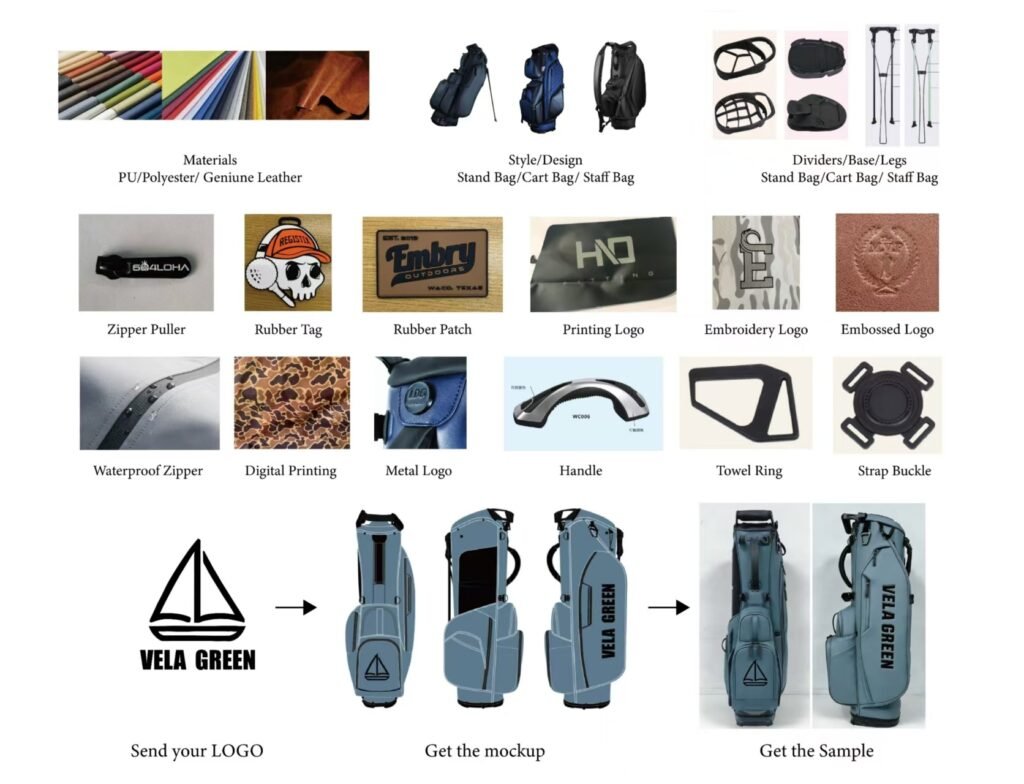
At Vela Green, we provide full-range OEM & ODM services for golf bags, golf headcovers, gloves, towels and other golf accessories. We support custom design, material selection, logo branding, color matching and mass production, strictly complying with CPSC, REACH and other international standards. With mature production experience, reliable quality control and professional export support, we help brands and importers develop market-oriented products with efficient lead times and flexible order quantities.