Golf Bags B2B: Common Sourcing Scams & Avoidance Tips for Wholesale Buyers 2026 is a critical risk-prevention guide for global golf bag distributors, private label brand owners, and cross-border wholesale buyers. The booming 2026 golf equipment wholesale market has attracted numerous unqualified suppliers and fraudulent middlemen, bringing hidden risks to B2B bulk sourcing. Many wholesale buyers suffer huge losses from fake samples, shoddy bulk goods, false low-price traps, fake payment receipts, and irregular logistics fraud. Mastering the latest common golf bag sourcing scams and professional avoidance tips can help you filter unreliable suppliers, protect capital and cargo safety, and ensure low-risk, high-profit bulk procurement for US and European markets.
Most B2B sourcing losses occur due to information asymmetry and blind pursuit of low prices. New wholesale buyers often ignore risk verification when facing ultra-low quotations, free sample promises, and large fake orders. In fact, golf bags B2B sourcing scams in 2026 are highly repetitive and recognizable. With standardized inspection steps and avoidance strategies, buyers can eliminate over 98% of cross-border sourcing risks and stabilize long-term supply chain security.
Why Golf Bag B2B Sourcing Has High Fraud Risks in 2026
Golf bags are functional customized sporting goods with variable materials, complex craftsmanship, and diverse customization demands. Unlike standardized industrial products, their quality is difficult to judge simply by pictures. Many unscrupulous suppliers take advantage of this feature to implement fraud through sample deception, material cutting, and after-sales prevarication. Meanwhile, the seasonal demand of the golf industry makes many buyers rush for peak-season stocking, thus ignoring supplier qualification verification and falling into sourcing traps.
In addition, emerging middlemen and unregistered small workshops lack formal corporate qualifications and after-sales mechanisms. Once fraud occurs, buyers cannot claim compensation through formal channels, resulting in lost deposits, unqualified bulk goods, and delayed peak-season sales, bringing double losses of capital and time.
6 Most Common Golf Bags B2B Sourcing Scams in 2026
Based on 2026 cross-border wholesale industry data, the following six scams are the most frequent in golf bag B2B sourcing, targeting both new and experienced wholesale buyers.
1. Sample Fraud & Bulk Shoddy Replacement
This is the most mainstream scam in customized golf bag orders. Unreliable factories provide high-standard qualified samples with thick fabrics, smooth zippers, and precise embroidery to pass buyer confirmation. However, during mass production, they replace core materials with low-cost recycled fabrics, inferior hardware, and thin waterproof coatings. The finished products have fading, water leakage, and loose stitching problems, completely inconsistent with the confirmed samples. Many buyers only inspect samples but ignore pre-shipment bulk inspection, leading to large-scale after-sales returns.
2. Ultra-Low Price Trap with Hidden Charges
Many unqualified suppliers quote prices far below the industry average to attract orders. After buyers pay the deposit and confirm the order, they propose additional hidden fees including mold opening fees, printing fees, packaging upgrade fees, and expedited production fees. If buyers refuse to pay extra costs, suppliers suspend production and default on delivery, resulting in buyer deposit losses and delayed stocking plans. This low-price bait-and-switch trick is extremely common in small-batch OEM golf bag orders.
3. Fake Payment Screenshot & Delivery Urgency Scam
Some fraudulent middlemen forge bank transfer receipts and payment screenshots to falsely notify buyers of successful payment, urging factories to arrange urgent production and shipment. After buyers complete delivery, they find that the funds never arrive, and the counterparty directly loses contact. For B2B wholesale orders with large cargo value, this scam will cause huge inventory and capital losses, especially for seasonal rush orders.
4. Fake Factory Qualification & Cross-Border Compliance Fraud
To win US and European market orders, many small workshops forge REACH, Prop 65, and GRS certification documents. Their products fail to meet Western environmental and safety standards. After bulk shipment, the goods are detained by customs or removed from retail platforms, causing buyers to face fines and order returns. These unqualified suppliers lack formal export experience and cannot provide effective compliance after-sales support.
5. Logistics & Packaging Cutting-Corner Scam
Some suppliers promise standard export packaging and fumigated pallets but use thin cartons and non-qualified wooden packaging in actual shipment. This leads to cargo extrusion deformation, mildew, and customs quarantine rejection. In addition, individual freight forwarders collude with suppliers to falsely report freight fees and increase buyers’ comprehensive logistics costs.
6. False Large Order & Pre-Charge Fee Fraud
Fraudulent buyers take the initiative to propose huge FCL orders, requiring suppliers to pay contract deposit, certification fee, and channel fee in advance. After receiving the advance fee, they cancel the order and disappear. This scam mainly targets eager new suppliers and disrupts normal B2B transaction order.
Practical Avoidance Tips for B2B Wholesale Buyers
To avoid the abovegolf bags B2B sourcing scams and protect wholesale order security, buyers need to implement standardized risk control processes in every sourcing step.
First, strictly verify supplier qualifications. Check business licenses, real factory videos, export records, and valid third-party compliance certifications. Reject unregistered workshops and middlemen without independent production capacity.
Second, lock sample and bulk standards in formal contracts. Clearly mark fabric density, hardware brand, waterproof technology, color difference range, and compensation clauses for inconsistent bulk goods in the contract to avoid supplier cutting corners.
Third, never trust payment screenshots. Only confirm production and shipment after checking the actual bank arrival record. Refuse all advance payment requirements from unfamiliar counterparties.
Fourth, arrange pre-shipment inspection. Conduct random inspections of bulk products to ensure consistency with sample standards, focusing on material, craftsmanship, and compliance details.
Fifth, fix packaging and logistics standards. Clarify export carton grade, moisture-proof measures, and ISPM 15 fumigation requirements in the order terms to avoid transportation losses and customs risks.
Final Thoughts
Golf Bags B2B: Common Sourcing Scams & Avoidance Tips for Wholesale Buyers 2026 provides systematic risk prevention solutions for global golf bag B2B procurement. Most sourcing scams stem from non-standard cooperation and insufficient pre-order verification. By adhering to qualification inspection, contract constraint, pre-shipment QC, and fund risk control, wholesale buyers can effectively eliminate fraud risks, maintain stable supply chain operation, and achieve safe and profitable golf bag bulk sourcing in 2026.
OEM & ODM Service
Whether you’re planning to build your own brand, develop new products, or find a stable manufacturing partner for the US and European markets, working with a professional OEM & ODM factory can significantly improve your product quality and market competitiveness.
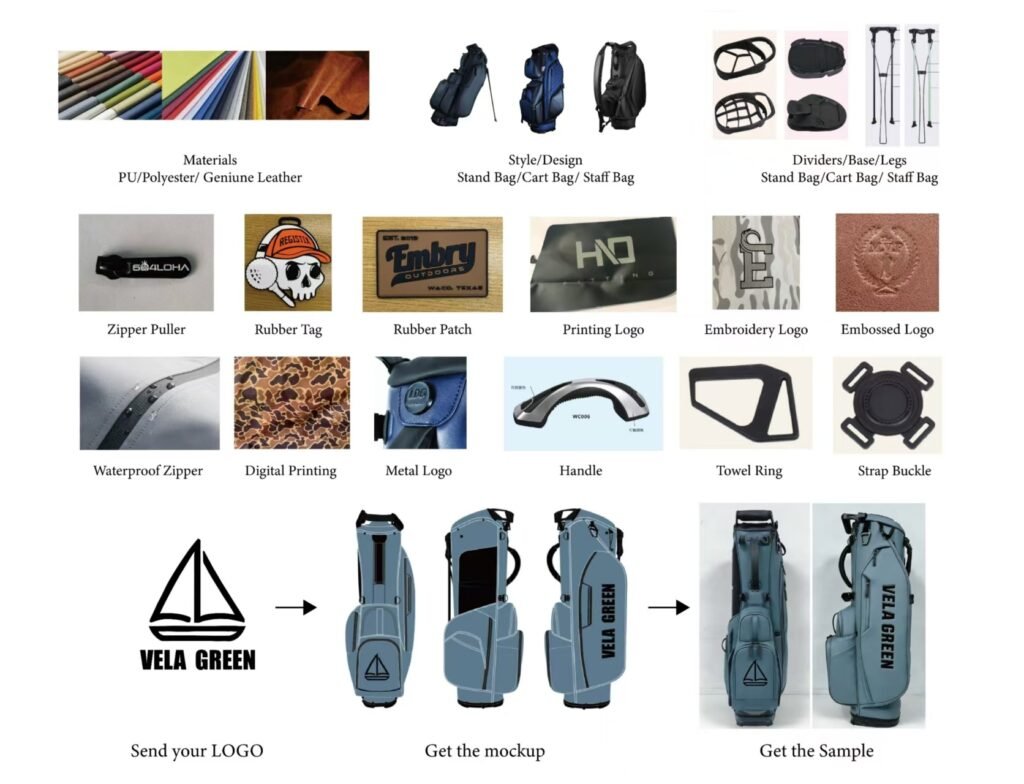
At Vela Green, we provide full-range OEM & ODM services for golf bags, golf headcovers, gloves, towels and other golf accessories. We support custom design, material selection, logo branding, color matching and mass production, strictly complying with CPSC, REACH and other international standards. With mature production experience, reliable quality control and professional export support, we help brands and importers develop market-oriented products with efficient lead times and flexible order quantities.